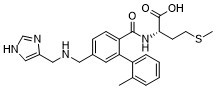
FTI-2148, a RAS C-terminal mimetic, is a novel, potent and highly selective dual inhibitor of farnesyl transferase (FT-1) and geranylgeranyl transferase-1 (GGT-1) with IC50s of 1.4 nM and 1.7 μM, respectively. It has potential antitumor activity. FTI-2148 suppressed the growth of the human lung adenocarcinoma A-549 cells in nude mice by 33, 67, and 91% in a dose-dependent manner. Combination therapy of FTI-2148 with either cisplatin, gemcitabine, or Taxol resulted in a greater antitumor efficacy than monotherapy.
Physicochemical Properties
| Molecular Formula | C24H28N4O3S |
| Molecular Weight | 452.56912 |
| Exact Mass | 452.188 |
| CAS # | 251577-09-0 |
| Related CAS # | FTI-2148 diTFA;817586-01-9 |
| PubChem CID | 9981319 |
| Appearance | Typically exists as solid at room temperature |
| Density | 1.3±0.1 g/cm3 |
| Boiling Point | 730.1±60.0 °C at 760 mmHg |
| Flash Point | 395.4±32.9 °C |
| Vapour Pressure | 0.0±2.5 mmHg at 25°C |
| Index of Refraction | 1.626 |
| LogP | 2.45 |
| Hydrogen Bond Donor Count | 4 |
| Hydrogen Bond Acceptor Count | 6 |
| Rotatable Bond Count | 11 |
| Heavy Atom Count | 32 |
| Complexity | 608 |
| Defined Atom Stereocenter Count | 1 |
| SMILES | N1C=C(CNCC2=CC(C3C=CC=CC=3C)=C(C(NC(C(O)=O)CCSC)=O)C=C2)N=C1 |
| InChi Key | KULAYTGUTXCHSV-QFIPXVFZSA-N |
| InChi Code | InChI=1S/C24H28N4O3S/c1-16-5-3-4-6-19(16)21-11-17(12-25-13-18-14-26-15-27-18)7-8-20(21)23(29)28-22(24(30)31)9-10-32-2/h3-8,11,14-15,22,25H,9-10,12-13H2,1-2H3,(H,26,27)(H,28,29)(H,30,31)/t22-/m0/s1 |
| Chemical Name | (5-((((1H-imidazol-4-yl)methyl)amino)methyl)-2'-methyl-[1,1'-biphenyl]-2-carbonyl)-L-methionine |
| Synonyms | FTI2148 FTI 2148 FTI-2148 FTI-2148 TFA FTI-2148 trfluoroacetic acid salt FTI-2148 free base |
| HS Tariff Code | 2934.99.9001 |
| Storage |
Powder-20°C 3 years 4°C 2 years In solvent -80°C 6 months -20°C 1 month |
| Shipping Condition | Room temperature (This product is stable at ambient temperature for a few days during ordinary shipping and time spent in Customs) |
Biological Activity
| ln Vitro | FTI-2148 (30 μM) in NIH3T3 cells transformed with all 3 RAS reduces the farnesylation of the single farnesylated protein, HDJ2 [1]. With respect to P. falciparum PFT, mammalian PFT, and mammalian PGGT-I, FTI-2148 has an IC50 value of 15 nM, 0.82 nM, and 1700 nM, respectively. Geranylgeranyl transferase-I is known as PGGT-I and protein farnesyl transferase (PFT)[2]. |
| ln Vivo | In a mouse model of human lung adenocarcinoma A-549 cells grown 91%, FTI-2148 (ip; 25 or 50 mpk/day using minipump; start on day 15, halt on day 45, restart on days 53-83) suppresses tumors. In a human xenograft nude mouse model, FTI-2148 (subcutaneous injection; 25 mpk/day using minipump; 14 days) reduced tumor development by 77% at the conclusion of two weeks of treatment [1]. In a ras transgenic mouse model, FTI-2148 (subcutaneous injection; 100 mg/kg/day; 14 days) promotes breast tumor regression [1]. In mouse mammary tumors cultured in vivo, FTI-2148 (subcutaneous injection; 100 mg/kg/day; 4 days) suppresses 85-88% of FTase activity but not GGTase I enzyme activity [3]. |
| Cell Assay |
Western Blot Analysis[] Cell Types: NIH3T3 cells transformed with KRAS HRAS and NRAS Tested Concentrations: 30 μM Incubation Duration: Experimental Results: Inhibition of prenylation of KRAS and NRAS. |
| Animal Protocol |
Animal/Disease Models: Ras transgenic mouse model [3] Doses: 100 mg/kg/day Route of Administration: subcutaneous injection; 100 mg/kg/day; 14 days Experimental Results: Induced 87 ± 3% of breast cancer regression in mice. |
| References |
[1]. Antitumor efficacy of a novel class of non-thiol-containing peptidomimetic inhibitors of farnesyltransferase and geranylgeranyltransferase I: combination therapy with the cytotoxic agents cisplatin, Taxol, and gemcitabine.Cancer Res. 1999 Oc. [2]. In vitro and in vivo antimalarial activity of peptidomimetic protein farnesyltransferase inhibitors with improved membrane permeability.Bioorg Med Chem. 2004 Dec 15;12(24):6517-26. [3]. Geranylgeranyltransferase I inhibitor GGTI-2154 induces breast carcinoma apoptosis and tumor regression in H-Ras transgenic mice.Cancer Res. 2003 Dec 15;63(24):8922-9. |
Solubility Data
| Solubility (In Vitro) | May dissolve in DMSO (in most cases), if not, try other solvents such as H2O, Ethanol, or DMF with a minute amount of products to avoid loss of samples |
| Solubility (In Vivo) |
Note: Listed below are some common formulations that may be used to formulate products with low water solubility (e.g. < 1 mg/mL), you may test these formulations using a minute amount of products to avoid loss of samples. Injection Formulations (e.g. IP/IV/IM/SC) Injection Formulation 1: DMSO : Tween 80: Saline = 10 : 5 : 85 (i.e. 100 μL DMSO stock solution → 50 μL Tween 80 → 850 μL Saline) *Preparation of saline: Dissolve 0.9 g of sodium chloride in 100 mL ddH ₂ O to obtain a clear solution. Injection Formulation 2: DMSO : PEG300 :Tween 80 : Saline = 10 : 40 : 5 : 45 (i.e. 100 μL DMSO → 400 μLPEG300 → 50 μL Tween 80 → 450 μL Saline) Injection Formulation 3: DMSO : Corn oil = 10 : 90 (i.e. 100 μL DMSO → 900 μL Corn oil) Example: Take the Injection Formulation 3 (DMSO : Corn oil = 10 : 90) as an example, if 1 mL of 2.5 mg/mL working solution is to be prepared, you can take 100 μL 25 mg/mL DMSO stock solution and add to 900 μL corn oil, mix well to obtain a clear or suspension solution (2.5 mg/mL, ready for use in animals). Injection Formulation 4: DMSO : 20% SBE-β-CD in saline = 10 : 90 [i.e. 100 μL DMSO → 900 μL (20% SBE-β-CD in saline)] *Preparation of 20% SBE-β-CD in Saline (4°C,1 week): Dissolve 2 g SBE-β-CD in 10 mL saline to obtain a clear solution. Injection Formulation 5: 2-Hydroxypropyl-β-cyclodextrin : Saline = 50 : 50 (i.e. 500 μL 2-Hydroxypropyl-β-cyclodextrin → 500 μL Saline) Injection Formulation 6: DMSO : PEG300 : castor oil : Saline = 5 : 10 : 20 : 65 (i.e. 50 μL DMSO → 100 μLPEG300 → 200 μL castor oil → 650 μL Saline) Injection Formulation 7: Ethanol : Cremophor : Saline = 10: 10 : 80 (i.e. 100 μL Ethanol → 100 μL Cremophor → 800 μL Saline) Injection Formulation 8: Dissolve in Cremophor/Ethanol (50 : 50), then diluted by Saline Injection Formulation 9: EtOH : Corn oil = 10 : 90 (i.e. 100 μL EtOH → 900 μL Corn oil) Injection Formulation 10: EtOH : PEG300:Tween 80 : Saline = 10 : 40 : 5 : 45 (i.e. 100 μL EtOH → 400 μLPEG300 → 50 μL Tween 80 → 450 μL Saline) Oral Formulations Oral Formulation 1: Suspend in 0.5% CMC Na (carboxymethylcellulose sodium) Oral Formulation 2: Suspend in 0.5% Carboxymethyl cellulose Example: Take the Oral Formulation 1 (Suspend in 0.5% CMC Na) as an example, if 100 mL of 2.5 mg/mL working solution is to be prepared, you can first prepare 0.5% CMC Na solution by measuring 0.5 g CMC Na and dissolve it in 100 mL ddH2O to obtain a clear solution; then add 250 mg of the product to 100 mL 0.5% CMC Na solution, to make the suspension solution (2.5 mg/mL, ready for use in animals). Oral Formulation 3: Dissolved in PEG400 Oral Formulation 4: Suspend in 0.2% Carboxymethyl cellulose Oral Formulation 5: Dissolve in 0.25% Tween 80 and 0.5% Carboxymethyl cellulose Oral Formulation 6: Mixing with food powders Note: Please be aware that the above formulations are for reference only. InvivoChem strongly recommends customers to read literature methods/protocols carefully before determining which formulation you should use for in vivo studies, as different compounds have different solubility properties and have to be formulated differently. (Please use freshly prepared in vivo formulations for optimal results.) |
| Preparing Stock Solutions | 1 mg | 5 mg | 10 mg | |
| 1 mM | 2.2096 mL | 11.0480 mL | 22.0960 mL | |
| 5 mM | 0.4419 mL | 2.2096 mL | 4.4192 mL | |
| 10 mM | 0.2210 mL | 1.1048 mL | 2.2096 mL |