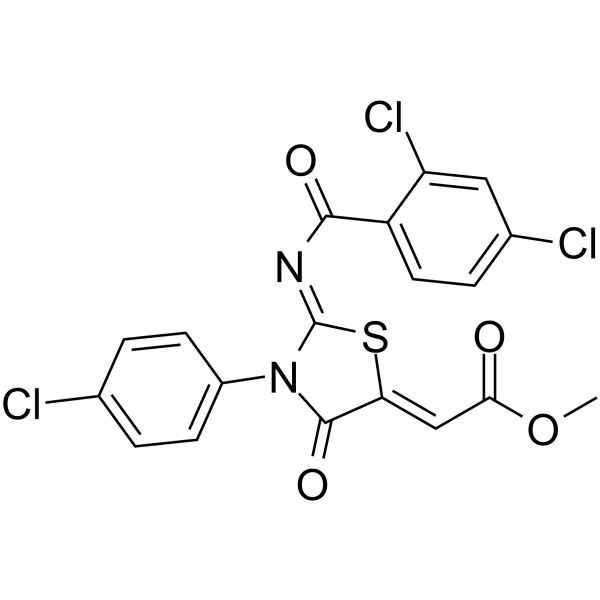
Physicochemical Properties
| Molecular Formula | C19H11CL3N2O4S |
| Molecular Weight | 469.73 |
| Exact Mass | 467.95 |
| CAS # | 173904-50-2 |
| PubChem CID | 25015749 |
| Appearance | Typically exists as solid at room temperature |
| Density | 1.5±0.1 g/cm3 |
| Boiling Point | 608.3±65.0 °C at 760 mmHg |
| Flash Point | 321.7±34.3 °C |
| Vapour Pressure | 0.0±1.7 mmHg at 25°C |
| Index of Refraction | 1.668 |
| LogP | 4.7 |
| Hydrogen Bond Donor Count | 0 |
| Hydrogen Bond Acceptor Count | 5 |
| Rotatable Bond Count | 4 |
| Heavy Atom Count | 29 |
| Complexity | 737 |
| Defined Atom Stereocenter Count | 0 |
| SMILES | COC(/C=C1/S/C(=N/C(C2=CC=C(Cl)C=C2Cl)=O)/N(C2=CC=C(Cl)C=C2)C/1=O)=O |
| InChi Key | SDGLYCKTPKZBGI-DALCUZTNSA-N |
| InChi Code | InChI=1S/C19H11Cl3N2O4S/c1-28-16(25)9-15-18(27)24(12-5-2-10(20)3-6-12)19(29-15)23-17(26)13-7-4-11(21)8-14(13)22/h2-9H,1H3/b15-9+,23-19? |
| Chemical Name | methyl (2E)-2-[3-(4-chlorophenyl)-2-(2,4-dichlorobenzoyl)imino-4-oxo-1,3-thiazolidin-5-ylidene]acetate |
| HS Tariff Code | 2934.99.9001 |
| Storage |
Powder-20°C 3 years 4°C 2 years In solvent -80°C 6 months -20°C 1 month |
| Shipping Condition | Room temperature (This product is stable at ambient temperature for a few days during ordinary shipping and time spent in Customs) |
Biological Activity
| ln Vitro | With IC50s of 1.5 and 0.35 μM, respectively, FR171113 exhibits an antiplatelet effect on the aggregation of guinea pig platelets induced by PAR1 agonist peptide and thrombin in vitro[2]. FR171113 (0.032-1 μM) inhibits platelet aggregation that is induced by TRAP-6 and thrombin in a dose-dependent manner[1]. In HUVECs, FR171113 dramatically inhibits the up-regulation of RAGE, MCP-1, and ICAM-1 mRNA levels that is induced by plasma[2]. FR171113 (1 μM; pretreatment for 30 minutes) inhibits ERK activation induced by thrombin and SFLLRN (human PAR1 agonist peptide), but not that induced by factor Xa or SLIGKV (PAR2 agonist peptide), suggesting that PAR2 in mesangial cells specifically mediates ERK activation by factor Xa[3]. |
| ln Vivo | In the carotid artery thrombosis model, FR171113 significantly prolongs the disease process at 1 mg/kg sc and suppresses occlusive thrombosis in a dose-dependent manner. In vivo, FR171113 exhibits antiplatelet and antithrombotic properties. A helpful tool for examining antithrombotic effects via PAR1 in vivo is FR171113[4]. |
| Cell Assay |
Cell Viability Assay[1] Cell Types: Human washed platelets Tested Concentrations: 0.001, 0.01, 0.1, 1, 10, 100 μM Incubation Duration: Experimental Results: The IC50 value for thrombin-induced platelet aggregation was 0.29 μM. The IC50 value for TRAP-6 -induced platelet aggregation was 0.15 μM. RT-PCR[2] Cell Types: human umbilical vein endothelial cells (HUVECs) Tested Concentrations: 1 μM Incubation Duration: 4 hrs (hours) Experimental Results: 3% citrated human plasma-evoked ROS generation, RAGE, MCP- 1 and ICAM-1 gene induction was Dramatically blocked. Western Blot Analysis[3] Cell Types: Mesangial cells Tested Concentrations: 1 μM Incubation Duration:Pretreatment for 30 minutes Experimental Results: Pretreatment inhibited thrombin (10 nM; for 5 minutes)- and SFLLRN( 100 μM for 5 minutes)-induced ERK activation. |
| Animal Protocol |
Animal/Disease Models: Male Hartley guinea pigs (650–950 g) were anesthetized with urethane (1.25 g/kg, ip)[4] Doses: 0.32, 1.0, and 3.2 mg/kg Route of Administration: Administered subcutaneously (sc) (sc) Experimental Results: Pretreatment with FR171113 prolonged this parameter in a dose-dependent manner. The time to thrombotic occlusion for 0.32, 1.0 and 3.2 mg/kg of FR171113 was 30.7±5.36, 44.7±8.41 and 92.6±9.79, respectively. |
| References |
[1]. In vitro antiplatelet profile of FR171113, a novel non-peptide thrombin receptor antagonist. Eur J Pharmacol. 1999 Nov 19;384(2-3):197-202. [2]. Advanced glycation end products potentiate citrated plasma-evoked oxidative and inflammatory reactions in endothelial cells by up-regulating protease-activated receptor-1 expression. Cardiovasc Diabetol. 2014 Mar 13;13:60. [3]. Role of coagulation factor Xa and protease-activated receptor 2 in human mesangial cell proliferation. Kidney Int. 2005 Jun;67(6):2123-33. [4]. Inhibition of arterial thrombosis by a protease-activated receptor 1 antagonist, FR171113, in the guinea pig. Eur J Pharmacol. 2003 Jul 25;473(2-3):163-9. |
Solubility Data
| Solubility (In Vitro) | May dissolve in DMSO (in most cases), if not, try other solvents such as H2O, Ethanol, or DMF with a minute amount of products to avoid loss of samples |
| Solubility (In Vivo) |
Note: Listed below are some common formulations that may be used to formulate products with low water solubility (e.g. < 1 mg/mL), you may test these formulations using a minute amount of products to avoid loss of samples. Injection Formulations (e.g. IP/IV/IM/SC) Injection Formulation 1: DMSO : Tween 80: Saline = 10 : 5 : 85 (i.e. 100 μL DMSO stock solution → 50 μL Tween 80 → 850 μL Saline) *Preparation of saline: Dissolve 0.9 g of sodium chloride in 100 mL ddH ₂ O to obtain a clear solution. Injection Formulation 2: DMSO : PEG300 :Tween 80 : Saline = 10 : 40 : 5 : 45 (i.e. 100 μL DMSO → 400 μLPEG300 → 50 μL Tween 80 → 450 μL Saline) Injection Formulation 3: DMSO : Corn oil = 10 : 90 (i.e. 100 μL DMSO → 900 μL Corn oil) Example: Take the Injection Formulation 3 (DMSO : Corn oil = 10 : 90) as an example, if 1 mL of 2.5 mg/mL working solution is to be prepared, you can take 100 μL 25 mg/mL DMSO stock solution and add to 900 μL corn oil, mix well to obtain a clear or suspension solution (2.5 mg/mL, ready for use in animals). Injection Formulation 4: DMSO : 20% SBE-β-CD in saline = 10 : 90 [i.e. 100 μL DMSO → 900 μL (20% SBE-β-CD in saline)] *Preparation of 20% SBE-β-CD in Saline (4°C,1 week): Dissolve 2 g SBE-β-CD in 10 mL saline to obtain a clear solution. Injection Formulation 5: 2-Hydroxypropyl-β-cyclodextrin : Saline = 50 : 50 (i.e. 500 μL 2-Hydroxypropyl-β-cyclodextrin → 500 μL Saline) Injection Formulation 6: DMSO : PEG300 : castor oil : Saline = 5 : 10 : 20 : 65 (i.e. 50 μL DMSO → 100 μLPEG300 → 200 μL castor oil → 650 μL Saline) Injection Formulation 7: Ethanol : Cremophor : Saline = 10: 10 : 80 (i.e. 100 μL Ethanol → 100 μL Cremophor → 800 μL Saline) Injection Formulation 8: Dissolve in Cremophor/Ethanol (50 : 50), then diluted by Saline Injection Formulation 9: EtOH : Corn oil = 10 : 90 (i.e. 100 μL EtOH → 900 μL Corn oil) Injection Formulation 10: EtOH : PEG300:Tween 80 : Saline = 10 : 40 : 5 : 45 (i.e. 100 μL EtOH → 400 μLPEG300 → 50 μL Tween 80 → 450 μL Saline) Oral Formulations Oral Formulation 1: Suspend in 0.5% CMC Na (carboxymethylcellulose sodium) Oral Formulation 2: Suspend in 0.5% Carboxymethyl cellulose Example: Take the Oral Formulation 1 (Suspend in 0.5% CMC Na) as an example, if 100 mL of 2.5 mg/mL working solution is to be prepared, you can first prepare 0.5% CMC Na solution by measuring 0.5 g CMC Na and dissolve it in 100 mL ddH2O to obtain a clear solution; then add 250 mg of the product to 100 mL 0.5% CMC Na solution, to make the suspension solution (2.5 mg/mL, ready for use in animals). Oral Formulation 3: Dissolved in PEG400 Oral Formulation 4: Suspend in 0.2% Carboxymethyl cellulose Oral Formulation 5: Dissolve in 0.25% Tween 80 and 0.5% Carboxymethyl cellulose Oral Formulation 6: Mixing with food powders Note: Please be aware that the above formulations are for reference only. InvivoChem strongly recommends customers to read literature methods/protocols carefully before determining which formulation you should use for in vivo studies, as different compounds have different solubility properties and have to be formulated differently. (Please use freshly prepared in vivo formulations for optimal results.) |
| Preparing Stock Solutions | 1 mg | 5 mg | 10 mg | |
| 1 mM | 2.1289 mL | 10.6444 mL | 21.2888 mL | |
| 5 mM | 0.4258 mL | 2.1289 mL | 4.2578 mL | |
| 10 mM | 0.2129 mL | 1.0644 mL | 2.1289 mL |