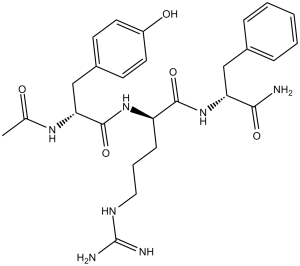
DTP3 (DTP-3) is a novel, potent and selective inhibitor of GADD45β/MKK7 ((growth arrest and DNA-damage-inducible β/mitogen-activated protein kinase kinase 7) with potential anticancer activity. It blocks the NF-κB survival pathway specifically in cancer. In a mouse plasmacytoma model, DTP3 demonstrates strong antitumor activity against MM. DTP3 dissociated the GADD45b/MKK7 complex through an allosteric mechanism after binding to MKK7, causing the kinase to rearrange its conformation. DTP3 was completely inactive in tumor cell lines with low GADD45B expression, but it inhibited cell growth and showed potent and selective activity in both MM and non-MM cell lines with high GADD45B expression.
Physicochemical Properties
| Molecular Formula | C26H35N7O5 | |
| Molecular Weight | 525.6 | |
| Exact Mass | 525.269 | |
| Elemental Analysis | C, 59.41; H, 6.71; N, 18.65; O, 15.22 | |
| CAS # | 1809784-29-9 | |
| Related CAS # | DTP3 TFA;2759216-46-9 | |
| PubChem CID | 86295191 | |
| Appearance | White to off-white solid powder | |
| Density | 1.4±0.1 g/cm3 | |
| Index of Refraction | 1.637 | |
| LogP | -0.43 | |
| Hydrogen Bond Donor Count | 7 | |
| Hydrogen Bond Acceptor Count | 6 | |
| Rotatable Bond Count | 14 | |
| Heavy Atom Count | 38 | |
| Complexity | 819 | |
| Defined Atom Stereocenter Count | 3 | |
| SMILES | O=C([C@@H](CCC/N=C(\N)/N)NC([C@@H](CC1C=CC(=CC=1)O)NC(C)=O)=O)N[C@@H](C(N)=O)CC1C=CC=CC=1 |
|
| InChi Key | AOUZPXZGMZUQQS-YPAWHYETSA-N | |
| InChi Code | InChI=1S/C26H35N7O5/c1-16(34)31-22(15-18-9-11-19(35)12-10-18)25(38)32-20(8-5-13-30-26(28)29)24(37)33-21(23(27)36)14-17-6-3-2-4-7-17/h2-4,6-7,9-12,20-22,35H,5,8,13-15H2,1H3,(H2,27,36)(H,31,34)(H,32,38)(H,33,37)(H4,28,29,30)/t20-,21-,22-/m1/s1 | |
| Chemical Name | (2R)-2-[[(2R)-2-acetamido-3-(4-hydroxyphenyl)propanoyl]amino]-N-[(2R)-1-amino-1-oxo-3-phenylpropan-2-yl]-5-(diaminomethylideneamino)pentanamide | |
| Synonyms |
|
|
| HS Tariff Code | 2934.99.9001 | |
| Storage |
Powder-20°C 3 years 4°C 2 years In solvent -80°C 6 months -20°C 1 month Note: Please store this product in a sealed and protected environment (e.g. under nitrogen), avoid exposure to moisture and light. |
|
| Shipping Condition | Room temperature (This product is stable at ambient temperature for a few days during ordinary shipping and time spent in Customs) |
Biological Activity
| Targets | GADD45β/MKK7; NF-κB |
| ln Vitro | DTP3 physically interacts with MKK7, both in isolation and within the complex with GADD45β, and dissociates the GADD45β/MKK7 complex via an allosteric mechanism. Without being toxic to healthy cells, DTP3 selectively kills cells and triggers apoptosis in MM cells with functional MKK7 and increased GADD45β expression. Additionally, DTP3 exhibits synergistic activity with bortezomib in two different MM cell lines, showing a combination index of 0.21 in U266 cells and of 0.56 in KMS-12 cells. [1] |
| ln Vivo | DTP3 (14.5 mg/kg/day) displays strong antitumor activity against MM in mouse plasmacytoma model. [1] |
| Enzyme Assay | Tryptophan fluorescence quenching analysis, used after a nonlinear regression algorithm has been used to fit the fluorescence data, is used to determine the stoichiometry and KD value of the DTP3/MKK7 interaction. |
| Cell Assay | [3H]Assays for thymidine incorporation are carried out according to established protocols. Briefly, cell lines are seeded into 96-well plates at 1.0x10⁴ cells per well and either left untreated or treated daily with the indicated concentrations of peptides. They are then maintained in complete RPMI-1640 medium at 37°C in 5% CO2, splitting them with medium as necessary. Cells are incubated for an additional 16 hours with 0.037 MBq/well of [3H]thymidine at 24, 72, or 144 hours. Following this, they are harvested onto glass fiber filter mats using a 96-well plate automated Tomtec cell harvester, and their liquid scintillation spectroscopy data is analyzed using a LKB Wallac Trilux Microbeta 3-counter. Values are expressed as the proportion of counts per minute (cpm) measured in the treated cultures to the corresponding untreated cultures. The mean compound concentration causing a 50% inhibition of [3H]thymidine uptake as compared to the uptake measured in untreated cells is known as the IC50 value, which is calculated using either 5 or 7 concentrations of the compound. Trypan blue exclusion assays are performed. Briefly, 2.0x10⁵ cells from lentivirus-infected cell lines are seeded into the wells of 48-well plates in complete medium, and they are then cultured at 37°C in 5% CO2, splitting them as necessary during the assays. Trypan blue is used to count cells, and cell viability is monitored over a period of up to 8 days. The numbers of live infected cells in the cultures are extrapolated, as needed, from the cell counts by taking into account the percentages of eGFP+ cells, using flow cytometry. The percentage of live infected cells present in the cultures at the indicated times compared to the number of live infected cells present in the same cultures on day 0 is used to express values. |
| Animal Protocol |
NOD/SCID mice bearing U266 or KMS-11 MM cells 14.5 mg/kg/day Administered using Alzet osmotic pumps |
| References |
[1]. Cancer Cell . 2014 Oct 13;26(4):495-508. [2]. Toxicol Rep . 2019 Apr 19:6:369-379. |
Solubility Data
| Solubility (In Vitro) |
|
|||
| Solubility (In Vivo) |
Solubility in Formulation 1: ≥ 2.5 mg/mL (4.76 mM) (saturation unknown) in 10% DMSO + 40% PEG300 + 5% Tween80 + 45% Saline (add these co-solvents sequentially from left to right, and one by one), clear solution. For example, if 1 mL of working solution is to be prepared, you can add 100 μL of 25.0 mg/mL clear DMSO stock solution to 400 μL PEG300 and mix evenly; then add 50 μL Tween-80 to the above solution and mix evenly; then add 450 μL normal saline to adjust the volume to 1 mL. Preparation of saline: Dissolve 0.9 g of sodium chloride in 100 mL ddH₂ O to obtain a clear solution. Solubility in Formulation 2: ≥ 2.5 mg/mL (4.76 mM) (saturation unknown) in 10% DMSO + 90% (20% SBE-β-CD in Saline) (add these co-solvents sequentially from left to right, and one by one), clear solution. For example, if 1 mL of working solution is to be prepared, you can add 100 μL of 25.0 mg/mL clear DMSO stock solution to 900 μL of 20% SBE-β-CD physiological saline solution and mix evenly. Preparation of 20% SBE-β-CD in Saline (4°C,1 week): Dissolve 2 g SBE-β-CD in 10 mL saline to obtain a clear solution. Solubility in Formulation 3: ≥ 2.5 mg/mL (4.76 mM) (saturation unknown) in 10% DMSO + 90% Corn Oil (add these co-solvents sequentially from left to right, and one by one), clear solution. For example, if 1 mL of working solution is to be prepared, you can add 100 μL of 25.0 mg/mL clear DMSO stock solution to 900 μL of corn oil and mix evenly. (Please use freshly prepared in vivo formulations for optimal results.) |
| Preparing Stock Solutions | 1 mg | 5 mg | 10 mg | |
| 1 mM | 1.9026 mL | 9.5129 mL | 19.0259 mL | |
| 5 mM | 0.3805 mL | 1.9026 mL | 3.8052 mL | |
| 10 mM | 0.1903 mL | 0.9513 mL | 1.9026 mL |