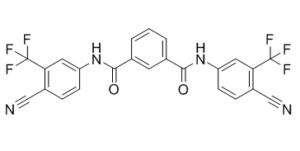
DJ-V-159 is a novel and potent agonist for G protein-coupled receptor family C group 6 member A (GPRC6A) with the potential for treating type 2 diabetes mellitus (T2D). GPRC6A is a potential therapeutic target for the treatment of type 2 diabetes mellitus (T2D), according to new insights into the regulation of glucose metabolism by β-cells, skeletal muscle, and liver hepatocytes via G protein coupled receptors. A small molecule medication that activates GPRC6A offers a potentially game-changing chance to simultaneously address several metabolic abnormalities that underpin type 2 diabetes (T2D), such as aberrant β-cell proliferation, insulin secretion, and peripheral insulin resistance. DJ-V-159 was found to stimulate GPRC6A signaling in a heterologous cell expression system in a dose-dependent manner through experimental testing. DJ-V-159 exhibited the highest efficacy in inducing β-cell insulin secretion and reducing serum glucose levels in mice of the wild-type.
Physicochemical Properties
| Molecular Formula | C24H12F6N4O2 | |
| Molecular Weight | 502.37 | |
| Exact Mass | 502.09 | |
| Elemental Analysis | C, 57.38; H, 2.41; F, 22.69; N, 11.15; O, 6.37 | |
| CAS # | 2253744-53-3 | |
| Related CAS # |
|
|
| PubChem CID | 137319717 | |
| Appearance | White to off-white solid powder | |
| LogP | 4.8 | |
| Hydrogen Bond Donor Count | 2 | |
| Hydrogen Bond Acceptor Count | 10 | |
| Rotatable Bond Count | 4 | |
| Heavy Atom Count | 36 | |
| Complexity | 845 | |
| Defined Atom Stereocenter Count | 0 | |
| InChi Key | VEVNLJLJLVESLL-UHFFFAOYSA-N | |
| InChi Code | InChI=1S/C24H12F6N4O2/c25-23(26,27)19-9-17(6-4-15(19)11-31)33-21(35)13-2-1-3-14(8-13)22(36)34-18-7-5-16(12-32)20(10-18)24(28,29)30/h1-10H,(H,33,35)(H,34,36) | |
| Chemical Name | 1-N,3-N-bis[4-cyano-3-(trifluoromethyl)phenyl]benzene-1,3-dicarboxamide | |
| Synonyms |
|
|
| HS Tariff Code | 2934.99.9001 | |
| Storage |
Powder-20°C 3 years 4°C 2 years In solvent -80°C 6 months -20°C 1 month |
|
| Shipping Condition | Room temperature (This product is stable at ambient temperature for a few days during ordinary shipping and time spent in Customs) |
Biological Activity
| Targets | GPRC6A |
| ln Vitro | DJ-V-159 activates ERK in HEK-293 transfected with GPRC6A but not in non-transfected HEK-293 cells, with potency similar to L-Arg. Furthermore, DJ-V-159 induces GPRC6A-expressing HEK-293 cells to produce cAMP in a dose-dependent manner; this response is seen at 0.2 nM concentrations in the media. DJ-V-159 induces mouse beta-cell MIN-6 cells to secrete insulin. In MIN-6 cells, DJ-V-159 raised the insulin stimulation index (SI) in a manner akin to that of Ocn, a known GPRC6A ligand[1]. |
| ln Vivo | DJ-V-159 at 60 and 90 minutes following intraperitoneal injection of 10 mg/kg, lowers blood glucose levels in wildtype mice; in contrast, the vehicle (95% PEG + 5% DMSO) has no effect on blood glucose. At 60 and 90 minutes following intraperitoneal injection of 10 mg/kg, DJ-V-159 lowers blood glucose levels in wild-type mice by 43.6% and 41.9%, respectively. The mice showed no obvious side effects from this brief exposure to DJ-V-159. However, DJ-V-159 is either inside or close to the edge of Lipinski's Rule of Five[1]. |
| Animal Protocol | Mice: Eight to ten weeks prior, wild type C57BL/6 mice were given an intraperitoneal injection of either ${DJ-V-159} (10 mg/kg body weight), 300 mg/kg body weight of metformin, or a vehicle (95% PEG + 5% DMSO; 10 μL/g body weight). The mice were then fasted for five hours. After injection, blood glucose levels are checked 0, 30, 60, and 90 minutes later[1]. |
| References |
[1]. Computationally identified novel agonists for GPRC6A. PLoS One. 2018 Apr 23;13(4):e0195980. |
Solubility Data
| Solubility (In Vitro) |
|
|||
| Solubility (In Vivo) |
Note: Listed below are some common formulations that may be used to formulate products with low water solubility (e.g. < 1 mg/mL), you may test these formulations using a minute amount of products to avoid loss of samples. Injection Formulations (e.g. IP/IV/IM/SC) Injection Formulation 1: DMSO : Tween 80: Saline = 10 : 5 : 85 (i.e. 100 μL DMSO stock solution → 50 μL Tween 80 → 850 μL Saline) *Preparation of saline: Dissolve 0.9 g of sodium chloride in 100 mL ddH ₂ O to obtain a clear solution. Injection Formulation 2: DMSO : PEG300 :Tween 80 : Saline = 10 : 40 : 5 : 45 (i.e. 100 μL DMSO → 400 μLPEG300 → 50 μL Tween 80 → 450 μL Saline) Injection Formulation 3: DMSO : Corn oil = 10 : 90 (i.e. 100 μL DMSO → 900 μL Corn oil) Example: Take the Injection Formulation 3 (DMSO : Corn oil = 10 : 90) as an example, if 1 mL of 2.5 mg/mL working solution is to be prepared, you can take 100 μL 25 mg/mL DMSO stock solution and add to 900 μL corn oil, mix well to obtain a clear or suspension solution (2.5 mg/mL, ready for use in animals). Injection Formulation 4: DMSO : 20% SBE-β-CD in saline = 10 : 90 [i.e. 100 μL DMSO → 900 μL (20% SBE-β-CD in saline)] *Preparation of 20% SBE-β-CD in Saline (4°C,1 week): Dissolve 2 g SBE-β-CD in 10 mL saline to obtain a clear solution. Injection Formulation 5: 2-Hydroxypropyl-β-cyclodextrin : Saline = 50 : 50 (i.e. 500 μL 2-Hydroxypropyl-β-cyclodextrin → 500 μL Saline) Injection Formulation 6: DMSO : PEG300 : castor oil : Saline = 5 : 10 : 20 : 65 (i.e. 50 μL DMSO → 100 μLPEG300 → 200 μL castor oil → 650 μL Saline) Injection Formulation 7: Ethanol : Cremophor : Saline = 10: 10 : 80 (i.e. 100 μL Ethanol → 100 μL Cremophor → 800 μL Saline) Injection Formulation 8: Dissolve in Cremophor/Ethanol (50 : 50), then diluted by Saline Injection Formulation 9: EtOH : Corn oil = 10 : 90 (i.e. 100 μL EtOH → 900 μL Corn oil) Injection Formulation 10: EtOH : PEG300:Tween 80 : Saline = 10 : 40 : 5 : 45 (i.e. 100 μL EtOH → 400 μLPEG300 → 50 μL Tween 80 → 450 μL Saline) Oral Formulations Oral Formulation 1: Suspend in 0.5% CMC Na (carboxymethylcellulose sodium) Oral Formulation 2: Suspend in 0.5% Carboxymethyl cellulose Example: Take the Oral Formulation 1 (Suspend in 0.5% CMC Na) as an example, if 100 mL of 2.5 mg/mL working solution is to be prepared, you can first prepare 0.5% CMC Na solution by measuring 0.5 g CMC Na and dissolve it in 100 mL ddH2O to obtain a clear solution; then add 250 mg of the product to 100 mL 0.5% CMC Na solution, to make the suspension solution (2.5 mg/mL, ready for use in animals). Oral Formulation 3: Dissolved in PEG400 Oral Formulation 4: Suspend in 0.2% Carboxymethyl cellulose Oral Formulation 5: Dissolve in 0.25% Tween 80 and 0.5% Carboxymethyl cellulose Oral Formulation 6: Mixing with food powders Note: Please be aware that the above formulations are for reference only. InvivoChem strongly recommends customers to read literature methods/protocols carefully before determining which formulation you should use for in vivo studies, as different compounds have different solubility properties and have to be formulated differently. (Please use freshly prepared in vivo formulations for optimal results.) |
| Preparing Stock Solutions | 1 mg | 5 mg | 10 mg | |
| 1 mM | 1.9906 mL | 9.9528 mL | 19.9056 mL | |
| 5 mM | 0.3981 mL | 1.9906 mL | 3.9811 mL | |
| 10 mM | 0.1991 mL | 0.9953 mL | 1.9906 mL |