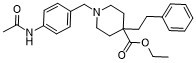
CYM51010 (also known as ML335; CYM-51010; CID23723457), is a biased ligand of μ-opioid receptor – δ-opioid receptor heterodimers (EC50=403 nM), exhibiting anti-nociceptive activity similar to morphine but with a decreased levels of tolerance development and withdrawal symptoms.
Physicochemical Properties
| Molecular Formula | C25H32N2O3 |
| Molecular Weight | 408.542 |
| Exact Mass | 408.241 |
| Elemental Analysis | C, 73.50; H, 7.90; N, 6.86; O, 11.75 |
| CAS # | 1069498-96-9 |
| PubChem CID | 23723457 |
| Appearance | Light yellow to light brown solid powder |
| Density | 1.1±0.1 g/cm3 |
| Boiling Point | 562.5±50.0 °C at 760 mmHg |
| Flash Point | 294.0±30.1 °C |
| Vapour Pressure | 0.0±1.5 mmHg at 25°C |
| Index of Refraction | 1.578 |
| LogP | 3.98 |
| Hydrogen Bond Donor Count | 1 |
| Hydrogen Bond Acceptor Count | 4 |
| Rotatable Bond Count | 9 |
| Heavy Atom Count | 30 |
| Complexity | 543 |
| Defined Atom Stereocenter Count | 0 |
| SMILES | CCOC(C1(CCN(CC2=CC=C(NC(C)=O)C=C2)CC1)CCC3=CC=CC=C3)=O |
| InChi Key | VUXRYYSKTWDPLO-UHFFFAOYSA-N |
| InChi Code | InChI=1S/C25H32N2O3/c1-3-30-24(29)25(14-13-21-7-5-4-6-8-21)15-17-27(18-16-25)19-22-9-11-23(12-10-22)26-20(2)28/h4-12H,3,13-19H2,1-2H3,(H,26,28) |
| Chemical Name | ethyl 1-[(4-acetamidophenyl)methyl]-4-(2-phenylethyl)piperidine-4-carboxylate |
| Synonyms | CID-23723457; ML 335; CYM-51010; CID23723457; ML335; CYM51010; CID 23723457; ML-335; CYM 51010 |
| HS Tariff Code | 2934.99.9001 |
| Storage |
Powder-20°C 3 years 4°C 2 years In solvent -80°C 6 months -20°C 1 month Note: This product requires protection from light (avoid light exposure) during transportation and storage. |
| Shipping Condition | Room temperature (This product is stable at ambient temperature for a few days during ordinary shipping and time spent in Customs) |
Biological Activity
| ln Vitro |
ML335(CYM51010), with an EC50 of 403 nM, and selectivities vs. OPRM1, OPRD1, and HTR5A of 37, 2.7, and >99, respectively.[1] ML335(CYM51010) has been evaluated in a series of cell-based assays (the OPRM1-OPRD1 screen, the OPRM1, OPRD1, 5HTRA counterscreens, and the cytotoxicity assay) and has been shown to have activity in a cell-based system.[1] To date, ML335(CYM51010) has been tested in 438 bioassays deposited in PubChem, and has shown activity in 10 of those assays, four of which are for this project. The other six assays give a hit rate of 1.4%, indicating that this molecule is generally inactive across a broad range of cell-based and non–cell-based assays. Five of the six cross-reactive assays are for transient receptor potential cation channel (TRPC) 4 and C6. These assays are performed with HEK cells expressing both mu opioid and TRPC. It is likely the cross-reactivity is due to activity on the mu receptor. The remaining assay (AID 504834) is “Primary qHTS for delayed death inhibitors of the malarial parasite plastid, 96 hour incubation”. It is likely the probe is active (4.1 μM) in this assay, but the species and dosing are not relevant to the current project.[1] |
| References |
[1]. Characterization of an agonist probe for opioid receptor mu 1 (OPRM1)-opioid receptor delta 1 (OPRD1) heterodimerization. 2012 Dec 17 [updated 2013 Apr 5]. |
Solubility Data
| Solubility (In Vitro) | DMSO: ~125 mg/mL (~306 mM) |
| Solubility (In Vivo) |
Note: Listed below are some common formulations that may be used to formulate products with low water solubility (e.g. < 1 mg/mL), you may test these formulations using a minute amount of products to avoid loss of samples. Injection Formulations (e.g. IP/IV/IM/SC) Injection Formulation 1: DMSO : Tween 80: Saline = 10 : 5 : 85 (i.e. 100 μL DMSO stock solution → 50 μL Tween 80 → 850 μL Saline) *Preparation of saline: Dissolve 0.9 g of sodium chloride in 100 mL ddH ₂ O to obtain a clear solution. Injection Formulation 2: DMSO : PEG300 :Tween 80 : Saline = 10 : 40 : 5 : 45 (i.e. 100 μL DMSO → 400 μLPEG300 → 50 μL Tween 80 → 450 μL Saline) Injection Formulation 3: DMSO : Corn oil = 10 : 90 (i.e. 100 μL DMSO → 900 μL Corn oil) Example: Take the Injection Formulation 3 (DMSO : Corn oil = 10 : 90) as an example, if 1 mL of 2.5 mg/mL working solution is to be prepared, you can take 100 μL 25 mg/mL DMSO stock solution and add to 900 μL corn oil, mix well to obtain a clear or suspension solution (2.5 mg/mL, ready for use in animals). Injection Formulation 4: DMSO : 20% SBE-β-CD in saline = 10 : 90 [i.e. 100 μL DMSO → 900 μL (20% SBE-β-CD in saline)] *Preparation of 20% SBE-β-CD in Saline (4°C,1 week): Dissolve 2 g SBE-β-CD in 10 mL saline to obtain a clear solution. Injection Formulation 5: 2-Hydroxypropyl-β-cyclodextrin : Saline = 50 : 50 (i.e. 500 μL 2-Hydroxypropyl-β-cyclodextrin → 500 μL Saline) Injection Formulation 6: DMSO : PEG300 : castor oil : Saline = 5 : 10 : 20 : 65 (i.e. 50 μL DMSO → 100 μLPEG300 → 200 μL castor oil → 650 μL Saline) Injection Formulation 7: Ethanol : Cremophor : Saline = 10: 10 : 80 (i.e. 100 μL Ethanol → 100 μL Cremophor → 800 μL Saline) Injection Formulation 8: Dissolve in Cremophor/Ethanol (50 : 50), then diluted by Saline Injection Formulation 9: EtOH : Corn oil = 10 : 90 (i.e. 100 μL EtOH → 900 μL Corn oil) Injection Formulation 10: EtOH : PEG300:Tween 80 : Saline = 10 : 40 : 5 : 45 (i.e. 100 μL EtOH → 400 μLPEG300 → 50 μL Tween 80 → 450 μL Saline) Oral Formulations Oral Formulation 1: Suspend in 0.5% CMC Na (carboxymethylcellulose sodium) Oral Formulation 2: Suspend in 0.5% Carboxymethyl cellulose Example: Take the Oral Formulation 1 (Suspend in 0.5% CMC Na) as an example, if 100 mL of 2.5 mg/mL working solution is to be prepared, you can first prepare 0.5% CMC Na solution by measuring 0.5 g CMC Na and dissolve it in 100 mL ddH2O to obtain a clear solution; then add 250 mg of the product to 100 mL 0.5% CMC Na solution, to make the suspension solution (2.5 mg/mL, ready for use in animals). Oral Formulation 3: Dissolved in PEG400 Oral Formulation 4: Suspend in 0.2% Carboxymethyl cellulose Oral Formulation 5: Dissolve in 0.25% Tween 80 and 0.5% Carboxymethyl cellulose Oral Formulation 6: Mixing with food powders Note: Please be aware that the above formulations are for reference only. InvivoChem strongly recommends customers to read literature methods/protocols carefully before determining which formulation you should use for in vivo studies, as different compounds have different solubility properties and have to be formulated differently. (Please use freshly prepared in vivo formulations for optimal results.) |
| Preparing Stock Solutions | 1 mg | 5 mg | 10 mg | |
| 1 mM | 2.4477 mL | 12.2387 mL | 24.4774 mL | |
| 5 mM | 0.4895 mL | 2.4477 mL | 4.8955 mL | |
| 10 mM | 0.2448 mL | 1.2239 mL | 2.4477 mL |