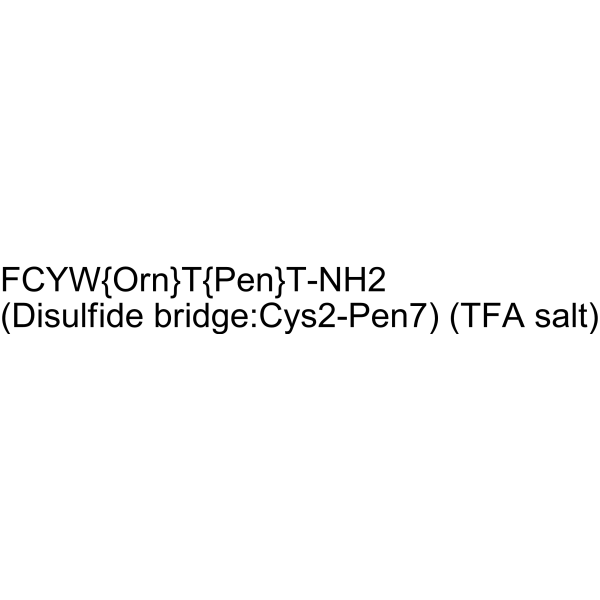
Physicochemical Properties
| Molecular Formula | C52H68F3N11O13S2 |
| Molecular Weight | 1176.28 |
| Related CAS # | CTOP;103429-31-8 |
| Appearance | White to off-white solid powder |
| HS Tariff Code | 2934.99.9001 |
| Storage |
Powder-20°C 3 years 4°C 2 years In solvent -80°C 6 months -20°C 1 month Note: Please store this product in a sealed and protected environment (e.g. under nitrogen), avoid exposure to moisture and light. |
| Shipping Condition | Room temperature (This product is stable at ambient temperature for a few days during ordinary shipping and time spent in Customs) |
Biological Activity
| Targets | μ Opioid Receptor/MOR |
| ln Vivo | In a dose-dependent manner, CTOP TFA (0-0.5 nmol, ICV, once) counteracts the analgesic effect[1]. Animals exposed to CTOP TFA (0–2 nmol, ICV, once) experience withdrawal hypothermia and body weight loss[ 1]. In the nucleus accumbens, CTOP TFA (0–1.5 nmol per side, Intra-VTA injection) raises extracellular dopamine levels and dose-dependently increases locomotor activity[2]. |
| Animal Protocol |
Animal/Disease Models: Male CFLP mice (25-30 g)[ 1] Doses: 0, 0.001, 0.05, 0.075, 0.1, and 0.5 nmol (made up in artificial cerebrospinal fluid (CSF) and kept in plastic tubes at -25℃ until use) Route of Administration: Intracerebroventricular (icv) administration, once Experimental Results: Antagonized the analgesic effect in a dose-dependent manner, antagonized the induced hypermotility in a dose-dependent manner. Animal/Disease Models: Male CFLP mice (25-30 g, Acute dependence to morphine was induced by a single dependence-inducing (100 mg/ kg) dose of morphine-HC1)[1] Doses: 0, 0.001, 0.05, 0.2, and 2 nmol Route of Administration: Intracerebroventricular (icv) administration, once Experimental Results: diminished the body temperature in a dose-dependent manner, and caused withdrawal hypothermia and a loss of body weight in animals. Animal/Disease Models: Long-Evans hooded rats (12, male, 350-450 g)[2] Doses: 0, 0.015, 0.15, and 1.5 nmol per side Route of Administration: Intra-VTA (ventral tegmental area) injection Experimental Results: Enhanced extracellular dopamine levels in the nucleus accumbens, dose-dependently increased activity, whereas had no effect on feeding and drinking behavior. |
| References |
[1]. Central effects of the potent and highly selective μ opioid antagonist D-Phe-Cys-Tyr-D-Trp-Orn-Thr-Pen-Thr-NH2 (CTOP) in mice. Eur J Pharmacol. 1988 Jun 10;150(3):355-60. [2]. Intra-VTA injections of the mu-opioid antagonist CTOP enhance locomotor activity. Brain Res. 1995 Aug 28;690(1):112-6. |
Solubility Data
| Solubility (In Vitro) | H2O :~50 mg/mL (~42.51 mM) |
| Solubility (In Vivo) |
Solubility in Formulation 1: 100 mg/mL (85.01 mM) in PBS (add these co-solvents sequentially from left to right, and one by one), clear solution; with sonication. (Please use freshly prepared in vivo formulations for optimal results.) |
| Preparing Stock Solutions | 1 mg | 5 mg | 10 mg | |
| 1 mM | 0.8501 mL | 4.2507 mL | 8.5014 mL | |
| 5 mM | 0.1700 mL | 0.8501 mL | 1.7003 mL | |
| 10 mM | 0.0850 mL | 0.4251 mL | 0.8501 mL |