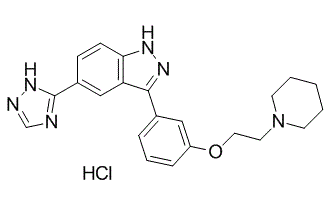
CC-401 HCl (CC401 hydrochloride) is an anthrapyrazolone-based inhibitor of c-Jun N terminal kinase (JNK) with potential anticancer activity. It inhibits all three JNK forms with a Ki value between 25 and 50 nM. It limits the dosage-dependent phosphorylation of c-Jun brought on by sorbitol. However, CC-401 is unable to stop the phosphorylation of JNK, p38, or ERK that is brought on by sorbitol. Celgene Corporation created the specific JNK inhibitor, CC-401, as a competitive inhibitor of the ATP binding site in the active, phosphorylated form of JNK. When compared to other related kinases, CC-401's selectivity for JNK is at least 40 times higher. However, CC-401's phase 1 clinical trials for myeloid leukemia (NCT00126893) were discontinued.
Physicochemical Properties
| Molecular Formula | C22H25CLN6O | |
| Molecular Weight | 424.93 | |
| Exact Mass | 424.177 | |
| Elemental Analysis | C, 62.18; H, 5.93; Cl, 8.34; N, 19.78; O, 3.77 | |
| CAS # | 1438391-30-0 | |
| Related CAS # | CC-401;395104-30-0 | |
| PubChem CID | 66576998 | |
| Appearance | White to off-white solid powder | |
| Hydrogen Bond Donor Count | 3 | |
| Hydrogen Bond Acceptor Count | 5 | |
| Rotatable Bond Count | 6 | |
| Heavy Atom Count | 30 | |
| Complexity | 516 | |
| Defined Atom Stereocenter Count | 0 | |
| SMILES | Cl[H].O(C1=C([H])C([H])=C([H])C(=C1[H])C1C2C([H])=C(C3=NC([H])=NN3[H])C([H])=C([H])C=2N([H])N=1)C([H])([H])C([H])([H])N1C([H])([H])C([H])([H])C([H])([H])C([H])([H])C1([H])[H] |
|
| InChi Key | OIBVXKYKWOUGAO-UHFFFAOYSA-N | |
| InChi Code | InChI=1S/C22H24N6O.ClH/c1-2-9-28(10-3-1)11-12-29-18-6-4-5-16(13-18)21-19-14-17(22-23-15-24-27-22)7-8-20(19)25-26-21;/h4-8,13-15H,1-3,9-12H2,(H,25,26) | |
| Chemical Name | 3-[3-(2-piperidin-1-ylethoxy)phenyl]-5-(1H-1,2,4-triazol-5-yl)-1H-indazole;hydrochloride | |
| Synonyms |
|
|
| HS Tariff Code | 2934.99.9001 | |
| Storage |
Powder-20°C 3 years 4°C 2 years In solvent -80°C 6 months -20°C 1 month Note: Please store this product in a sealed and protected environment, avoid exposure to moisture. |
|
| Shipping Condition | Room temperature (This product is stable at ambient temperature for a few days during ordinary shipping and time spent in Customs) |
Biological Activity
| Targets | JNK (Ki = 25-50 nM) |
| ln Vitro | CC-401, a small molecule that is a specific inhibitor of all three JNK isoforms. The N-terminal activation domain of the transcription factor c-Jun is prevented from being phosphorylated when the drug CC-401 binds the ATP binding site in JNK in a competitive manner. Using osmotic stress on the HK-2 human tubular epithelial cell line, the specificity of this inhibitor is examined in vitro. |
| ln Vivo | CC-401 treatment from days 7 to 24 slows the progression of proteinuria, which is significantly reduced compared to the no-treatment and vehicle groups at days 14 and 21. In contrast to proteinuria at day 5, there is still an increase in the severity of proteinuria in CC-401-treated rats at day 21. At day 24, the vehicle and no-treatment groups exhibited renal impairment as evidenced by an increase in serum creatinine. Treatment with CC-401 stops this from happening. In comparison to the control, bevazicumab and oxaliplatin treatments moderately increased the staining of p-JNK, and the p-cJun content was significantly lower in the samples treated with CC-401, indicating effective JNK inhibition. In combination treatments with CC-401, DNA damage is slightly increased. |
| Enzyme Assay | CC-401 is a potent, specific, second generation and ATP-competitive anthrapyrazolone c-Jun N terminal kinase (JNK) inhibitor with potential antineoplastic activity. It has a Ki of between 25 and 50 nM and is a strong inhibitor of all three JNK forms. It limits the dosage-dependent phosphorylation of c-Jun brought on by sorbitol. However, CC-401 is unable to stop the phosphorylation of JNK, p38, or ERK that is brought on by sorbitol. Celgene Corporation created the specific JNK inhibitor, CC-401, as a competitive inhibitor of the ATP binding site in the active, phosphorylated form of JNK. When compared to other related kinases, CC-401's selectivity for JNK is at least 40 times higher. |
| Cell Assay | In DMEM/F12 media that has been supplemented with 10% FCS, 10 ng/mL EGF, and 10 g/mL bovine pituitary extract, human HK-2 proximal tubular epithelial cells are cultured. Cells are seeded into six-well plates and allowed to adhere over night. The following day, the medium is changed to DMEM/F12 supplemented with only 0.5% FCS, and the cells are confluent by this point. Confluent cells are treated with CC-401 prepared in citric acid (pH 5.5), which is added 1 hour before 300 mM sorbitol is added. Cells are harvested using urea-RIPA buffer 30 minutes later. There are three experiments, each with two replicates for each condition. After 48 hours, supernatants are collected and tested for TGF-β1 content using a commercial ELISA kit. Six replicates are used in each experiment across three different conditions[1]. |
| Animal Protocol |
Mice: Female adult severe combined immunodeficient mice (C.B.17 SCID), which are 8–10 weeks old, are used to evaluate the effectiveness of CC-401 in inhibiting JNK signaling in anti-angiogenic and Oxaliplatin combination therapy in a mouse xenograft model. HT29 cells (1×10⁶ cells) are subcutaneously injected into the left flank of the mice to produce tumors. To treat the mice with bevacizumab, oxaliplatin, CC401, and the proper combinations of bevacizumab, oxaliplatin, and CC-401, the tumors were divided into eight groups of eight mice each when they reached a size of about 200 mm3. The intraperitoneal injection of 5 mg/kg of bevacizumab is given to mice in the bevacizumab treatment group every three days for 21 days. The Oxaliplatin treatment group receives 2 weeks of intraperitoneal injections of 5 mg/kg Oxaliplatin each week. Every three days, 25 mg/kg of the CC-401 treatment group receives an intraperitoneal injection. The combination treatment groups are given Bevacizumab (5 mg/kg every 3 days), Oxaliplatin (5 mg/kg every week for 2 weeks), and CC-401 (25 mg/kg every 3 days). In the control group, intraperitoneal saline is administered. Every three days, the body's weight and tumor volume are measured. The tumor volume is determined. The time difference between control and treated tumors to grow from 200 to 800 mm3 is used to calculate the tumor growth delay. In order to calculate the tumor growth delay, mice were given treatments until the tumor volume reached 800 mm3. Mice are sacrificed for immunohistochemistry on day 9 after treatments for tumor processing and staining. Rats: Female WKY rats weighing 180–220 g are employed. Injections of sheep anti-rat GBM serum are administered intravenously five days later (referred to as day 0), after groups of nine or ten rats have received subcutaneous injections of 5 mg of sheep IgG in Freund's complete adjuvant. In this study, treatment with CC-401 (200 mg/kg/b.i.d. by oral gavage) or the control (sodium citrate) is started seven days after anti-GBM serum administration and continued twice daily until the animals are killed on day 24. At days 7 or 24 after receiving an injection of anti-GBM serum, additional groups of untreated rats are put to death. On days 5, 14, and 21, urine is collected from animals that have spent 22 hours in metabolic cages. At the time of death, blood is collected. Urinary and serum creatinine and protein levels are analyzed. |
| References |
[1]. A pathogenic role for c-Jun amino-terminal kinase signaling in renal fibrosis and tubular cell apoptosis. J Am Soc Nephrol. 2007 Feb;18(2):472-84. [2]. Inhibition of JNK Sensitizes Hypoxic Colon Cancer Cells to DNA-Damaging Agents. Clin Cancer Res. 2015 Sep 15;21(18):4143-52. [3]. Blockade of the c-Jun amino terminal kinase prevents crescent formation and halts established anti-GBM glomerulonephritis in the rat. Lab Invest. 2009 Apr;89(4):470-84. |
Solubility Data
| Solubility (In Vitro) |
|
|||
| Solubility (In Vivo) |
Solubility in Formulation 1: ≥ 2.5 mg/mL (5.88 mM) (saturation unknown) in 10% DMSO + 40% PEG300 + 5% Tween80 + 45% Saline (add these co-solvents sequentially from left to right, and one by one), clear solution. For example, if 1 mL of working solution is to be prepared, you can add 100 μL of 25.0 mg/mL clear DMSO stock solution to 400 μL PEG300 and mix evenly; then add 50 μL Tween-80 to the above solution and mix evenly; then add 450 μL normal saline to adjust the volume to 1 mL. Preparation of saline: Dissolve 0.9 g of sodium chloride in 100 mL ddH₂ O to obtain a clear solution. Solubility in Formulation 2: ≥ 2.5 mg/mL (5.88 mM) (saturation unknown) in 10% DMSO + 90% (20% SBE-β-CD in Saline) (add these co-solvents sequentially from left to right, and one by one), clear solution. For example, if 1 mL of working solution is to be prepared, you can add 100 μL of 25.0 mg/mL clear DMSO stock solution to 900 μL of 20% SBE-β-CD physiological saline solution and mix evenly. Preparation of 20% SBE-β-CD in Saline (4°C,1 week): Dissolve 2 g SBE-β-CD in 10 mL saline to obtain a clear solution. Solubility in Formulation 3: ≥ 2.5 mg/mL (5.88 mM) (saturation unknown) in 10% DMSO + 90% Corn Oil (add these co-solvents sequentially from left to right, and one by one), clear solution. For example, if 1 mL of working solution is to be prepared, you can add 100 μL of 25.0 mg/mL clear DMSO stock solution to 900 μL of corn oil and mix evenly. Solubility in Formulation 4: 14.29 mg/mL (33.63 mM) in PBS (add these co-solvents sequentially from left to right, and one by one), clear solution; with ultrasonication (<60°C). (Please use freshly prepared in vivo formulations for optimal results.) |
| Preparing Stock Solutions | 1 mg | 5 mg | 10 mg | |
| 1 mM | 2.3533 mL | 11.7666 mL | 23.5333 mL | |
| 5 mM | 0.4707 mL | 2.3533 mL | 4.7067 mL | |
| 10 mM | 0.2353 mL | 1.1767 mL | 2.3533 mL |