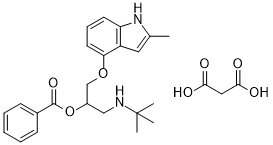
Bopindolol Malonate (CTK-8F8315; LS-120081; HE-393689; D-01794) is a potent beta adrenoceptor antagonist with the potential to be used for essential and renovascular hypertension.
Physicochemical Properties
| Molecular Formula | C26H32N2O7 |
| Molecular Weight | 484.54 |
| Exact Mass | 380.21 |
| Elemental Analysis | C, 64.45; H, 6.66; N, 5.78; O, 23.11 |
| CAS # | 82857-38-3 |
| Related CAS # | Bopindolol; 62658-63-3; 79125-22-7 (furamate); 82857-38-3 (malonate) |
| PubChem CID | 636368 |
| Appearance | Solid powder |
| LogP | 4.859 |
| Hydrogen Bond Donor Count | 4 |
| Hydrogen Bond Acceptor Count | 8 |
| Rotatable Bond Count | 11 |
| Heavy Atom Count | 35 |
| Complexity | 582 |
| Defined Atom Stereocenter Count | 0 |
| SMILES | CC1=CC2=C(N1)C=CC=C2OCC(CNC(C)(C)C)OC(=O)C3=CC=CC=C3.C(C(=O)O)C(=O)O |
| InChi Key | LDOONRJGLKHGJI-UHFFFAOYSA-N |
| InChi Code | InChI=1S/C23H28N2O3.C3H4O4/c1-16-13-19-20(25-16)11-8-12-21(19)27-15-18(14-24-23(2,3)4)28-22(26)17-9-6-5-7-10-17;4-2(5)1-3(6)7/h5-13,18,24-25H,14-15H2,1-4H3;1H2,(H,4,5)(H,6,7) |
| Chemical Name | [1-(tert-butylamino)-3-[(2-methyl-1H-indol-4-yl)oxy]propan-2-yl] benzoate;propanedioic acid |
| Synonyms | Bopindolol hydrogen malonate; LS-120081; D01794; Sandonorm; Bopindolol malonate; Bopindolol Malonate; AC1LCS45; SCHEMBL348872; CTK8F8315; HE393689; Wandonorm; Sandonorm (TN); Bopindolol hydrogen malonate; Bopindolol malonate [JAN]; |
| HS Tariff Code | 2934.99.9001 |
| Storage |
Powder-20°C 3 years 4°C 2 years In solvent -80°C 6 months -20°C 1 month |
| Shipping Condition | Room temperature (This product is stable at ambient temperature for a few days during ordinary shipping and time spent in Customs) |
Biological Activity
| Targets | Adrenergic receptor, Renin, 5-HT receptors |
| ln Vitro | Bopindolol, a non-selective antagonist of beta 1- and beta 2-adrenoceptors (ARs), has been found by pharmacological, molecular biological techniques and molecular modeling to have several unique properties. Bopindolol produces sustained blockade of beta 1- and beta 2-ARs, has intrinsic sympathomimetic as well as membrane stabilizing actions, inhibits renin secretion, and interacts with 5-HT receptors. Also, our recent molecular modeling studies identified possible interaction sites between bopindolol and beta-AR subtypes. The reviewed studies support our findings that bopindolol is non-selective for beta 1- and beta 2-ARs, has low affinity for beta 3-AR subtype and has pharmacological properties that are likely to be beneficial in the treatment of cardiovascular diseases [4]. |
| ln Vivo |
Bopindolol (intravenous injection; 8, 16, and 32 μg/kg) is four times more potent than propranolol in dogs under anesthesia, and it inhibits isoprenaline-induced tachycardia in a dose-dependent manner[1]. Bopindolol (0.3, 1 and 3 mg/kg; IP; single dosage) lowers heart rate and diastolic blood pressure in a dose-dependent manner[2]. 1. Effects of bopindolol, a beta adrenoceptor antagonist with partial agonist activity, on the diastolic blood pressure and heart rate of pithed rats were compared with those of pindolol. 2. Both bopindolol and pindolol reduced the diastolic blood pressure (DBP) in pithed rats. Bopindolol (3.0 mg/kg) and pindolol (1.0 mg/kg) produced similar decreases in DBP of about 8 mmHg; thus pindolol had a 3-fold higher hypotensive potency when compared with bopindolol. 3. Both drugs also produced a dose-dependent decrease in heart rate. 4. Propranolol (5 mg/kg) had no antagonistic effect on the decrease in DBP produced by either bopindolol or pindolol. 5. These results suggest that both bopindolol and pindolol reduce DBP and heart rate in pithed rats through some mechanism independent of beta-adrenoceptors [2]. |
| Animal Protocol |
Male Wistar rats (260-300 g) 0.3, 1 and 3 mg/kg IP; single dosage |
| ADME/Pharmacokinetics | Bopindolol is a nonselective beta-adrenoceptor antagonist [corrected] with partial agonist activity which is used in the treatment of hypertension. The drug is rapidly metabolised to an active hydrolysed form. The antihypertensive effects of bopindolol 0.5 to 4 mg are sustained for more than 24 hours after once daily dosing, and the drug appears similar in efficacy to propranolol, metoprolol, atenolol, pindolol and slow release nifedipine in the treatment of mild to moderate forms of this disease. In limited trials bopindolol has also successfully reduced symptoms in patients with angina pectoris, anxiety and essential tremor. Thus, bopindolol is an effective and well-tolerated beta-adrenoceptor antagonist. [1] |
| Toxicity/Toxicokinetics |
636368 rat LD50 oral 824 mg/kg SENSE ORGANS AND SPECIAL SENSES: PTOSIS: EYE; BEHAVIORAL: CONVULSIONS OR EFFECT ON SEIZURE THRESHOLD; GASTROINTESTINAL: ULCERATION OR BLEEDING FROM STOMACH Kiso to Rinsho. Clinical Report., 23(4369), 1989 636368 rat LD50 subcutaneous 481 mg/kg BEHAVIORAL: ATAXIA; LUNGS, THORAX, OR RESPIRATION: CYANOSIS; SKIN AND APPENDAGES (SKIN): HAIR: OTHER Kiso to Rinsho. Clinical Report., 23(4369), 1989 636368 mouse LD50 oral 228 mg/kg Drugs in Japan, -(1293), 1995 636368 rabbit LD50 oral 318 mg/kg Drugs in Japan, -(1293), 1995 636368 rat LD50 intravenous 9200 ug/kg SENSE ORGANS AND SPECIAL SENSES: MYDRIASIS (PUPILLARY DILATION): EYE; BEHAVIORAL: CONVULSIONS OR EFFECT ON SEIZURE THRESHOLD; LUNGS, THORAX, OR RESPIRATION: OTHER CHANGES Kiso to Rinsho. Clinical Report., 23(4369), 1989 |
| References |
[1]. Bopindolol. A review of its pharmacodynamic and pharmacokinetic properties and therapeutic efficacy. Drugs. 1991 Jan;41(1):130-49. [2]. Hypotensive effect of bopindolol in pithed rats. Gen Pharmacol. 1993 Mar;24(2):373-5. [3]. Bopindolol is a slowly dissociating beta 1-adrenoceptor antagonist when compared to other beta-blockers. Biol Pharm Bull. 1995 Aug;18(8):1066-71. [4]. Bopindolol: pharmacological basis and clinical implications. Cardiovasc Drug Rev. 2001 Spring;19(1):9-24. |
| Additional Infomation | Bopindolol malonate is a benzoate ester. |
Solubility Data
| Solubility (In Vitro) | May dissolve in DMSO (in most cases), if not, try other solvents such as H2O, Ethanol, or DMF with a minute amount of products to avoid loss of samples |
| Solubility (In Vivo) |
Note: Listed below are some common formulations that may be used to formulate products with low water solubility (e.g. < 1 mg/mL), you may test these formulations using a minute amount of products to avoid loss of samples. Injection Formulations (e.g. IP/IV/IM/SC) Injection Formulation 1: DMSO : Tween 80: Saline = 10 : 5 : 85 (i.e. 100 μL DMSO stock solution → 50 μL Tween 80 → 850 μL Saline) *Preparation of saline: Dissolve 0.9 g of sodium chloride in 100 mL ddH ₂ O to obtain a clear solution. Injection Formulation 2: DMSO : PEG300 :Tween 80 : Saline = 10 : 40 : 5 : 45 (i.e. 100 μL DMSO → 400 μLPEG300 → 50 μL Tween 80 → 450 μL Saline) Injection Formulation 3: DMSO : Corn oil = 10 : 90 (i.e. 100 μL DMSO → 900 μL Corn oil) Example: Take the Injection Formulation 3 (DMSO : Corn oil = 10 : 90) as an example, if 1 mL of 2.5 mg/mL working solution is to be prepared, you can take 100 μL 25 mg/mL DMSO stock solution and add to 900 μL corn oil, mix well to obtain a clear or suspension solution (2.5 mg/mL, ready for use in animals). Injection Formulation 4: DMSO : 20% SBE-β-CD in saline = 10 : 90 [i.e. 100 μL DMSO → 900 μL (20% SBE-β-CD in saline)] *Preparation of 20% SBE-β-CD in Saline (4°C,1 week): Dissolve 2 g SBE-β-CD in 10 mL saline to obtain a clear solution. Injection Formulation 5: 2-Hydroxypropyl-β-cyclodextrin : Saline = 50 : 50 (i.e. 500 μL 2-Hydroxypropyl-β-cyclodextrin → 500 μL Saline) Injection Formulation 6: DMSO : PEG300 : castor oil : Saline = 5 : 10 : 20 : 65 (i.e. 50 μL DMSO → 100 μLPEG300 → 200 μL castor oil → 650 μL Saline) Injection Formulation 7: Ethanol : Cremophor : Saline = 10: 10 : 80 (i.e. 100 μL Ethanol → 100 μL Cremophor → 800 μL Saline) Injection Formulation 8: Dissolve in Cremophor/Ethanol (50 : 50), then diluted by Saline Injection Formulation 9: EtOH : Corn oil = 10 : 90 (i.e. 100 μL EtOH → 900 μL Corn oil) Injection Formulation 10: EtOH : PEG300:Tween 80 : Saline = 10 : 40 : 5 : 45 (i.e. 100 μL EtOH → 400 μLPEG300 → 50 μL Tween 80 → 450 μL Saline) Oral Formulations Oral Formulation 1: Suspend in 0.5% CMC Na (carboxymethylcellulose sodium) Oral Formulation 2: Suspend in 0.5% Carboxymethyl cellulose Example: Take the Oral Formulation 1 (Suspend in 0.5% CMC Na) as an example, if 100 mL of 2.5 mg/mL working solution is to be prepared, you can first prepare 0.5% CMC Na solution by measuring 0.5 g CMC Na and dissolve it in 100 mL ddH2O to obtain a clear solution; then add 250 mg of the product to 100 mL 0.5% CMC Na solution, to make the suspension solution (2.5 mg/mL, ready for use in animals). Oral Formulation 3: Dissolved in PEG400 Oral Formulation 4: Suspend in 0.2% Carboxymethyl cellulose Oral Formulation 5: Dissolve in 0.25% Tween 80 and 0.5% Carboxymethyl cellulose Oral Formulation 6: Mixing with food powders Note: Please be aware that the above formulations are for reference only. InvivoChem strongly recommends customers to read literature methods/protocols carefully before determining which formulation you should use for in vivo studies, as different compounds have different solubility properties and have to be formulated differently. (Please use freshly prepared in vivo formulations for optimal results.) |
| Preparing Stock Solutions | 1 mg | 5 mg | 10 mg | |
| 1 mM | 2.0638 mL | 10.3191 mL | 20.6381 mL | |
| 5 mM | 0.4128 mL | 2.0638 mL | 4.1276 mL | |
| 10 mM | 0.2064 mL | 1.0319 mL | 2.0638 mL |