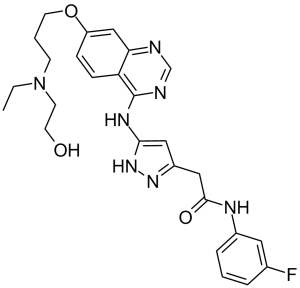
Barasertib-HQPA (AZD2811; INH34; AZD1152-HQPA) is a novel, potent, highly selective, orally bioavailable small-molecule Aurora B inhibitor with potential antitumor activity. It inhibits Aurora B with an IC50 of 0.37 nM in a cell-free assay. As a dihydrogen phosphate pro-drug of Barasertib-hQPA, it shows potent in vitro antiproliferative activity and high in vivo antitumor efficacy. Barasertib shows inhibitory effects against a broad range of aurora kinases, including aurora A kinase (AKB), aurora B kinase (ABK), and aurora C kinase (ACK) with inhibition constant (Ki) of 1369 nM, 0.36 nM, and 17.0 nM respectively, as well as the FMS-like tyrosine kinase 3 internal tandem duplication (FLT3-ITD) mutation.
Physicochemical Properties
| Molecular Formula | C26H30FN7O3 |
| Molecular Weight | 507.56 |
| Exact Mass | 507.239 |
| Elemental Analysis | C, 61.53; H, 5.96; F, 3.74; N, 19.32; O, 9.46 |
| CAS # | 722544-51-6 |
| Related CAS # | Barasertib;722543-31-9 (free acid); 722543-50-2 (2HCl); 957104-91-5; 722544-51-6 |
| PubChem CID | 16007391 |
| Appearance | Typically exists as white to yellow solids at room temperature |
| Density | 1.4±0.1 g/cm3 |
| Boiling Point | 796.7±60.0 °C at 760 mmHg |
| Flash Point | 435.6±32.9 °C |
| Vapour Pressure | 0.0±2.9 mmHg at 25°C |
| Index of Refraction | 1.677 |
| LogP | 2.82 |
| Hydrogen Bond Donor Count | 4 |
| Hydrogen Bond Acceptor Count | 9 |
| Rotatable Bond Count | 13 |
| Heavy Atom Count | 37 |
| Complexity | 693 |
| Defined Atom Stereocenter Count | 0 |
| SMILES | FC1=C([H])C([H])=C([H])C(=C1[H])N([H])C(C([H])([H])C1=C([H])C(=NN1[H])N([H])C1C2C([H])=C([H])C(=C([H])C=2N=C([H])N=1)OC([H])([H])C([H])([H])C([H])([H])N(C([H])([H])C([H])([H])[H])C([H])([H])C([H])([H])O[H])=O |
| InChi Key | QYZOGCMHVIGURT-UHFFFAOYSA-N |
| InChi Code | InChI=1S/C26H30FN7O3/c1-2-34(10-11-35)9-4-12-37-21-7-8-22-23(16-21)28-17-29-26(22)31-24-14-20(32-33-24)15-25(36)30-19-6-3-5-18(27)13-19/h3,5-8,13-14,16-17,35H,2,4,9-12,15H2,1H3,(H,30,36)(H2,28,29,31,32,33) |
| Chemical Name | 2-(3-((7-(3-(ethyl(2-hydroxyethyl)amino)propoxy)quinazolin-4-yl)amino)-1H-pyrazol-5-yl)-N-(3-fluorophenyl)acetamide |
| Synonyms | INH-34; INH34; AZD 2811; AZD2811; INH 34; AZD1152-HQPA; AZD1152; AZD-1152; AZD 1152 HQPA; AZD-2811; AZD-1152HQPA; AZD 1152HQPA; AZD1152HQPA; AZD1152 HQPA; AZD1152-HQPA; AZD1152HQPA.AZD1152-HQPA; AZD-1152HQPA; barasertib-hQPA; Barasertib (AZD1152-HQPA); defosbarasertib; INH 34; 2-(3-((7-(3-(ethyl(2-hydroxyethyl)amino)propoxy)quinazolin-4-yl)amino)-1H-pyrazol-5-yl)-N-(3-fluorophenyl)acetamide; |
| HS Tariff Code | 2934.99.9001 |
| Storage |
Powder-20°C 3 years 4°C 2 years In solvent -80°C 6 months -20°C 1 month |
| Shipping Condition | Room temperature (This product is stable at ambient temperature for a few days during ordinary shipping and time spent in Customs) |
Biological Activity
| Targets | Aurora B (IC50 = 0.37 nM) | ||
| ln Vitro | In newly isolated leukemia cells, barasertib-HQPA (3 μM, 3 hours) dramatically lowers the expression of phosphorylated variants of histone H3 [1]. In plasma, barasertib-HQPA is quickly transformed into active barasertib-HQPA [2]. In the LNCaP cell line, barasertib-HQPA therapy causes suboptimal cell survival, polyploidy, and cell death [3]. Significant antiproliferative effects caused by barasertib-HQPA are accompanied by polyploid population emergence, which typically results in apoptosis [4]. | ||
| ln Vivo | The development and weight of tumors treated with AZD1152 were considerably decreased by barasertib-HQPA (AZD1152, 25 mg/kg) [1]. In human MOLM13 leukemia xenografts, barasertib-HQPA (AZD1152, 5 mg/kg) amplifies the suppression of proliferation caused by vincristine or daunorubicin [1]. Effectively inhibiting human colon, lung, and hematological tumor xenografts in immunodeficient mice, barasertib-HQPA (AZD1152, 10–150 mg/kg/d) (mean tumor growth inhibition range, 55% to z100%; P < 0.05) [2]. | ||
| Enzyme Assay |
In vitro studies. [2] Phospho-histone H3 (PhH3) suppression was determined by high-content image analysis screening. SW620 cells, seeded in 96-well plates, were incubated with AZD1152-HQPA for 24 h before being fixed in 3.7% formaldehyde for 30 min. Cells were then washed with PBS, permeabilized with 0.5% Triton X-100, and stained with rabbit anti-PhH3 (Ser10) antibodies (1:100) for 1 h at room temperature. After washing with PBS, cells were incubated with Alexa Fluor 488 goat anti-rabbit antibodies (1:200) and Hoechst stain (1:10,000) for 1 h at room temperature. Cellular levels of PhH3 were analyzed on the Array Scan II using the Target Activation algorithm to calculate the percentage of PhH3-positive cells. Individual IC50 values were calculated in Origin (version 7.5) and the data were summarized using the geometric mean (i.e., the average of the logarithmic values converted back to a base 10 number). |
||
| Cell Assay |
Cell Proliferation Assay[1]. Cell Types: AML lines (HL-60, NB4, MOLM13), ALL line (PALL-2), biphenotypic leukemia (MV4-11), acute eosinophilic leukemia (EOL-1), and the blast crisis of chronic myeloid leukemia K562 cells. Tested Concentrations: 0-100 nM. (Barasertib -HQPA) Incubation Duration: 48 h. Experimental Results: IC50 values ranged from 3 nM to 40 nM. Colony-forming assay[1] The effects of AZD1152 on clonogenic growth of leukemia cells as well as normal bone marrow mononuclear cells were assessed by colony-forming assay using methylcellulose medium H4534, as previously described. Cell-cycle analysis by flow cytometry[1] Cell-cycle analysis was performed on leukemia cells incubated with AZD1152-HQPA (1-10 nM) for 2 days at 5 × 10⁵ cells/mL in 12-well plates. Apoptosis assays[1] The ability of AZD1152-HQPA to induce apoptosis of leukemia cells was measured by annexin V–FITC apoptosis detection kit according to the manufacturer's instructions. |
||
| Animal Protocol |
|
||
| References |
[1]. AZD1152, a novel and selective aurora B kinase inhibitor, induces growth arrest, apoptosis, and sensitization for tubulin depolymerizing agent or topoisomerase II inhibitor in human acute leukemia cells in vitro and in vivo. Blood. 2007 Sep 15;110(6):2034-40. [2]. AZD1152, a selective inhibitor of Aurora B kinase, inhibits human tumor xenograft growth by inducing apoptosis. Clin Cancer Res. 2007 Jun 15;13(12):3682-8. [3]. AZD1152-HQPA induces growth arrest and apoptosis in androgen-dependent prostate cancer cell line (LNCaP) via producing aneugenic micronuclei and polyploidy. Tumour Biol. 2015 Feb;36(2):623-32. [4]. AZD1152 rapidly and negatively affects the growth and survival of human acute myeloid leukemia cells in vitro and in vivo. Cancer Res. 2009 May 15;69(10):4150-8. |
||
| Additional Infomation |
AZD-1152 is a member of the of quinazolines that is 4-aminoquinazolin-7-ol in which the amino group at position 4 has been substituted by a 5-[2-(3-fluoroanilino)-2-oxoethyl]-1H-pyrazol-3-yl group, while the hydroxy group at position 7 has been converted into the corresponding 3-[ethyl(2-hydroxyethyl)aminopropyl ether. It has a role as an antineoplastic agent and an Aurora kinase inhibitor. It is a member of quinazolines, a secondary carboxamide, a tertiary amino compound, a secondary amino compound, a member of pyrazoles, a primary alcohol, a member of monofluorobenzenes and an anilide. Defosbarasertib is a small-molecule inhibitor of the serine-threonine kinase Aurora B, with potential antineoplastic activity. Upon administration, defosbarasertib specifically binds to and inhibits Aurora kinase B, which disrupts spindle checkpoint functions and chromosome alignment, and results in the disruption of chromosome segregation and cytokinesis. This inhibits cell division and cell proliferation and induces apoptosis in Aurora kinase B-overexpressing tumor cells. Aurora kinase B, a serine/threonine protein kinase that functions in the attachment of the mitotic spindle to the centromere, is overexpressed in a wide variety of cancer cell types. Aurora kinases play an important role in chromosome alignment, segregation, and cytokinesis during mitosis. We have recently shown that hematopoietic malignant cells including those from acute myeloid leukemia (AML) and acute lymphoblastic leukemia (ALL) aberrantly expressed Aurora A and B kinases, and ZM447439, a potent inhibitor of Aurora kinases, effectively induced growth arrest and apoptosis of a variety of leukemia cells. The present study explored the effect of AZD1152, a highly selective inhibitor of Aurora B kinase, on various types of human leukemia cells. AZD1152 inhibited the proliferation of AML lines (HL-60, NB4, MOLM13), ALL line (PALL-2), biphenotypic leukemia (MV4-11), acute eosinophilic leukemia (EOL-1), and the blast crisis of chronic myeloid leukemia K562 cells with an IC50 ranging from 3 nM to 40 nM, as measured by thymidine uptake on day 2 of culture. These cells had 4N/8N DNA content followed by apoptosis, as measured by cell-cycle analysis and annexin V staining, respectively. Of note, AZD1152 synergistically enhanced the antiproliferative activity of vincristine, a tubulin depolymerizing agent, and daunorubicin, a topoisomerase II inhibitor, against the MOLM13 and PALL-2 cells in vitro. Furthermore, AZD1152 potentiated the action of vincristine and daunorubicin in a MOLM13 murine xenograft model. Taken together, AZD1152 is a promising new agent for treatment of individuals with leukemia. The combined administration of AZD1152 and conventional chemotherapeutic agent to patients with leukemia warrants further investigation. [1] Purpose: In the current study, we examined the in vivo effects of AZD1152, a novel and specific inhibitor of Aurora kinase activity (with selectivity for Aurora B). Experimental design: The pharmacodynamic effects and efficacy of AZD1152 were determined in a panel of human tumor xenograft models. AZD1152 was dosed via several parenteral (s.c. osmotic mini-pump, i.p., and i.v.) routes. Results: AZD1152 potently inhibited the growth of human colon, lung, and hematologic tumor xenografts (mean tumor growth inhibition range, 55% to > or =100%; P < 0.05) in immunodeficient mice. Detailed pharmacodynamic analysis in colorectal SW620 tumor-bearing athymic rats treated i.v. with AZD1152 revealed a temporal sequence of phenotypic events in tumors: transient suppression of histone H3 phosphorylation followed by accumulation of 4N DNA in cells (2.4-fold higher compared with controls) and then an increased proportion of polyploid cells (>4N DNA, 2.3-fold higher compared with controls). Histologic analysis showed aberrant cell division that was concurrent with an increase in apoptosis in AZD1152-treated tumors. Bone marrow analyses revealed transient myelosuppression with the drug that was fully reversible following cessation of AZD1152 treatment. Conclusions: These data suggest that selective targeting of Aurora B kinase may be a promising therapeutic approach for the treatment of a range of malignancies. In addition to the suppression of histone H3 phosphorylation, determination of tumor cell polyploidy and apoptosis may be useful biomarkers for this class of therapeutic agent. AZD1152 is currently in phase I trials. [2] Prostate cancer is the frequent non-cutaneous tumor with high mortality in men. Prostate tumors contain cells with different status of androgen receptor. Androgen receptor plays important roles in progression and treatment of prostate cancer. Aurora B kinase, with oncogenic potential, is involved in chromosome segregation and cytokinesis, and its inhibition is a promising anti-cancer therapy. In the present study, we aimed to investigate the effects of Aurora B inhibitor, AZD1152-HQPA, on survival and proliferation of androgen receptor (AR)-positive prostate cancer cells. LNCaP was used as androgen-dependent prostate cancer cell line. We explored the effects of AZD1152-HQPA on cell viability, DNA content, micronuclei formation, and expression of genes involved in apoptosis and cell cycle. Moreover, the expression of Aurora B and AR were investigated in 23 benign prostatic hyperplasia and 38 prostate cancer specimens. AZD1152-HQPA treatment induced defective cell survival, polyploidy, and cell death in LNCaP cell line. Centromeric labeling with fluorescence in situ hybridization (FISH) showed that the loss of whole chromosomes is the origin of micronuclei, indicating on aneugenic action of AZD1152-HQPA. Treatment of AZD1152-HQPA decreased expression of AR. Moreover, we found weak positive correlations between the expression of Aurora B and AR in both benign prostatic hyperplasia and prostate cancer specimens (r = 0.25, r = 0.41). This is the first time to show that AZD1152-HQPA can be a useful therapeutic strategy for the treatment of androgen-dependent prostate cancer cell line. AZD1152-HQPA induces aneugenic mechanism of micronuclei production. Taken together, this study provides new insight into the direction to overcome the therapeutic impediments against prostate cancer. [3] Aurora kinases play a critical role in regulating mitosis and cell division, and their overexpression has been implicated in the survival and proliferation of human cancer. In this study, we report the in vitro and in vivo activities of AZD1152, a compound that has selectivity for aurora B kinase, in acute myeloid leukemia (AML) cell lines, primary AML samples, and cord blood cells. AZD1152 exerted antiproliferative or cytotoxic effects in all cell lines studied, inhibited the phosphorylation of histone H3 (pHis H3) on Ser10 in a dose-dependent manner, and resulted in cells with >4N DNA content. THP-1 cells treated with AZD1152 accumulated in a state of polyploidy and showed a senescent response to the drug, in contrast to the apoptotic response seen in other cell lines. Accordingly, AZD1152 profoundly affected the growth of AML cell lines and primary AML in an in vivo xenotransplantation model. However, concentration-dependent effects on cell growth, apoptosis, and cell cycle progression were also observed when human cord blood and primary lineage-negative stem and progenitor cells were analyzed in vitro and in vivo. These data suggest that the inhibition of aurora B kinase may be a useful therapeutic strategy in the treatment of AML and that further exploration of dosing and treatment schedules is warranted in clinical trials.[4] |
Solubility Data
| Solubility (In Vitro) |
|
|||
| Solubility (In Vivo) |
Solubility in Formulation 1: ≥ 2.5 mg/mL (4.93 mM) (saturation unknown) in 10% DMSO + 40% PEG300 + 5% Tween80 + 45% Saline (add these co-solvents sequentially from left to right, and one by one), clear solution. For example, if 1 mL of working solution is to be prepared, you can add 100 μL of 25.0 mg/mL clear DMSO stock solution to 400 μL PEG300 and mix evenly; then add 50 μL Tween-80 to the above solution and mix evenly; then add 450 μL normal saline to adjust the volume to 1 mL. Preparation of saline: Dissolve 0.9 g of sodium chloride in 100 mL ddH₂ O to obtain a clear solution. Solubility in Formulation 2: ≥ 2.5 mg/mL (4.93 mM) (saturation unknown) in 10% DMSO + 90% Corn Oil (add these co-solvents sequentially from left to right, and one by one), clear solution. For example, if 1 mL of working solution is to be prepared, you can add 100 μL of 25.0 mg/mL clear DMSO stock solution to 900 μL of corn oil and mix evenly. Solubility in Formulation 3: 30% PEG400+0.5% Tween80+5% propylene glycol:30mg/mL (Please use freshly prepared in vivo formulations for optimal results.) |
| Preparing Stock Solutions | 1 mg | 5 mg | 10 mg | |
| 1 mM | 1.9702 mL | 9.8511 mL | 19.7021 mL | |
| 5 mM | 0.3940 mL | 1.9702 mL | 3.9404 mL | |
| 10 mM | 0.1970 mL | 0.9851 mL | 1.9702 mL |