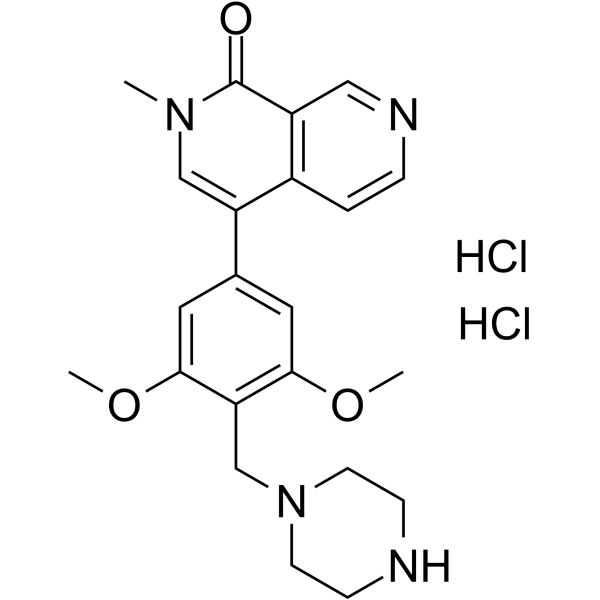
BRD7-IN-1, a novel BI7273 analog (a BRD7/9 inhibitor), is utilized in PROTAC VZ185 by binding to a VHL ligand via a linker to form a PROTAC VZ185 against BRD7/9 with DC50s of 4.5 and 1.8 nM, respectively. VZ185 is a potent, fast, and selective degrader of BRD9 and of its close homolog BRD7. Developing PROTACs to redirect the ubiquitination activity of E3 ligases and potently degrade a target protein within cells can be a lengthy and unpredictable process, and it remains unclear whether any combination of E3 and target might be productive for degradation. BI-7273 is a novel, potent, selective, and cell-permeable BRD9 inhibitor with IC50 and Kd of 19 and 0.75 nM, respectively; it also shows high effect on BRD7 with IC50 and Kd of 117 nM and 0.3 nM, respectively. BI-7273 may be useful in further exploring BRD9 bromodomain biology in both in vitro and in vivo settings. Selective inhibitors of bromodomain-containing protein 9 (BRD9) may have therapeutic potential in the treatment of human malignancies and inflammatory diseases.
Physicochemical Properties
| Molecular Formula | C22H26N4O3 |
| Molecular Weight | 394.47 |
| Exact Mass | 394.2 |
| CAS # | 2305379-66-0 |
| PubChem CID | 138377579 |
| Appearance | Off-white to yellow solid powder |
| LogP | 0.7 |
| Hydrogen Bond Donor Count | 1 |
| Hydrogen Bond Acceptor Count | 6 |
| Rotatable Bond Count | 5 |
| Heavy Atom Count | 29 |
| Complexity | 593 |
| Defined Atom Stereocenter Count | 0 |
| SMILES | C1(=O)C2C(=CC=NC=2)C(C2C=C(OC)C(CN3CCNCC3)=C(OC)C=2)=CN1C |
| InChi Key | NWXABBDHVJBGQH-UHFFFAOYSA-N |
| InChi Code | InChI=1S/C22H26N4O3/c1-25-13-18(16-4-5-24-12-17(16)22(25)27)15-10-20(28-2)19(21(11-15)29-3)14-26-8-6-23-7-9-26/h4-5,10-13,23H,6-9,14H2,1-3H3 |
| Chemical Name | 4-[3,5-dimethoxy-4-(piperazin-1-ylmethyl)phenyl]-2-methyl-2,7-naphthyridin-1-one |
| Synonyms | BRD7-IN-1; BRD7 IN-1; BRD7 IN 1; BRD7-IN 1 |
| HS Tariff Code | 2934.99.9001 |
| Storage |
Powder-20°C 3 years 4°C 2 years In solvent -80°C 6 months -20°C 1 month |
| Shipping Condition | Room temperature (This product is stable at ambient temperature for a few days during ordinary shipping and time spent in Customs) |
Biological Activity
| Targets |
BRD7 bromodomain, BRD9 bromodomain. [1] |
| ln Vitro |
BRD7-IN-1 is described as a chemical probe for BRD7/9 used in cells to help clarify the roles of the BRD7/9 bromodomains in oncogenesis and other disease states. [1] Pharmacological studies of BRD7/9 inhibitors (including related compounds) revealed that an active bromodomain of BRD9 is required to sustain MYC transcription and proliferation of leukemic cells. [1] |
| References |
[1]. Iterative Design and Optimization of Initially Inactive Proteolysis Targeting Chimeras (PROTACs) Identify VZ185 as a Potent, Fast, and Selective von Hippel-Lindau (VHL) Based Dual Degrader Probe of BRD9 and BRD7. J Med Chem. 2019 Jan 24;62. |
| Additional Infomation |
BRD7-IN-1 is listed among several potent and selective inhibitors (including I-BRD9, LP99, BI-7273, BI-9564, GNE-375) that bind to the BRD7/9 bromodomains, emerging from structure-guided medicinal chemistry campaigns. [1] These BRD7/9 chemical probes, including BRD7-IN-1, were developed to aid in unraveling the physiological roles of BAF/PBAF subunits and for targeted therapeutics in cancer and other diseases. [1] Studies using such inhibitors revealed the requirement of BRD9's active bromodomain for sustaining MYC transcription and proliferation in leukemic cells. [1] |
Solubility Data
| Solubility (In Vitro) | May dissolve in DMSO (in most cases), if not, try other solvents such as H2O, Ethanol, or DMF with a minute amount of products to avoid loss of samples |
| Solubility (In Vivo) |
Note: Listed below are some common formulations that may be used to formulate products with low water solubility (e.g. < 1 mg/mL), you may test these formulations using a minute amount of products to avoid loss of samples. Injection Formulations (e.g. IP/IV/IM/SC) Injection Formulation 1: DMSO : Tween 80: Saline = 10 : 5 : 85 (i.e. 100 μL DMSO stock solution → 50 μL Tween 80 → 850 μL Saline) *Preparation of saline: Dissolve 0.9 g of sodium chloride in 100 mL ddH ₂ O to obtain a clear solution. Injection Formulation 2: DMSO : PEG300 :Tween 80 : Saline = 10 : 40 : 5 : 45 (i.e. 100 μL DMSO → 400 μLPEG300 → 50 μL Tween 80 → 450 μL Saline) Injection Formulation 3: DMSO : Corn oil = 10 : 90 (i.e. 100 μL DMSO → 900 μL Corn oil) Example: Take the Injection Formulation 3 (DMSO : Corn oil = 10 : 90) as an example, if 1 mL of 2.5 mg/mL working solution is to be prepared, you can take 100 μL 25 mg/mL DMSO stock solution and add to 900 μL corn oil, mix well to obtain a clear or suspension solution (2.5 mg/mL, ready for use in animals). Injection Formulation 4: DMSO : 20% SBE-β-CD in saline = 10 : 90 [i.e. 100 μL DMSO → 900 μL (20% SBE-β-CD in saline)] *Preparation of 20% SBE-β-CD in Saline (4°C,1 week): Dissolve 2 g SBE-β-CD in 10 mL saline to obtain a clear solution. Injection Formulation 5: 2-Hydroxypropyl-β-cyclodextrin : Saline = 50 : 50 (i.e. 500 μL 2-Hydroxypropyl-β-cyclodextrin → 500 μL Saline) Injection Formulation 6: DMSO : PEG300 : castor oil : Saline = 5 : 10 : 20 : 65 (i.e. 50 μL DMSO → 100 μLPEG300 → 200 μL castor oil → 650 μL Saline) Injection Formulation 7: Ethanol : Cremophor : Saline = 10: 10 : 80 (i.e. 100 μL Ethanol → 100 μL Cremophor → 800 μL Saline) Injection Formulation 8: Dissolve in Cremophor/Ethanol (50 : 50), then diluted by Saline Injection Formulation 9: EtOH : Corn oil = 10 : 90 (i.e. 100 μL EtOH → 900 μL Corn oil) Injection Formulation 10: EtOH : PEG300:Tween 80 : Saline = 10 : 40 : 5 : 45 (i.e. 100 μL EtOH → 400 μLPEG300 → 50 μL Tween 80 → 450 μL Saline) Oral Formulations Oral Formulation 1: Suspend in 0.5% CMC Na (carboxymethylcellulose sodium) Oral Formulation 2: Suspend in 0.5% Carboxymethyl cellulose Example: Take the Oral Formulation 1 (Suspend in 0.5% CMC Na) as an example, if 100 mL of 2.5 mg/mL working solution is to be prepared, you can first prepare 0.5% CMC Na solution by measuring 0.5 g CMC Na and dissolve it in 100 mL ddH2O to obtain a clear solution; then add 250 mg of the product to 100 mL 0.5% CMC Na solution, to make the suspension solution (2.5 mg/mL, ready for use in animals). Oral Formulation 3: Dissolved in PEG400 Oral Formulation 4: Suspend in 0.2% Carboxymethyl cellulose Oral Formulation 5: Dissolve in 0.25% Tween 80 and 0.5% Carboxymethyl cellulose Oral Formulation 6: Mixing with food powders Note: Please be aware that the above formulations are for reference only. InvivoChem strongly recommends customers to read literature methods/protocols carefully before determining which formulation you should use for in vivo studies, as different compounds have different solubility properties and have to be formulated differently. (Please use freshly prepared in vivo formulations for optimal results.) |
| Preparing Stock Solutions | 1 mg | 5 mg | 10 mg | |
| 1 mM | 2.5350 mL | 12.6752 mL | 25.3505 mL | |
| 5 mM | 0.5070 mL | 2.5350 mL | 5.0701 mL | |
| 10 mM | 0.2535 mL | 1.2675 mL | 2.5350 mL |