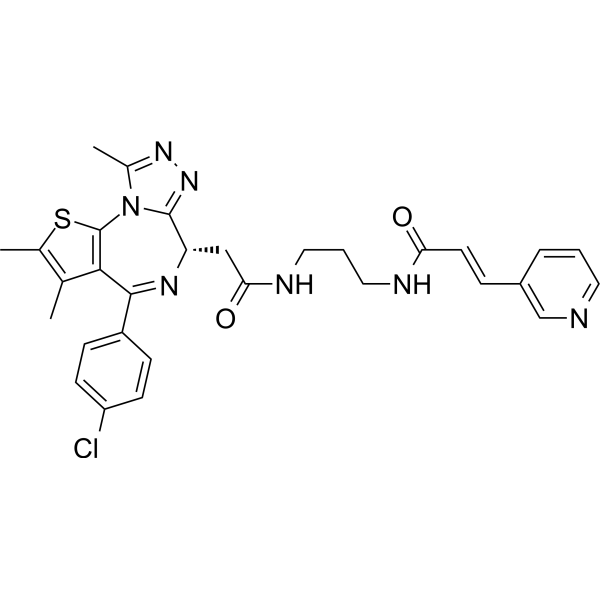
Physicochemical Properties
| Molecular Formula | C30H30CLN7O2S |
| Molecular Weight | 588.12 |
| Appearance | Solid powder |
| HS Tariff Code | 2934.99.9001 |
| Storage |
Powder-20°C 3 years 4°C 2 years In solvent -80°C 6 months -20°C 1 month |
| Shipping Condition | Room temperature (This product is stable at ambient temperature for a few days during ordinary shipping and time spent in Customs) |
Biological Activity
| Targets | BRD4(BD1BD2) 58 nM (IC50) BRD4 (BD1) 12 nM (IC50) BRD4 (BD2) 41 nM (IC50) |
| ln Vitro | The IC50 of BRD4/NAMPT-IN-1 against other members of the BET family is 12 nM (BRD4(BD1)) and 41 nM (BRD4(BD2))[1]. The IC50 of BRD4/NAMPT-IN-1 in inhibiting cancer cell proliferation is 2.37 μM (Hep3B), 6.49 μM (Huh7), 5.44 μM (HCCLM3) and 9.51 μM (LX-2)[1]. Treatment of Hep3B cells with BRD4/NAMPT-IN-1 (1-10 μM; 72 h) revealed that: it can inhibit the expression of oncogenes upregulated by BRD4, while reducing the levels of NAPRT and NAMPT; significantly increase the arrest of cells in the G0/G1 phase; induce cell apoptosis in a dose-dependent manner; and inhibit cell migration in a dose-dependent manner[1]. BRD4/NAMPT-IN-1 (1-10 μM; 72 h) dose-dependently reduces the concentration of NAD + in Hep3B cells and HCCLM3 cells [1]. Apoptosis Analysis[1] Cell Line: Hep3B cells Concentration: 1; 5; 10 μM Incubation Time: 72 h Result: The apoptosis rate induced was significantly higher than that of the control FK866 (HY-50876) and JQ1 (HY-13030) at the same dose. Cell Cycle Analysis[1] Cell Line: Hep3B cells Concentration: 1; 5; 10 μM Incubation Time : 72 h Result: Significantly increased the accumulation of Hep3B cells at the G0/G1 stage over the commonly used hepatocellular carcinoma therapeutic agents FK866 (HY-50876) and JQ1 (HY-13030). |
| ln Vivo | BRD4/NAMPT-IN-1 (ip; 40 mg/kg/day and 80 mg/kg/day; for 27 days) exhibited a dose-dependent tumor inhibitory effect in nude mice bearing HCCLM3 xenografts [1]. |
| Animal Protocol |
Animal/Disease Models:HCCLM3 xenograft nude mice [1] Doses: 40 mg/kg/day and 80 mg/kg/day Route of Administration: i.p.; 27day Experimental Results: Inhibited the growth of HCCLM3 tumors significantly in both groups at two different doses, with significant decreases in tumor volume and weight. In the 40 mg/kg dose group, the tumor growth inhibition rate reached 37.20%, and in the 80 mg/kg dose group, the tumor growth inhibition rate reached 58.17%. Showed no significant weight loss or other significant toxic side effects. |
| References |
[1]. Discovery of potent and novel dual NAMPT/BRD4 inhibitors for efficient treatment of hepatocellular carcinoma. Eur J Med Chem. 2024 May 5;271:116444. |
Solubility Data
| Solubility (In Vitro) | DMSO : 100 mg/mL (170.03 mM; with sonication) |
| Solubility (In Vivo) |
Solubility in Formulation 1: ≥ 2.5 mg/mL (4.25 mM)(Saturation unknown) in 10% DMSO 40% PEG300 5% Tween-80 45% Saline (add these co-solvents sequentially from left to right, and one by one), clear solution. For example, if 1 mL of working solution, add 100 μL of 25.0 mg/mL clear DMSO stock solution to 400 μL PEG300 and mix well; then add 50 μL Tween-80 to the above system and mix well; then continue to add 450 μL saline to make up to 1 mL. *Preparation of saline: Dissolve 0.9 g of sodium chloride in 100 mL ddH₂ O to obtain a clear solution. Solubility in Formulation 2: ≥ 2.5 mg/mL (4.25 mM)(Saturation unknown) in 10% DMSO 90% (20% SBE-β-CD in Saline) (add these co-solvents sequentially from left to right, and one by one), clear solution. For example, if 1 mL of working solution, add 100 μL of 25.0 mg/mL clear DMSO stock solution to 900 μL of 20% SBE-β-CD in saline and mix well. *Preparation of 20% SBE-β-CD in Saline (4°C,1 week): Dissolve 2 g SBE-β-CD in 10 mL saline to obtain a clear solution. Solubility in Formulation 3: ≥ 2.5 mg/mL (4.25 mM)(Saturation unknown) in 10% DMSO 90% Corn Oil (add these co-solvents sequentially from left to right, and one by one), clear solution. For example, if 1 mL of working solution, add 100 μL of 25.0 mg/mL clear DMSO stock solution to 900 μL corn oil and mix well. (Please use freshly prepared in vivo formulations for optimal results.) |
| Preparing Stock Solutions | 1 mg | 5 mg | 10 mg | |
| 1 mM | 1.7003 mL | 8.5017 mL | 17.0033 mL | |
| 5 mM | 0.3401 mL | 1.7003 mL | 3.4007 mL | |
| 10 mM | 0.1700 mL | 0.8502 mL | 1.7003 mL |