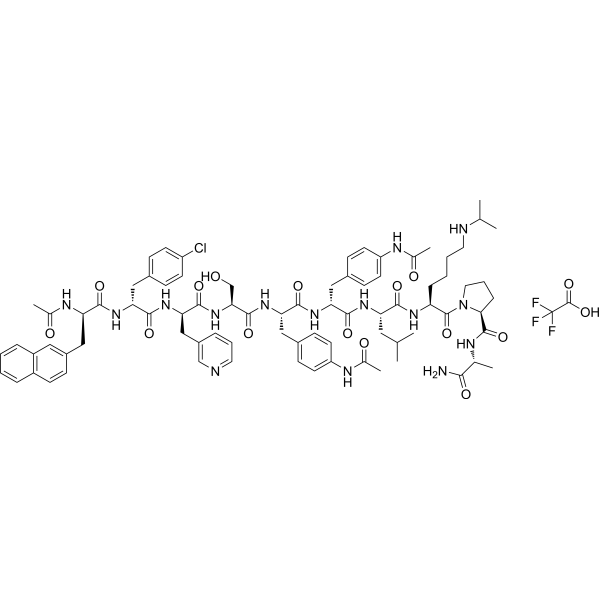
Physicochemical Properties
| Molecular Formula | C82H103CLF3N15O16 |
| Molecular Weight | 1647.23 |
| Related CAS # | Acyline;170157-13-8 |
| Appearance | White to off-white solid powder |
| HS Tariff Code | 2934.99.9001 |
| Storage |
Powder-20°C 3 years 4°C 2 years In solvent -80°C 6 months -20°C 1 month Note: Please store this product in a sealed and protected environment (e.g. under nitrogen), avoid exposure to moisture and light. |
| Shipping Condition | Room temperature (This product is stable at ambient temperature for a few days during ordinary shipping and time spent in Customs) |
Biological Activity
| ln Vivo | Acyline (50 μg, sc, twice daily, 5 days) TFA disrupted vaginal estrus, decreased uterine weight, and increased luteinizing hormone concentrations in female rats that were Kiss1−/− and Gpr54−/−. decrease[1]. Acyline (50 μg, sc, once) TFA lowers the amounts of follicle-stimulating growth hormone in male Kiss1−/− and Gpr54−/− cells. |
| Animal Protocol |
Animal/Disease Models: Female Kiss1−/−and Gpr54−/− mice[1] Doses: 50 μg (1 mg/mL in PBS) Route of Administration: subcutaneous (sc) injection; twice (two times) daily; 5 days Experimental Results: 12 Kiss1−/− mice left oestrus within 4 days of 13 mice received acyline while only 2 of 17 mice received vehicle left oestrus. Also, 7 of 8 Gpr54−/− mice received acyline left oestrus compared to 1 of 7 received vehicle. decreased uterine weights of Kiss1−/−and Gpr54 −/− mice in treated group compared to the vehicle group, and decreased serum LH concentrations in Kiss1−/− mice. |
| References |
[1]. Kisspeptin/Gpr54-independent gonadotrophin-releasing hormone activity in Kiss1 and Gpr54 mutant mice. J Neuroendocrinol. 2009 Dec;21(12):1015-23. |
Solubility Data
| Solubility (In Vitro) | DMSO :~100 mg/mL (~60.71 mM) |
| Solubility (In Vivo) |
Solubility in Formulation 1: ≥ 2.5 mg/mL (1.52 mM) (saturation unknown) in 10% DMSO + 40% PEG300 + 5% Tween80 + 45% Saline (add these co-solvents sequentially from left to right, and one by one), clear solution. For example, if 1 mL of working solution is to be prepared, you can add 100 μL of 25.0 mg/mL clear DMSO stock solution to 400 μL PEG300 and mix evenly; then add 50 μL Tween-80 to the above solution and mix evenly; then add 450 μL normal saline to adjust the volume to 1 mL. Preparation of saline: Dissolve 0.9 g of sodium chloride in 100 mL ddH₂ O to obtain a clear solution. Solubility in Formulation 2: ≥ 2.5 mg/mL (1.52 mM) (saturation unknown) in 10% DMSO + 90% (20% SBE-β-CD in Saline) (add these co-solvents sequentially from left to right, and one by one), clear solution. For example, if 1 mL of working solution is to be prepared, you can add 100 μL of 25.0 mg/mL clear DMSO stock solution to 900 μL of 20% SBE-β-CD physiological saline solution and mix evenly. Preparation of 20% SBE-β-CD in Saline (4°C,1 week): Dissolve 2 g SBE-β-CD in 10 mL saline to obtain a clear solution. (Please use freshly prepared in vivo formulations for optimal results.) |
| Preparing Stock Solutions | 1 mg | 5 mg | 10 mg | |
| 1 mM | 0.6071 mL | 3.0354 mL | 6.0708 mL | |
| 5 mM | 0.1214 mL | 0.6071 mL | 1.2142 mL | |
| 10 mM | 0.0607 mL | 0.3035 mL | 0.6071 mL |