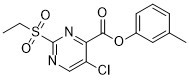
SBI-115 (SBI115) is a novel and potent TGR5 (GPCR19) antagonist with the potential to be used for polycystic liver disease. In polycystic liver diseases, it reduces hepatic cystogenesis by blocking TGR5. By boosting cholangiocyte proliferation and cAMP levels, TGR5 aids in the process of hepatic cystogenesis1. A TGR5 antagonist, either by itself or in combination with somatostatin receptor agonists, may be a useful treatment option for polycystic liver disease. TGR5 promotes hepatic cystogenesis by elevating cAMP and cholangiocyte proliferation.
Physicochemical Properties
| Molecular Formula | C14H13CLN2O4S |
| Molecular Weight | 340.782021284103 |
| Exact Mass | 340.03 |
| Elemental Analysis | C, 49.34; H, 3.85; Cl, 10.40; N, 8.22; O, 18.78; S, 9.41 |
| CAS # | 882366-16-7 |
| PubChem CID | 18879973 |
| Appearance | White to off-white solid powder |
| LogP | 2.9 |
| Hydrogen Bond Donor Count | 0 |
| Hydrogen Bond Acceptor Count | 6 |
| Rotatable Bond Count | 5 |
| Heavy Atom Count | 22 |
| Complexity | 494 |
| Defined Atom Stereocenter Count | 0 |
| InChi Key | IJPXOPBVXVPPEW-UHFFFAOYSA-N |
| InChi Code | InChI=1S/C14H13ClN2O4S/c1-3-22(19,20)14-16-8-11(15)12(17-14)13(18)21-10-6-4-5-9(2)7-10/h4-8H,3H2,1-2H3 |
| Chemical Name | (3-methylphenyl) 5-chloro-2-ethylsulfonylpyrimidine-4-carboxylate |
| Synonyms | SBI115; SBI 115; SBI-115 |
| HS Tariff Code | 2934.99.9001 |
| Storage |
Powder-20°C 3 years 4°C 2 years In solvent -80°C 6 months -20°C 1 month |
| Shipping Condition | Room temperature (This product is stable at ambient temperature for a few days during ordinary shipping and time spent in Customs) |
Biological Activity
| Targets | TGR5 |
| ln Vitro | SBI-115 (100-200 μM, 24 hours) prevents the proliferation of shRNA-transfected ADPKD cholangiocytes that is caused by pre-treating cystic cholangiocytes with taurolithocholic acid (TLCA)[1]. |
| ln Vivo | In order to further investigate TGR5's role in PLD, we produced double-mutant mice with the TGR5−/−;Pkhd1del2/del2 phenotype. TGR5−/− mice demonstrated good health and reproducibility, in line with an earlier report. 29, Overall morphology (Supporting Fig. 4), liver, cholangiocyte, and primary cilium morphology (Supporting Table 4), and serum biochemistries (Supporting Table 3) were similar in WT and TGR5−/− mice. More than one hepatic cyst is present in Pkhd1del2/del2 rodents. 30, TGR5 was overexpressed in Pkhd1del2/del2 mice relative to WT, while it was not seen in TGR5−/− mice or TGR5−/−;Pkhd1del2/del2 mice, which is in line with our findings in other animal models of PLD (Supporting Fig. 5). Compared to Pkhd1del2/del2 littermates, we observed reductions in liver weight (30%), hepatic cystic areas (31%), and hepatic fibrotic areas (33%), in double mutant TGR5−/−;Pkhd1del2/del2 mice (both males and females). * Supporting Table 4 and Figure 5A. The mouse serum biochemistries in each group were comparable (Supporting Table 3). Reduced quantity of PCNA-positive nuclei by three times was linked to attenuated hepatic cystogenesis in double mutant TGR5−/−;Pkhd1del2/del2 mice (Fig. 5B). |
| Cell Assay |
Cell Line: shRNA-transfected ADPKD cholangiocytes Concentration: 100, 200 µM Incubation Time: 24 hours Result: Inhibited proliferation (by 32-48%) triggered by pre-treatment of cystic cholangiocytes with TLCA. |
| References |
[1]. TGR5 contributes to hepatic cystogenesis in rodents with polycystic liver diseases through cyclic adenosine monophosphate/Gαs signaling. Hepatology. 2017 Oct; 66(4):1197-1218. |
Solubility Data
| Solubility (In Vitro) | DMSO: 68~150 mg/mL (199.5~440.2 mM) |
| Solubility (In Vivo) |
Solubility in Formulation 1: 3 mg/mL (8.80 mM) in 2% DMSO + 40% PEG300 + 5% Tween80 + 53% Saline (add these co-solvents sequentially from left to right, and one by one), suspension solution; with sonication. Preparation of saline: Dissolve 0.9 g of sodium chloride in 100 mL ddH₂ O to obtain a clear solution. Solubility in Formulation 2: ≥ 2.5 mg/mL (7.34 mM) (saturation unknown) in 10% DMSO + 40% PEG300 + 5% Tween80 + 45% Saline (add these co-solvents sequentially from left to right, and one by one), clear solution. For example, if 1 mL of working solution is to be prepared, you can add 100 μL of 25.0 mg/mL clear DMSO stock solution to 400 μL PEG300 and mix evenly; then add 50 μL Tween-80 to the above solution and mix evenly; then add 450 μL normal saline to adjust the volume to 1 mL. Preparation of saline: Dissolve 0.9 g of sodium chloride in 100 mL ddH₂ O to obtain a clear solution. Solubility in Formulation 3: ≥ 2.5 mg/mL (7.34 mM) (saturation unknown) in 10% DMSO + 90% Corn Oil (add these co-solvents sequentially from left to right, and one by one), clear solution. For example, if 1 mL of working solution is to be prepared, you can add 100 μL of 25.0 mg/mL clear DMSO stock solution to 900 μL of corn oil and mix evenly. Solubility in Formulation 4: 5 mg/mL (14.67 mM) in Corn Oil (add these co-solvents sequentially from left to right, and one by one), suspension solution; with ultrasonication. (Please use freshly prepared in vivo formulations for optimal results.) |
| Preparing Stock Solutions | 1 mg | 5 mg | 10 mg | |
| 1 mM | 2.9344 mL | 14.6722 mL | 29.3444 mL | |
| 5 mM | 0.5869 mL | 2.9344 mL | 5.8689 mL | |
| 10 mM | 0.2934 mL | 1.4672 mL | 2.9344 mL |