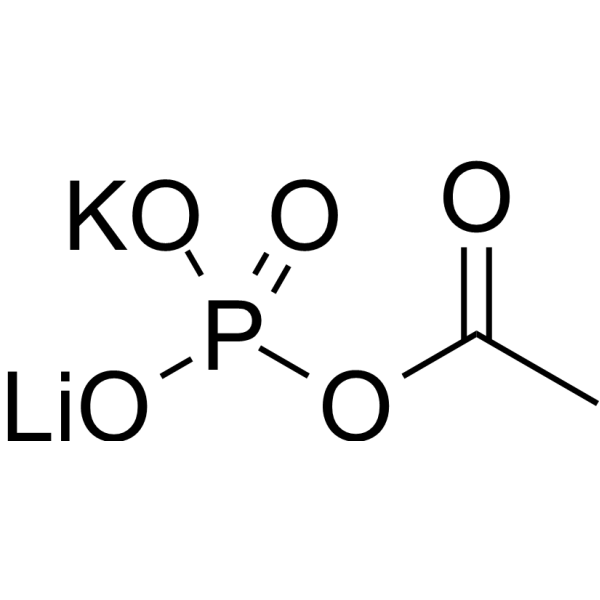
Physicochemical Properties
| Molecular Formula | C2H3KLIO5P |
| Molecular Weight | 184.06 |
| Exact Mass | 183.952 |
| CAS # | 94249-01-1 |
| PubChem CID | 6098323 |
| Appearance | White to off-white solid powder |
| Melting Point | >300ºC(lit.) |
| LogP | 0.518 |
| Hydrogen Bond Donor Count | 0 |
| Hydrogen Bond Acceptor Count | 5 |
| Rotatable Bond Count | 1 |
| Heavy Atom Count | 10 |
| Complexity | 122 |
| Defined Atom Stereocenter Count | 0 |
| InChi Key | RLQMPLKXFIXRCV-UHFFFAOYSA-L |
| InChi Code | InChI=1S/C2H5O5P.K.Li/c1-2(3)7-8(4,5)6;;/h1H3,(H2,4,5,6);;/q;2*+1/p-2 |
| Chemical Name | lithium;potassium;acetyl phosphate |
| Synonyms | 94249-01-1; Lithium potassium acetyl phosphate; Acetyl phosphate lithium potassium salt; Acetyl phosphate(lithium potassium); lithium;potassium;acetyl phosphate; SCHEMBL7214154; DTXSID50915877; Acetyl phosphate lithium potassium; |
| HS Tariff Code | 2934.99.9001 |
| Storage |
Powder-20°C 3 years 4°C 2 years In solvent -80°C 6 months -20°C 1 month Note: Please store this product in a sealed and protected environment, avoid exposure to moisture. |
| Shipping Condition | Room temperature (This product is stable at ambient temperature for a few days during ordinary shipping and time spent in Customs) |
Biological Activity
| Targets | Endogenous metabolite. |
| ln Vitro |
Phosphoketolase activity assay [2] Phosphoketolase activity was measured using the ferric hydroxamate method, based on the chemical conversion of enzymatically produced acetyl-phosphate into ferric acetyl hydroxamate, according to the protocol from. The standard reactions were carried out in 1.5 mL of Eppendorf tube in a total assay volume of 100 μL consisting of 50 mM Tris (pH 7.5), 5 mM MgCl2, 5 mM potassium phosphate, 1 mM thiamine pyrophosphate and 10 mM F6P as a substrate. The crude cell-free extract was added to start the reaction and incubated at 30 °C for 1 h. To stop the enzymatic reaction, 60 μL hydroxylamine hydrochloride (2 M, pH 6.5) was added to 40 µL of assay solution. After incubation for 10 min at room temperature, 120 μL colouring reagent consisting of 15% (w/v) trichloroacetic acid, 4 M HCl, and FeCl3·6H2O (5% [w/v] in 0.1 M HCl) were added to generate ferric hydroxamate, which was then spectrophotometrically quantified at 505 nm by comparing to a series of lithium potassium acetyl-phosphate standards. |
| Enzyme Assay | Phosphorylation of LiaR by acetyl phosphate We used acetyl phosphate to investigate the phosphorylation of LiaR by small molecule phosphate donors. Briefly, LiaR (30 μM) in the PB buffer was incubated with lithium potassium acetyl-phosphate (50 mM). The reaction mixture was incubated at 37 °C at different time intervals. The extent of phosphorylation was investigated by 15% SDS-PAGE, containing acrylamide-pedant Phos-tag™AAL-107 at 50 μM. These experiments were repeated two times. |
| References |
[1]. Low phosphatase activity of LiaS and strong LiaR-DNA affinity explain the unusual LiaS to LiaR in vivo stoichiometry. BMC Microbiol. 2020 Apr 29;20:104. [2]. Increasing cellular fitness and product yields in Pseudomonas putida through an engineered phosphoketolase shunt. Microb Cell Fact. 2023 Jan 19;22:14. |
Solubility Data
| Solubility (In Vitro) | H2O :~50 mg/mL (~271.65 mM) |
| Solubility (In Vivo) |
Solubility in Formulation 1: 100 mg/mL (543.30 mM) in PBS (add these co-solvents sequentially from left to right, and one by one), clear solution; with sonication. (Please use freshly prepared in vivo formulations for optimal results.) |
| Preparing Stock Solutions | 1 mg | 5 mg | 10 mg | |
| 1 mM | 5.4330 mL | 27.1651 mL | 54.3301 mL | |
| 5 mM | 1.0866 mL | 5.4330 mL | 10.8660 mL | |
| 10 mM | 0.5433 mL | 2.7165 mL | 5.4330 mL |