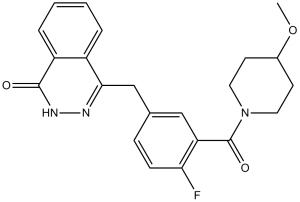
AZD-2461 is a novel, selective and potent inhibitor of Poly (ADP-ribose) polymerase (PARP) with potential anticancer activity. In inhibits PARP1/2/3 with IC50 values of 5 nM, 2 nM and 200 nM, respectively. It was created as an improved form of olaparib and is a weak substrate of P-glycoprotein.
Physicochemical Properties
| Molecular Formula | C22H22FN3O3 | |
| Molecular Weight | 395.43 | |
| Exact Mass | 395.164 | |
| Elemental Analysis | C, 66.82; H, 5.61; F, 4.80; N, 10.63; O, 12.14 | |
| CAS # | 1174043-16-3 | |
| Related CAS # |
|
|
| PubChem CID | 44199317 | |
| Appearance | White solid powder | |
| Density | 1.3±0.1 g/cm3 | |
| Index of Refraction | 1.640 | |
| LogP | 0.53 | |
| Hydrogen Bond Donor Count | 1 | |
| Hydrogen Bond Acceptor Count | 5 | |
| Rotatable Bond Count | 4 | |
| Heavy Atom Count | 29 | |
| Complexity | 647 | |
| Defined Atom Stereocenter Count | 0 | |
| SMILES | FC1C([H])=C([H])C(C([H])([H])C2C3=C([H])C([H])=C([H])C([H])=C3C(N([H])N=2)=O)=C([H])C=1C(N1C([H])([H])C([H])([H])C([H])(C([H])([H])C1([H])[H])OC([H])([H])[H])=O |
|
| InChi Key | HYNBNUYQTQIHJK-UHFFFAOYSA-N | |
| InChi Code | InChI=1S/C22H22FN3O3/c1-29-15-8-10-26(11-9-15)22(28)18-12-14(6-7-19(18)23)13-20-16-4-2-3-5-17(16)21(27)25-24-20/h2-7,12,15H,8-11,13H2,1H3,(H,25,27) | |
| Chemical Name | 4-[[4-fluoro-3-(4-methoxypiperidine-1-carbonyl)phenyl]methyl]-2H-phthalazin-1-one | |
| Synonyms | AZD 2461; AZD-2461; AZD2461 | |
| HS Tariff Code | 2934.99.9001 | |
| Storage |
Powder-20°C 3 years 4°C 2 years In solvent -80°C 6 months -20°C 1 month |
|
| Shipping Condition | Room temperature (This product is stable at ambient temperature for a few days during ordinary shipping and time spent in Customs) |
Biological Activity
| Targets | PARP2 ( IC50 = 2 nM ); PARP1 ( IC50 = 5 nM ); PARP3 ( IC50 = 200 nM ) | |
| ln Vitro |
|
|
| ln Vivo |
|
|
| Enzyme Assay | AZD-2461 is a novel and potent inhibitor of PARP, with IC50s of 5 nM, 2 nM and 200 nM for PARP1, PARP2 and PARP3, respectively. | |
| Cell Assay | The assay uses human primary breast cancer cell lines, BT-20 and SKBr-3. SKBr-3 cells are grown in DMEM medium containing 10% FCS and BT-20 in RPMI medium in a 5% CO2 environment. The cells are treated with the PARP-1 inhibitors NU1025, AZD-2461, iniparib, olaparib, and rucaparib twenty-four hours after plating (at 60–70% confluence) for the durations shown in figures 1–7[2]. The concentrations of the inhibitors range from 50 to 200 μM, 5 to 50 μM, 1 to 10 μM, and 0.3 to 10 μM, respectively. | |
| Animal Protocol |
|
|
| References |
[1]. The PARP Inhibitor AZD2461 Provides Insights into the Role of PARP3 Inhibition for Both Synthetic Lethality and Tolerability with Chemotherapy in Preclinical Models. Cancer Res . 2016 Oct 15;76(20):6084-6094. [2]. Differential Potential of Pharmacological PARP Inhibitors for Inhibiting Cell Proliferation and Inducing Apoptosis in Human Breast Cancer Cells. J Cell Biochem. 2015 Dec;116(12):2824-39. [3]. Loss of 53BP1 causes PARP inhibitor resistance in Brca1-mutated mouse mammary tumors. Cancer Discov. 2013 Jan;3(1):68-81. |
|
| Additional Infomation | PARP Inhibitor AZD2461 is an orally bioavailable inhibitor of the nuclear enzyme poly(ADP-ribose) polymerase (PARP) with potential antineoplastic activity. PARP inhibitor AZD2461 selectively binds to PARP and prevents PARP-mediated DNA repair of single strand DNA breaks via the base-excision repair pathway. This enhances the accumulation of DNA strand breaks and promotes genomic instability and eventually leads to apoptosis. PARP catalyzes post-translational ADP-ribosylation of nuclear proteins that signal and recruit other proteins to repair damaged DNA and is activated by single-strand DNA breaks. |
Solubility Data
| Solubility (In Vitro) |
|
|||
| Solubility (In Vivo) |
Solubility in Formulation 1: ≥ 2.5 mg/mL (6.32 mM) (saturation unknown) in 10% DMSO + 40% PEG300 + 5% Tween80 + 45% Saline (add these co-solvents sequentially from left to right, and one by one), clear solution. For example, if 1 mL of working solution is to be prepared, you can add 100 μL of 25.0 mg/mL clear DMSO stock solution to 400 μL PEG300 and mix evenly; then add 50 μL Tween-80 to the above solution and mix evenly; then add 450 μL normal saline to adjust the volume to 1 mL. Preparation of saline: Dissolve 0.9 g of sodium chloride in 100 mL ddH₂ O to obtain a clear solution. Solubility in Formulation 2: ≥ 2.5 mg/mL (6.32 mM) (saturation unknown) in 10% DMSO + 90% (20% SBE-β-CD in Saline) (add these co-solvents sequentially from left to right, and one by one), clear solution. For example, if 1 mL of working solution is to be prepared, you can add 100 μL of 25.0 mg/mL clear DMSO stock solution to 900 μL of 20% SBE-β-CD physiological saline solution and mix evenly. Preparation of 20% SBE-β-CD in Saline (4°C,1 week): Dissolve 2 g SBE-β-CD in 10 mL saline to obtain a clear solution. Solubility in Formulation 3: ≥ 2.5 mg/mL (6.32 mM) (saturation unknown) in 10% DMSO + 90% Corn Oil (add these co-solvents sequentially from left to right, and one by one), clear solution. For example, if 1 mL of working solution is to be prepared, you can add 100 μL of 25.0 mg/mL clear DMSO stock solution to 900 μL of corn oil and mix evenly. (Please use freshly prepared in vivo formulations for optimal results.) |
| Preparing Stock Solutions | 1 mg | 5 mg | 10 mg | |
| 1 mM | 2.5289 mL | 12.6445 mL | 25.2889 mL | |
| 5 mM | 0.5058 mL | 2.5289 mL | 5.0578 mL | |
| 10 mM | 0.2529 mL | 1.2644 mL | 2.5289 mL |