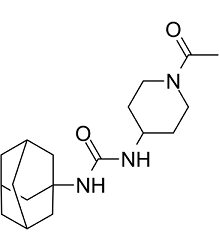
AR-9281 is a novel and potent inhibitor of soluble epoxide hydrolase (s-EH) that can be potentially used for the treatment of hypertension and type 2 diabetes. s-EH is an essential enzyme in the metabolism of arachidonic acid, and has been implicated in the development of hypertension, inflammatory disease and metabolic abnormalities
Physicochemical Properties
| Molecular Formula | C18H29N3O2 |
| Molecular Weight | 319.441764593124 |
| Exact Mass | 319.225 |
| CAS # | 913548-29-5 |
| Related CAS # | 913548-29-5; |
| PubChem CID | 12000797 |
| Appearance | White to off-white solid powder |
| LogP | 2.1 |
| Hydrogen Bond Donor Count | 2 |
| Hydrogen Bond Acceptor Count | 2 |
| Rotatable Bond Count | 2 |
| Heavy Atom Count | 23 |
| Complexity | 455 |
| Defined Atom Stereocenter Count | 0 |
| SMILES | O=C(NC12CC3CC(C1)CC(C3)C2)NC1CCN(C(C)=O)CC1 |
| InChi Key | HUDQLWBKJOMXSZ-UHFFFAOYSA-N |
| InChi Code | InChI=1S/C18H29N3O2/c1-12(22)21-4-2-16(3-5-21)19-17(23)20-18-9-13-6-14(10-18)8-15(7-13)11-18/h13-16H,2-11H2,1H3,(H2,19,20,23) |
| Chemical Name | 1-(1-acetylpiperidin-4-yl)-3-(1-adamantyl)urea |
| HS Tariff Code | 2934.99.9001 |
| Storage |
Powder-20°C 3 years 4°C 2 years In solvent -80°C 6 months -20°C 1 month |
| Shipping Condition | Room temperature (This product is stable at ambient temperature for a few days during ordinary shipping and time spent in Customs) |
Biological Activity
| ln Vitro | AR-9281 (APAU), with IC50 values of 13.8 nM and 1.7 nM, respectively, has inhibitory efficacy against human sEH (HsEH) and murine sEH (MsEH)[1]. |
| ln Vivo | AR-9281 (APAU) (oral, 150-200 mg/dL for 6 weeks) increases the therapeutic impact of EETs, slows the progression of hyperglycemia, protects myocyte structure, and lowers Ca2+ dysregulation and SERCA remodeling in hyperglycemic rats [2] . |
| Animal Protocol |
Animal/Disease Models: T2DM rat model [2] Doses: 150-200 mg/dL Route of Administration: Oral (drinking) for 6 weeks Experimental Results: Attenuated the progressive increase in blood glucose concentration and preserved the mitochondrial structure and myogen of cardiomyocytes Fiber morphology. Protect intracellular Ca2+ effector system. There was less downregulation of sarco(end)oplasmic reticulum Ca2+ ATPase (SERCA) and lower expression of hypertrophy markers. |
| References |
[1]. Discovery of memantyl urea derivatives as potent soluble epoxide hydrolase inhibitors against lipopolysaccharide-induced sepsis. Eur J Med Chem. 2021 Nov 5;223:113678. [2]. Pharmacological inhibition of soluble epoxide hydrolase provides cardioprotection in hyperglycemic rats. Am J Physiol Heart Circ Physiol. 2012 Oct 1;303(7):H853-62. |
| Additional Infomation |
AR-9281 inhibits soluble epoxide hydrolase. Drug Indication Investigated for use/treatment in hypertension. Mechanism of Action AR9281 inhibits soluble epoxide hydrolase (s-EH), an enzyme that plays a key role in the cytochrome P450 pathway of arachidonic acid metabolism. Nuclear factor alpha B (NF-alphaB) is a transcription factor implicated in cardiac hypertrophy, and can be anti or pro apoptotic under different conditions. Epoxyeicosatrienoic acids (EETs), a product of cytochrome P450 epoxygenase enzyme action, have a variety of anti-hypertensive and anti-inflammatory effects. EETs have a vasodilatory action similar to endothelium derived hyperpolarizing factor and may inhibit NF-alphaB through a currently unknown mechanism. The enzyme s-EH catalyzes the breakdown of EETs to dihydroxyeicosatrienoic acids. AR9281's inhibition of s-EH enhances EETs anti-hypertensive and anti-inflammatory activities by preventing their breakdown by s-EH, as well as inhibiting NF-alphaB. |
Solubility Data
| Solubility (In Vitro) | DMSO : ~25 mg/mL (~78.26 mM) |
| Solubility (In Vivo) |
Solubility in Formulation 1: ≥ 2.08 mg/mL (6.51 mM) (saturation unknown) in 10% DMSO + 40% PEG300 + 5% Tween80 + 45% Saline (add these co-solvents sequentially from left to right, and one by one), clear solution. For example, if 1 mL of working solution is to be prepared, you can add 100 μL of 20.8 mg/mL clear DMSO stock solution to 400 μL PEG300 and mix evenly; then add 50 μL Tween-80 to the above solution and mix evenly; then add 450 μL normal saline to adjust the volume to 1 mL. Preparation of saline: Dissolve 0.9 g of sodium chloride in 100 mL ddH₂ O to obtain a clear solution. Solubility in Formulation 2: ≥ 2.08 mg/mL (6.51 mM) (saturation unknown) in 10% DMSO + 90% (20% SBE-β-CD in Saline) (add these co-solvents sequentially from left to right, and one by one), clear solution. For example, if 1 mL of working solution is to be prepared, you can add 100 μL of 20.8 mg/mL clear DMSO stock solution to 900 μL of 20% SBE-β-CD physiological saline solution and mix evenly. Preparation of 20% SBE-β-CD in Saline (4°C,1 week): Dissolve 2 g SBE-β-CD in 10 mL saline to obtain a clear solution. Solubility in Formulation 3: ≥ 2.08 mg/mL (6.51 mM) (saturation unknown) in 10% DMSO + 90% Corn Oil (add these co-solvents sequentially from left to right, and one by one), clear solution. For example, if 1 mL of working solution is to be prepared, you can add 100 μL of 20.8 mg/mL clear DMSO stock solution to 900 μL of corn oil and mix evenly. (Please use freshly prepared in vivo formulations for optimal results.) |
| Preparing Stock Solutions | 1 mg | 5 mg | 10 mg | |
| 1 mM | 3.1305 mL | 15.6524 mL | 31.3048 mL | |
| 5 mM | 0.6261 mL | 3.1305 mL | 6.2610 mL | |
| 10 mM | 0.3130 mL | 1.5652 mL | 3.1305 mL |