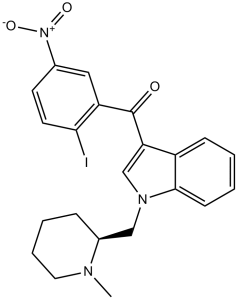
AM-1241 (AM1241; AM 1241), an aminoalkylindole analog, is a novel, potent and selective cannabinoid (CB2) receptor agonist with potential analgesic effects (pain-killing). It exhibits 82-fold selectivity over the CB1 receptor and activates CB2 with a Ki of 3.4 nM.
Physicochemical Properties
| Molecular Formula | C22H22IN3O3 | |
| Molecular Weight | 503.33 | |
| Exact Mass | 503.07 | |
| Elemental Analysis | C, 52.50; H, 4.41; I, 25.21; N, 8.35; O, 9.54 | |
| CAS # | 444912-48-5 | |
| Related CAS # |
|
|
| PubChem CID | 10141893 | |
| Appearance | Solid powder | |
| Density | 1.3±0.1 g/cm3 | |
| Boiling Point | 630.7±55.0 °C at 760 mmHg | |
| Flash Point | 335.2±31.5 °C | |
| Vapour Pressure | 0.0±1.8 mmHg at 25°C | |
| Index of Refraction | 1.693 | |
| LogP | 3.41 | |
| Hydrogen Bond Donor Count | 0 | |
| Hydrogen Bond Acceptor Count | 4 | |
| Rotatable Bond Count | 4 | |
| Heavy Atom Count | 29 | |
| Complexity | 613 | |
| Defined Atom Stereocenter Count | 0 | |
| SMILES | O=C(C1=CC([N+]([O-])=O)=CC=C1I)C2=CN(CC3N(C)CCCC3)C4=C2C=CC=C4 |
|
| InChi Key | ZUHIXXCLLBMBDW-UHFFFAOYSA-N | |
| InChi Code | InChI=1S/C22H22IN3O3/c1-24-11-5-4-6-16(24)13-25-14-19(17-7-2-3-8-21(17)25)22(27)18-12-15(26(28)29)9-10-20(18)23/h2-3,7-10,12,14,16H,4-6,11,13H2,1H3 | |
| Chemical Name | (2-iodo-5-nitrophenyl)-[1-[(1-methylpiperidin-2-yl)methyl]indol-3-yl]methanone | |
| Synonyms |
|
|
| HS Tariff Code | 2934.99.9001 | |
| Storage |
Powder-20°C 3 years 4°C 2 years In solvent -80°C 6 months -20°C 1 month |
|
| Shipping Condition | Room temperature (This product is stable at ambient temperature for a few days during ordinary shipping and time spent in Customs) |
Biological Activity
| Targets | CB2 ( Ki = 3.4 nM ); CB1 ( Ki = 280 nM ) | ||
| ln Vitro |
|
||
| ln Vivo |
|
||
| Enzyme Assay | Competition-equilibrium binding versus is used to assess cannabinoid receptor binding. Three-h After diluting AM-1241 (CP55,940) in 25 mM Tris base (pH 7.4), 5 mM MgCl2, 1 mM EDTA, and 0.1% effectively fatty acid-free BSA, the mixture is put into 96-well plates that have been treated with Regisil. Three-h Add CP55,940 (DuPont_NEN; specific activity 100–180 Ci/mmol; 1 Ci = 37 GBq) at a concentration of 0.8 nM. Packard Filtermate 196 cell harvester is used to filter the contents over Packard Unifilter GF/B 96-well filters after adding membranes made from rat brain (which contain CB1 receptors) or mouse spleen (which contain CB2 receptors) (approximately 50 μg of membrane protein per well). The plates are then incubated at 30 °C for one hour. The filters are dried after being rinsed with ice-cold 50 mM Tris base/5 mM MgCl2/0.5% BSA. The amount of bound radioactivity is measured, nonspecific binding is adjusted for, and the results are normalized between 0% and 100% [3H]. Specifically bound to CP-55,940. Using GraphPad PRISM for nonlinear regression analysis, the IC50 is calculated and converted to a Ki value. Every data set is gathered twice. Three separate experiments yielded the IC50 and Ki values. | ||
| Cell Assay | Membrane samples are prepared from the CHO cell line, which stably expresses the human CB1 receptor, or from HEK cells that stably express the human CB2 receptors that were previously generated (Mukherjee et al., 2004). The following is how radioligand binding assays are carried out. In a nutshell, the cells are taken and homogenized with a Polytron for two × 10-s bursts in a buffer that contains 50 mM Tris-HCl, pH 7.4, 1 mM MgCl2, and 1 mM EDTA with protease inhibitors. This is done for 20 minutes at 45 000 g of centrifugation. After washing, the membrane pellets are frozen in aliquots at -80 °C until needed. The experiment involves conducting saturation binding reactions with [3H]CP 55,940 (0.01–8 nM) at 30 °C for 90 minutes. The reaction is stopped by rapidly vacuum filtering the mixture through UniFilter-96 GF/C filter plates, followed by four washes with cold assay buffer and 50 mM Tris-HCl, pH 7.4, 2.5 mM EDTA, 5 mM MgCl2, and 0.05% fatty acid free bovine serum albumin (BSA). In competition experiments, test compounds (0.1 nM–10 μM) are used in conjunction with 0.5 nM [3H]CP 55,940. 10 mM unlabeled CP 55,940 is used to define nonspecific binding. Using the Prism software, one site binding or one site competition curve fitting is used to determine KD values from saturation binding assays and Ki values from competition binding assays. | ||
| Animal Protocol |
|
||
| References |
[1]. AProc Natl Acad Sci U S A . 2003 Sep 2;100(18):10529-33. [2]. Br J Pharmacol . 2006 Sep;149(2):145-54. [3]. Neuroscience . 2003;119(3):747-57. [4]. Pain . 2001 Sep;93(3):239-245. [5]. J Neurochem . 2007 Apr;101(1):87-98. |
Solubility Data
| Solubility (In Vitro) |
|
|||
| Solubility (In Vivo) |
|
| Preparing Stock Solutions | 1 mg | 5 mg | 10 mg | |
| 1 mM | 1.9868 mL | 9.9338 mL | 19.8677 mL | |
| 5 mM | 0.3974 mL | 1.9868 mL | 3.9735 mL | |
| 10 mM | 0.1987 mL | 0.9934 mL | 1.9868 mL |