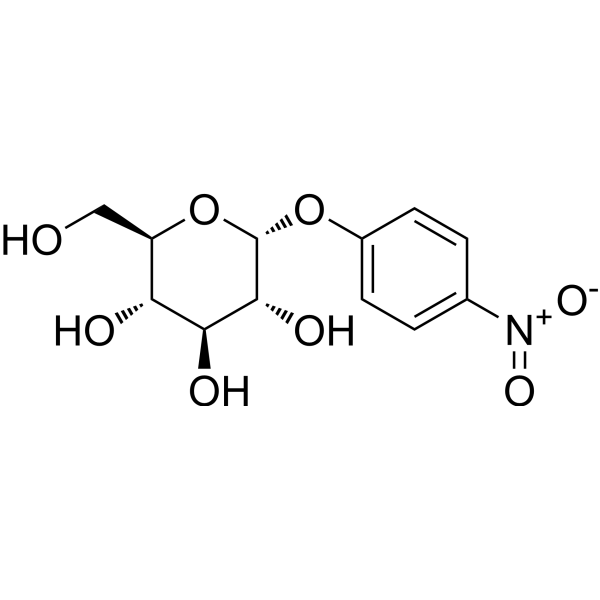
Physicochemical Properties
| Molecular Formula | C12H15NO8 |
| Molecular Weight | 301.25 |
| Exact Mass | 301.079 |
| Elemental Analysis | C, 47.84; H, 5.02; N, 4.65; O, 42.49 |
| CAS # | 3767-28-0 |
| PubChem CID | 92969 |
| Appearance | White to off-white solid powder |
| Density | 1.6±0.1 g/cm3 |
| Boiling Point | 582.2±50.0 °C at 760 mmHg |
| Melting Point | 210-216ºC |
| Flash Point | 305.9±30.1 °C |
| Vapour Pressure | 0.0±1.7 mmHg at 25°C |
| Index of Refraction | 1.648 |
| LogP | -0.55 |
| Hydrogen Bond Donor Count | 4 |
| Hydrogen Bond Acceptor Count | 8 |
| Rotatable Bond Count | 3 |
| Heavy Atom Count | 21 |
| Complexity | 354 |
| Defined Atom Stereocenter Count | 5 |
| SMILES | C1=CC(=CC=C1[N+](=O)[O-])O[C@@H]2[C@@H]([C@H]([C@@H]([C@H](O2)CO)O)O)O |
| InChi Key | IFBHRQDFSNCLOZ-ZIQFBCGOSA-N |
| InChi Code | InChI=1S/C12H15NO8/c14-5-8-9(15)10(16)11(17)12(21-8)20-7-3-1-6(2-4-7)13(18)19/h1-4,8-12,14-17H,5H2/t8-,9-,10+,11-,12+/m1/s1 |
| Chemical Name | (2R,3S,4S,5R,6R)-2-(hydroxymethyl)-6-(4-nitrophenoxy)oxane-3,4,5-triol |
| Synonyms | 3767-28-0; 4-nitrophenyl-alpha-D-glucopyranoside; 4-Nitrophenyl alpha-D-glucopyranoside; 4-Nitrophenyl a-D-glucopyranoside; 4-Nitrophenyl alpha-glucoside; pNPalphaGlu; a-D-Glucopyranoside, 4-nitrophenyl; p-Nitrophenyl alpha-D-glucopyranoside; |
| HS Tariff Code | 2934.99.9001 |
| Storage |
Powder-20°C 3 years 4°C 2 years In solvent -80°C 6 months -20°C 1 month |
| Shipping Condition | Room temperature (This product is stable at ambient temperature for a few days during ordinary shipping and time spent in Customs) |
Biological Activity
| Targets | α-glucosidase |
| ln Vitro | P-nitrophenol is released by 4-Nitrophenyl aD-glucopyranoside by enzymatic cleavage. By using colorimetric detection at 405 nm, p-nitrophenol can be measured[2]. |
| Enzyme Assay | p-Nitrophenyl alpha-D-glucopyranoside has been shown to be a substrate for the glucansucrases of various strains of Leuconostoc mesenteroides and Streptococcus mutans. The products from a digest of p-nitrophenyl alpha-D-glucopyranoside with L. mesenteroides B-512F dextransucrase were found to include dextran, a series of p-nitrophenyl isomaltodextrin glycosides, and p-nitrophenyl nigeroside. The kinetics of the reaction were non-Michaelis-Menten, possibly because p-nitrophenyl alpha-D-glucopyranoside has a dual role in the reaction as both a D-glucosyl donor and acceptor [2]. |
| References |
[1]. Inhibitory mechanism of morin on α-glucosidase and its anti-glycation properties. Food Funct. 2016 Sep 14;7(9):3953-63. [2]. p-Nitrophenyl alpha-D-glucopyranoside, a new substrate for glucansucrases. Carbohydr Res. 1983 Dec 23;124(2):287-99. |
| Additional Infomation |
4-nitrophenyl alpha-D-glucoside is an alpha-D-glucoside that is beta-D-glucopyranose in which the anomeric hydroxy hydrogen is replaced by a 4-nitrophenyl group. It has a role as a chromogenic compound. It is a monosaccharide derivative, an alpha-D-glucoside and a C-nitro compound. It is functionally related to a 4-nitrophenol. It is important to investigate the inhibition of α-glucosidase due to its correlation with type 2 diabetes. Morin was found to exert significant inhibition activity on α-glucosidase in a reversible mixed-type manner with an IC50 value of (4.48 ± 0.04) μM. Analyses of fluorescence and circular dichroism spectra indicated that the formation of the morin-α-glucosidase complex was driven mainly by hydrophobic forces and hydrogen bonding, and caused the conformational changes of α-glucosidase. The phase diagrams of fluorescence showed that the conformational change process was monophasic without intermediates. Molecular docking indicated that morin mainly interacted with amino acid residues located close to the active site of α-glucosidase, which may move to cover the active pocket to reduce the binding of the substrate and then inhibit the catalytic activity. Morin was also found to exhibit inhibition in the generation of advanced glycation end products which was related to the long term complications of diabetes.[1] |
Solubility Data
| Solubility (In Vitro) | DMSO: 50 mg/mL (165.98 mM) |
| Solubility (In Vivo) |
Solubility in Formulation 1: ≥ 2.5 mg/mL (8.30 mM) (saturation unknown) in 10% DMSO + 40% PEG300 + 5% Tween80 + 45% Saline (add these co-solvents sequentially from left to right, and one by one), clear solution. For example, if 1 mL of working solution is to be prepared, you can add 100 μL of 25.0 mg/mL clear DMSO stock solution to 400 μL PEG300 and mix evenly; then add 50 μL Tween-80 to the above solution and mix evenly; then add 450 μL normal saline to adjust the volume to 1 mL. Preparation of saline: Dissolve 0.9 g of sodium chloride in 100 mL ddH₂ O to obtain a clear solution. Solubility in Formulation 2: ≥ 2.5 mg/mL (8.30 mM) (saturation unknown) in 10% DMSO + 90% (20% SBE-β-CD in Saline) (add these co-solvents sequentially from left to right, and one by one), clear solution. For example, if 1 mL of working solution is to be prepared, you can add 100 μL of 25.0 mg/mL clear DMSO stock solution to 900 μL of 20% SBE-β-CD physiological saline solution and mix evenly. Preparation of 20% SBE-β-CD in Saline (4°C,1 week): Dissolve 2 g SBE-β-CD in 10 mL saline to obtain a clear solution. Solubility in Formulation 3: ≥ 2.5 mg/mL (8.30 mM) (saturation unknown) in 10% DMSO + 90% Corn Oil (add these co-solvents sequentially from left to right, and one by one), clear solution. For example, if 1 mL of working solution is to be prepared, you can add 100 μL of 25.0 mg/mL clear DMSO stock solution to 900 μL of corn oil and mix evenly. (Please use freshly prepared in vivo formulations for optimal results.) |
| Preparing Stock Solutions | 1 mg | 5 mg | 10 mg | |
| 1 mM | 3.3195 mL | 16.5975 mL | 33.1950 mL | |
| 5 mM | 0.6639 mL | 3.3195 mL | 6.6390 mL | |
| 10 mM | 0.3320 mL | 1.6598 mL | 3.3195 mL |