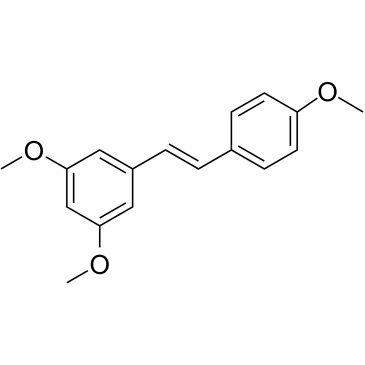
Trans-Trimethoxyresveratrol is an analogue of Resveratrol (RSV), and it may be a more potent anti-inflammatory, antiangiogenic and vascular-disrupting agent when compared with resveratrol.
Physicochemical Properties
| Molecular Formula | C₁₇H₁₈O₃ |
| Molecular Weight | 270.32 |
| Exact Mass | 270.125 |
| CAS # | 22255-22-7 |
| PubChem CID | 5388063 |
| Appearance | White to off-white solid powder |
| Density | 1.1±0.1 g/cm3 |
| Boiling Point | 423.8±35.0 °C at 760 mmHg |
| Melting Point | 57ºC |
| Flash Point | 144.4±23.2 °C |
| Vapour Pressure | 0.0±1.0 mmHg at 25°C |
| Index of Refraction | 1.600 |
| LogP | 4.61 |
| Hydrogen Bond Donor Count | 0 |
| Hydrogen Bond Acceptor Count | 3 |
| Rotatable Bond Count | 5 |
| Heavy Atom Count | 20 |
| Complexity | 283 |
| Defined Atom Stereocenter Count | 0 |
| SMILES | COC1=CC=C(C=C1)/C=C/C2=CC(=CC(=C2)OC)OC |
| InChi Key | GDHNBPHYVRHYCC-SNAWJCMRSA-N |
| InChi Code | InChI=1S/C17H18O3/c1-18-15-8-6-13(7-9-15)4-5-14-10-16(19-2)12-17(11-14)20-3/h4-12H,1-3H3/b5-4+ |
| Chemical Name | 1,3-dimethoxy-5-[(E)-2-(4-methoxyphenyl)ethenyl]benzene |
| Synonyms | trans-trismethoxy Resveratrol; 22255-22-7; trans-Trimethoxyresveratrol; (E)-1,3-Dimethoxy-5-(4-methoxystyryl)benzene; 3,4',5-trimethoxy-trans-stilbene; (E)-3,5,4'-Trimethoxystilbene; 3,4',5-trimethoxystilbene; 3,5,4'-trimethoxystilbene; TRIMETHOXYSTILBENE; E-Resveratrol Trimethyl Ether; Tri-O-methylresveratrol |
| HS Tariff Code | 2934.99.9001 |
| Storage |
Powder-20°C 3 years 4°C 2 years In solvent -80°C 6 months -20°C 1 month |
| Shipping Condition | Room temperature (This product is stable at ambient temperature for a few days during ordinary shipping and time spent in Customs) |
Biological Activity
| Targets | Anti-inflammatory; antiangiogenic; vascular-disrupting agent |
| ln Vitro | Angiogenesis plays an important role in the development of neoplastic diseases such as cancer. Resveratrol and its derivatives exert antiangiogenic effects, but the mechanisms of their actions remain unclear. The aim of this study was to evaluate the antiangiogenic activity of resveratrol and its derivative trans-3,5,4'-trimethoxystilbene in vitro using human umbilical vein endothelial cells (HUVECs) and in vivo using transgenic zebrafish, and to clarify their mechanisms of action in zebrafish by gene expression analysis of the vascular endothelial growth factor (VEGF) receptor (VEGFR2/KDR) and cell-cycle analysis. trans-3,5,4'-Trimethoxystilbene showed significantly more potent antiangiogenic activity than that of resveratrol in both assays. [1] |
| ln Vivo | In zebrafish, trans-3,5,4'-trimethoxystilbene caused intersegmental vessel regression and downregulated VEGFR2 mRNA expression. Trans-3,5,4'-trimethoxystilbene also induced G2/M cell-cycle arrest, most specifically in endothelial cells of zebrafish embryos. We propose that the antiangiogenic and vascular-targeting activities of trans-3,5,4'-trimethoxystilbene result from the downregulation of VEGFR2 expression and cell-cycle arrest at G2/M phase.[2] |
| Cell Assay |
Growth Inhibitory Assay of Cell Lines[1] HepG2, MCF-7, and MDA-MB-231 cells were seeded in 96-well microplates at 1 × 10⁴ cells/well in 100 µl of medium. Drugs were added to the cells at serially diluted concentrations, from a 100 mM stock solution in DMSO, and incubated for 24 h. The controls were treated with 1% DMSO. 3-(4,5-Dimethylthiazol-2yl)-2,5-diphenyltrtrazolium bromide solution (30 µl; 5 mg/ml in PBS) was added, and after incubation for 4 h, the blue formazan crystals were dissolved with 100 µl of DMSO. Optical density (OD) was measured with a Multilabel Counte at 570 nm. MTT solution with DMSO was used as the blank. Cell viability (percentage of the control) was calculated relative to the untreated control. The inhibition of cell proliferation was calculated using the following formula: growth inhibition (%) = ([ODcontrol − ODtreated]/ODcontrol) × 100%. Cell Proliferation Assay[1] HUVECs were seeded into 96-well gelatin-coated plates at a density of 104 cells/well. To achieve a quiescent state, the complete medium was replaced after incubation for 24 h with low-serum (0.5% FBS) medium and incubated for a further 24 h. The medium was replaced with various doses of drugs together with 10 ng/ml basic fibroblast growth factor. The plates were incubated for an additional 48 h and cell proliferation was assessed with the Cell Proliferation Kit II , in accordance with the manufacturer's protocol. The spectrophotometric absorbance was measured with a Multilabel Counter at 490 nm, with the reference wavelength at 690 nm. |
| Animal Protocol |
Morphological Observations of Zebrafish[1] Transgenic Tg(fli1:EGFP) zebrafish embryos at 48 h post-fertilization (hpf) were treated with different concentrations of TMS, vehicle-control and SU5416 as positive control. After 20 h of drug treatment, the embryos were anesthetized with 0.02% tricaine, and observed for viability and gross morphological changes under a fluorescence microscope equipped with a digital camera. The images were analyzed with Adobe Photoshop 7.0 and ACDSee 7.0. |
| References |
[1]. Resveratrol derivative, trans-3,5,4'-trimethoxystilbene, exerts antiangiogenic and vascular-disrupting effects in zebrafish through the downregulation of VEGFR2 and cell-cycle modulation. Journal of cellular biochemistry 109, 339-346, doi:. |
| Additional Infomation | (E)-3,5,4'-Trimethoxystilbene has been reported in Scirpoides holoschoenus, Dalea versicolor, and other organisms with data available. |
Solubility Data
| Solubility (In Vitro) |
DMSO : ≥ 50 mg/mL (~184.97 mM) H2O : < 0.1 mg/mL |
| Solubility (In Vivo) |
Solubility in Formulation 1: ≥ 2.5 mg/mL (9.25 mM) (saturation unknown) in 10% DMSO + 40% PEG300 + 5% Tween80 + 45% Saline (add these co-solvents sequentially from left to right, and one by one), clear solution. For example, if 1 mL of working solution is to be prepared, you can add 100 μL of 25.0 mg/mL clear DMSO stock solution to 400 μL PEG300 and mix evenly; then add 50 μL Tween-80 to the above solution and mix evenly; then add 450 μL normal saline to adjust the volume to 1 mL. Preparation of saline: Dissolve 0.9 g of sodium chloride in 100 mL ddH₂ O to obtain a clear solution. Solubility in Formulation 2: ≥ 2.5 mg/mL (9.25 mM) (saturation unknown) in 10% DMSO + 90% (20% SBE-β-CD in Saline) (add these co-solvents sequentially from left to right, and one by one), clear solution. For example, if 1 mL of working solution is to be prepared, you can add 100 μL of 25.0 mg/mL clear DMSO stock solution to 900 μL of 20% SBE-β-CD physiological saline solution and mix evenly. Preparation of 20% SBE-β-CD in Saline (4°C,1 week): Dissolve 2 g SBE-β-CD in 10 mL saline to obtain a clear solution. Solubility in Formulation 3: ≥ 2.5 mg/mL (9.25 mM) (saturation unknown) in 10% DMSO + 90% Corn Oil (add these co-solvents sequentially from left to right, and one by one), clear solution. For example, if 1 mL of working solution is to be prepared, you can add 100 μL of 25.0 mg/mL clear DMSO stock solution to 900 μL of corn oil and mix evenly. (Please use freshly prepared in vivo formulations for optimal results.) |
| Preparing Stock Solutions | 1 mg | 5 mg | 10 mg | |
| 1 mM | 3.6993 mL | 18.4966 mL | 36.9932 mL | |
| 5 mM | 0.7399 mL | 3.6993 mL | 7.3986 mL | |
| 10 mM | 0.3699 mL | 1.8497 mL | 3.6993 mL |