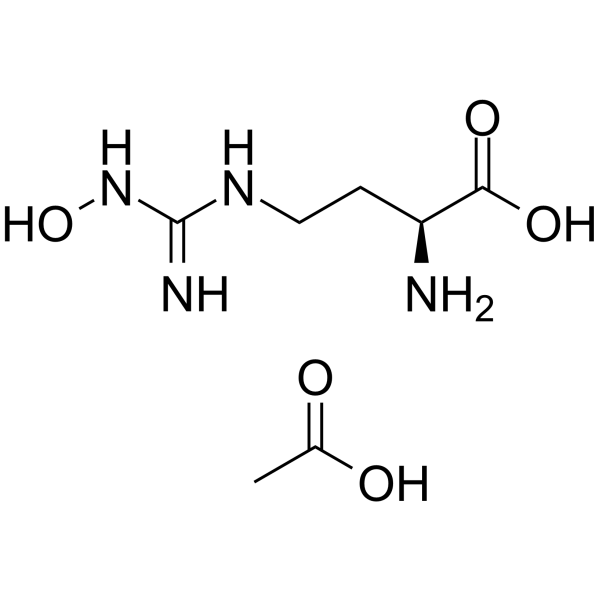
Physicochemical Properties
| Molecular Formula | C7H16N4O5 |
| Molecular Weight | 236.225741386414 |
| Exact Mass | 236.112 |
| Elemental Analysis | C, 35.59; H, 6.83; N, 23.72; O, 33.86 |
| CAS # | 2250019-93-1 |
| Related CAS # | 189302-40-7; 1140844-63-8 (acetate); 291758-32-2 (HCl); 2250019-93-1 (nor-NOHA monoacetate) |
| PubChem CID | 131648256 |
| Appearance | White to off-white solid powder |
| Hydrogen Bond Donor Count | 6 |
| Hydrogen Bond Acceptor Count | 7 |
| Rotatable Bond Count | 5 |
| Heavy Atom Count | 16 |
| Complexity | 213 |
| Defined Atom Stereocenter Count | 1 |
| SMILES | OC([C@H](CC/N=C(\N)/NO)N)=O.OC(C)=O |
| InChi Key | RYUGHGOGNIYFKU-DFWYDOINSA-N |
| InChi Code | InChI=1S/C5H12N4O3.C2H4O2/c6-3(4(10)11)1-2-8-5(7)9-12;1-2(3)4/h3,12H,1-2,6H2,(H,10,11)(H3,7,8,9);1H3,(H,3,4)/t3-;/m0./s1 |
| Chemical Name | acetic acid;(2S)-2-amino-4-[[amino-(hydroxyamino)methylidene]amino]butanoic acid |
| Synonyms | Nor NOHA monoacetate; 2250019-93-1; nor-NOHA (monoacetate); nor-NOHA monoacetate; N-OMega-hydroxy-L-norarginine acetate salt; AKOS032962868; HY-112885B; N-OMega-hydroxy-L-norarginineacetatesalt; |
| HS Tariff Code | 2934.99.9001 |
| Storage |
Powder-20°C 3 years 4°C 2 years In solvent -80°C 6 months -20°C 1 month Note: Please store this product in a sealed and protected environment, avoid exposure to moisture. |
| Shipping Condition | Room temperature (This product is stable at ambient temperature for a few days during ordinary shipping and time spent in Customs) |
Biological Activity
| Targets | Arginase |
| ln Vitro | nor-NOHA (0.1-1 mM, 72 h) induces apoptosis of K562 cells in a dose-dependent manner under hypoxia (1.5% O2)[1]. nor-NOHA (1 mM, 72 h) can attenuate hypoxia-mediated imatinib resistance in K562 or KCL22 cells[1]. |
| ln Vivo | nor-NOHA (100 mg/kg, intravenous injection, once) can significantly reduce infarct size in male Sprague-Dawley rats [2]. nor-NOHA (100 mg/kg IV once) increases plasma citrulline and nitrite levels and decreases plasma ornithine levels in male Sprague-Dawley rats [2] |
| Enzyme Assay |
Arginase activity assay[1] Arginase activity was analysed as described with modifications. Cells were counted, and equal numbers of cells were lysed in 50μl of lysis buffer (PBS with 1mM EDTA, 0.1% Triton X−100 and protease Inhibitors) and centrifuged for 15 minutes at 14,000g at 4°C. The supernatants were mixed with 50μl of freshly prepared activation buffer (10mM MnCl2, 50mM Tris-HCl pH7.5) and 50μl of 0.5M arginine, and heated for 10 minutes at 56°C. Thereafter, 800μl of acidic solution (H2SO4 (96%)/H3PO4 (85%)/H2O, 1/3/7, v/v/v) and 25μl of 9% α–isonitrosopropiophenone (in ethanol) were added to the mixture and heated for 15 minutes at 100°C. The mixture was allowed to develop colour in the dark. Finally, 250μl was transferred to a 96-well plate for OD measurements at 550nm. |
| Cell Assay |
Measurement of cellular respiration by Seahorse Analyzer[1] 0.1x10⁶ K562 cells were plated per well in poly–L–lysine-coated XF–24 well cell culture microplates in XF Assay media supplemented with 4.5 g/L glucose and 1mM sodium pyruvate. The cells were spin–immobilized to the microplates at 200g for 1 minute. The cellular oxygen consumption rate (OCR), extracellular acidification rate (ECAR), and photon production rate (PPR) were obtained using an XF24 Analyzer from Seahorse Bioscience. The measurements were performed according to the manufacturer’s instructions, using Oligomycin, Carbonyl cyanide–4–(trifluoromethoxy) phenylhydrazone (FCCP) and Rotenone & antimycin A (R/A; all from Sigma−Aldrich) at the specified concentrations. Data was analysed using the Seahorse XF software. |
| Animal Protocol |
Sprague-Dawley rats were subjected to 30 min of coronary artery ligation, followed by 2 h of reperfusion. The animals were given either saline, or the arginase inhibitor N-omega-hydroxy-nor-l-arginine (nor-NOHA) with or without the NO scavenger carboxy-2-phenyl-4,4,5,5-tetramethyl-imidazoline-1-oxyl-3-oxide (cPTIO) or the NOS inhibitor N(G)-monomethyl-l-arginine (l-NMMA) iv 15 min before ischaemia. The infarct size was 79 +/- 4% of the area at risk in the control group. Nor-NOHA treatment reduced the infarct size to 39 +/- 7% (P < 0.001). Administration of cPTIO or l-NMMA completely abolished the protective effect of nor-NOHA. Expression of arginase I was significantly (P < 0.05) increased in ischaemic myocardium. Nor-NOHA treatment resulted in higher plasma levels of nitrite (P < 0.05) and a 10-fold increase in the citrulline/ornithine ratio (P < 0.001), indicating a shift in arginine utilization towards NOS. Conclusion: Inhibition of arginase protects from myocardial infarction by a mechanism that is dependent on NOS activity and bioavailability of NO by shifting arginine utilization from arginase towards NOS. These findings suggest that targeting of arginase is a promising future therapeutic strategy for protection against myocardial IR injury.[2] |
| References |
[1]. The arginase inhibitor Nω-hydroxy-nor-arginine (nor-NOHA) induces apoptosis in leukemic cells specifically under hypoxic conditions but CRISPR/Cas9 excludes arginase 2 (ARG2) as the functional target. PLoS One. 2018 Oct 11;13(10):e0205254. [2]. Arginase inhibition mediates cardioprotection during ischaemia-reperfusion. Cardiovasc Res. 2010 Jan 1;85(1):147-54. |
| Additional Infomation |
Nomega-hydroxy-nor-l-arginine is a L-alpha-amino acid. N-Hydroxy-nor-L-arginine (nor-NOHA) is under investigation in clinical trial NCT02009527 (Arginase Inhibition in Ischemia-reperfusion Injury). Cancer cells, including in chronic myeloid leukemia (CML), depend on the hypoxic response to persist in hosts and evade therapy. Accordingly, there is significant interest in drugging cancer-specific hypoxic responses. However, a major challenge in leukemia is identifying differential and druggable hypoxic responses between leukemic and normal cells. Previously, we found that arginase 2 (ARG2), an enzyme of the urea cycle, is overexpressed in CML but not normal progenitors. ARG2 is a target of the hypoxia inducible factors (HIF1-α and HIF2-α), and is required for the generation of polyamines which are required for cell growth. We therefore explored if the clinically-tested arginase inhibitor Nω-hydroxy-nor-arginine (nor-NOHA) would be effective against leukemic cells under hypoxic conditions. Remarkably, nor-NOHA effectively induced apoptosis in ARG2-expressing cells under hypoxia but not normoxia. Co-treatment with nor-NOHA overcame hypoxia-mediated resistance towards BCR-ABL1 kinase inhibitors. While nor-NOHA itself is promising in targeting the leukemia hypoxic response, we unexpectedly found that its anti-leukemic activity was independent of ARG2 inhibition. Genetic ablation of ARG2 using CRISPR/Cas9 had no effect on the viability of leukemic cells and their sensitivity towards nor-NOHA. This discrepancy was further evidenced by the distinct effects of ARG2 knockouts and nor-NOHA on cellular respiration. In conclusion, we show that nor-NOHA has significant but off-target anti-leukemic activity among ARG2-expressing hypoxic cells. Since nor-NOHA has been employed in clinical trials, and is widely used in studies on endothelial dysfunction, immunosuppression and metabolism, the diverse biological effects of nor-NOHA must be cautiously evaluated before attributing its activity to ARG inhibition.[1] |
Solubility Data
| Solubility (In Vitro) |
DMSO : ~100 mg/mL (~423.32 mM) H2O : ~50 mg/mL (~211.66 mM) |
| Solubility (In Vivo) |
Solubility in Formulation 1: ≥ 2.5 mg/mL (10.58 mM) (saturation unknown) in 10% DMSO + 40% PEG300 + 5% Tween80 + 45% Saline (add these co-solvents sequentially from left to right, and one by one), clear solution. For example, if 1 mL of working solution is to be prepared, you can add 100 μL of 25.0 mg/mL clear DMSO stock solution to 400 μL PEG300 and mix evenly; then add 50 μL Tween-80 to the above solution and mix evenly; then add 450 μL normal saline to adjust the volume to 1 mL. Preparation of saline: Dissolve 0.9 g of sodium chloride in 100 mL ddH₂ O to obtain a clear solution. Solubility in Formulation 2: ≥ 2.5 mg/mL (10.58 mM) (saturation unknown) in 10% DMSO + 90% (20% SBE-β-CD in Saline) (add these co-solvents sequentially from left to right, and one by one), clear solution. For example, if 1 mL of working solution is to be prepared, you can add 100 μL of 25.0 mg/mL clear DMSO stock solution to 900 μL of 20% SBE-β-CD physiological saline solution and mix evenly. Preparation of 20% SBE-β-CD in Saline (4°C,1 week): Dissolve 2 g SBE-β-CD in 10 mL saline to obtain a clear solution. Solubility in Formulation 3: ≥ 2.5 mg/mL (10.58 mM) (saturation unknown) in 10% DMSO + 90% Corn Oil (add these co-solvents sequentially from left to right, and one by one), clear solution. For example, if 1 mL of working solution is to be prepared, you can add 100 μL of 25.0 mg/mL clear DMSO stock solution to 900 μL of corn oil and mix evenly. Solubility in Formulation 4: 100 mg/mL (423.32 mM) in PBS (add these co-solvents sequentially from left to right, and one by one), clear solution; with ultrasonication (<60°C). (Please use freshly prepared in vivo formulations for optimal results.) |
| Preparing Stock Solutions | 1 mg | 5 mg | 10 mg | |
| 1 mM | 4.2332 mL | 21.1658 mL | 42.3316 mL | |
| 5 mM | 0.8466 mL | 4.2332 mL | 8.4663 mL | |
| 10 mM | 0.4233 mL | 2.1166 mL | 4.2332 mL |