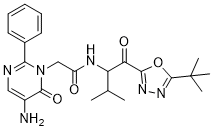
Freselestat (also known as ONO-6818) is a novel, potent and selective inhibitor of Human Neutrophil Elastase (HNE). Freselestat reduces inflammatory mediators during simulated extracorporeal circulation. ONO-6818 significantly reduced interleukin 8 and C5b-9 production. ONO-6818 did not modulate changes of CD11b and L-selectin during recirculation.
Physicochemical Properties
| Molecular Formula | C23H28N6O4 |
| Molecular Weight | 452.50600 |
| Exact Mass | 452.217 |
| CAS # | 208848-19-5 |
| Related CAS # | Freselestat quarterhydrate |
| PubChem CID | 216294 |
| Appearance | White to off-white solid powder |
| Density | 1.32g/cm3 |
| Index of Refraction | 1.633 |
| LogP | 3.168 |
| Hydrogen Bond Donor Count | 2 |
| Hydrogen Bond Acceptor Count | 8 |
| Rotatable Bond Count | 8 |
| Heavy Atom Count | 33 |
| Complexity | 825 |
| Defined Atom Stereocenter Count | 0 |
| InChi Key | YSIHYROEMJSOAS-UHFFFAOYSA-N |
| InChi Code | InChI=1S/C23H28N6O4/c1-13(2)17(18(31)20-27-28-22(33-20)23(3,4)5)26-16(30)12-29-19(14-9-7-6-8-10-14)25-11-15(24)21(29)32/h6-11,13,17H,12,24H2,1-5H3,(H,26,30) |
| Chemical Name | 2-(5-amino-6-oxo-2-phenylpyrimidin-1(6H)-yl)-N-(1-(5-(tert-butyl)-1,3,4-oxadiazol-2-yl)-3-methyl-1-oxobutan-2-yl)acetamide |
| Synonyms | ONO-6818; ONO6818; ONO 6818; ONO-PO 736; ONO-PO-736; ONO PO 736; |
| HS Tariff Code | 2934.99.9001 |
| Storage |
Powder-20°C 3 years 4°C 2 years In solvent -80°C 6 months -20°C 1 month |
| Shipping Condition | Room temperature (This product is stable at ambient temperature for a few days during ordinary shipping and time spent in Customs) |
Biological Activity
| ln Vitro | Recirculating fresh heparinized (3.75 U/mL) human blood in a roller pump and membrane oxygenator for 120 minutes with or without 1.0 μM Freselestat (ONO-6818) allowed for the establishment of simulated extracorporeal circulation. The Freselestat group showed a significant decrease in neutrophil elastase levels. Freselestat dramatically lowers the synthesis of C5b-9 and interleukin-8. L-selectin and CD11b alterations during recycling are not modulated by frecelsestat [3]. |
| ln Vivo | Hemoglobin, neutrophil counts in bronchoalveolar lavage fluid, and pulmonary myeloperoxidase activity are all affected by HNE. Treatment with Freselestat (ONO-6818; 10-100 mg/kg; oral; daily; for 8 weeks) attenuates these dose-dependent increases. ONO-6818 decreases pulmonary bleeding and neutrophil buildup in the lungs to prevent HNE-induced acute lung damage [1]. |
| Animal Protocol |
Animal/Disease Models: Human neutrophil elastase (HNE)-induced male Wistar rats (228 g) [1] Doses: 10 mg/kg, 100 mg/kg Route of Administration: oral; Route of Administration: oral. Routine; continued for 8 weeks Experimental Results: HNE-induced increases in pulmonary myeloperoxidase activity, hemoglobin, and neutrophil counts in bronchoalveolar lavage fluid were dose-dependently attenuated. |
| References |
[1]. Am J Respir Crit Care Med. 2002 Aug 15;166(4):496-500. [2]. Design and synthesis of new orally active inhibitors of human neutrophil elastase. Bioorg Med Chem. 2001 May;9(5):1307-23. [3]. Effects of the neutrophil elastase inhibitor (ONO-6818) on acetic acid induced colitis in Syrian hamsters. J Vet Med Sci. 2004 Oct;66(10):1223-8. [4]. ONO-6818, a novel, potent neutrophil elastase inhibitor, reduces inflammatory mediators during simulated extracorporeal circulation. Ann Thorac Surg. 2003 Oct;76(4):1234-9. |
| Additional Infomation |
Drug Indication Investigated for use/treatment in chronic obstructive pulmonary disease (COPD). Mechanism of Action ONO-6818 inhibits neutrophil elastase activity, reducing interleukin 8 production and the formation of the complement membrane attack complex. Consequently, neutrophil elastase levels are reduced during stimulated extracorporeal circulation. |
Solubility Data
| Solubility (In Vitro) | May dissolve in DMSO (in most cases), if not, try other solvents such as H2O, Ethanol, or DMF with a minute amount of products to avoid loss of samples |
| Solubility (In Vivo) |
Note: Listed below are some common formulations that may be used to formulate products with low water solubility (e.g. < 1 mg/mL), you may test these formulations using a minute amount of products to avoid loss of samples. Injection Formulations (e.g. IP/IV/IM/SC) Injection Formulation 1: DMSO : Tween 80: Saline = 10 : 5 : 85 (i.e. 100 μL DMSO stock solution → 50 μL Tween 80 → 850 μL Saline) *Preparation of saline: Dissolve 0.9 g of sodium chloride in 100 mL ddH ₂ O to obtain a clear solution. Injection Formulation 2: DMSO : PEG300 :Tween 80 : Saline = 10 : 40 : 5 : 45 (i.e. 100 μL DMSO → 400 μLPEG300 → 50 μL Tween 80 → 450 μL Saline) Injection Formulation 3: DMSO : Corn oil = 10 : 90 (i.e. 100 μL DMSO → 900 μL Corn oil) Example: Take the Injection Formulation 3 (DMSO : Corn oil = 10 : 90) as an example, if 1 mL of 2.5 mg/mL working solution is to be prepared, you can take 100 μL 25 mg/mL DMSO stock solution and add to 900 μL corn oil, mix well to obtain a clear or suspension solution (2.5 mg/mL, ready for use in animals). Injection Formulation 4: DMSO : 20% SBE-β-CD in saline = 10 : 90 [i.e. 100 μL DMSO → 900 μL (20% SBE-β-CD in saline)] *Preparation of 20% SBE-β-CD in Saline (4°C,1 week): Dissolve 2 g SBE-β-CD in 10 mL saline to obtain a clear solution. Injection Formulation 5: 2-Hydroxypropyl-β-cyclodextrin : Saline = 50 : 50 (i.e. 500 μL 2-Hydroxypropyl-β-cyclodextrin → 500 μL Saline) Injection Formulation 6: DMSO : PEG300 : castor oil : Saline = 5 : 10 : 20 : 65 (i.e. 50 μL DMSO → 100 μLPEG300 → 200 μL castor oil → 650 μL Saline) Injection Formulation 7: Ethanol : Cremophor : Saline = 10: 10 : 80 (i.e. 100 μL Ethanol → 100 μL Cremophor → 800 μL Saline) Injection Formulation 8: Dissolve in Cremophor/Ethanol (50 : 50), then diluted by Saline Injection Formulation 9: EtOH : Corn oil = 10 : 90 (i.e. 100 μL EtOH → 900 μL Corn oil) Injection Formulation 10: EtOH : PEG300:Tween 80 : Saline = 10 : 40 : 5 : 45 (i.e. 100 μL EtOH → 400 μLPEG300 → 50 μL Tween 80 → 450 μL Saline) Oral Formulations Oral Formulation 1: Suspend in 0.5% CMC Na (carboxymethylcellulose sodium) Oral Formulation 2: Suspend in 0.5% Carboxymethyl cellulose Example: Take the Oral Formulation 1 (Suspend in 0.5% CMC Na) as an example, if 100 mL of 2.5 mg/mL working solution is to be prepared, you can first prepare 0.5% CMC Na solution by measuring 0.5 g CMC Na and dissolve it in 100 mL ddH2O to obtain a clear solution; then add 250 mg of the product to 100 mL 0.5% CMC Na solution, to make the suspension solution (2.5 mg/mL, ready for use in animals). Oral Formulation 3: Dissolved in PEG400 Oral Formulation 4: Suspend in 0.2% Carboxymethyl cellulose Oral Formulation 5: Dissolve in 0.25% Tween 80 and 0.5% Carboxymethyl cellulose Oral Formulation 6: Mixing with food powders Note: Please be aware that the above formulations are for reference only. InvivoChem strongly recommends customers to read literature methods/protocols carefully before determining which formulation you should use for in vivo studies, as different compounds have different solubility properties and have to be formulated differently. (Please use freshly prepared in vivo formulations for optimal results.) |
| Preparing Stock Solutions | 1 mg | 5 mg | 10 mg | |
| 1 mM | 2.2099 mL | 11.0495 mL | 22.0990 mL | |
| 5 mM | 0.4420 mL | 2.2099 mL | 4.4198 mL | |
| 10 mM | 0.2210 mL | 1.1049 mL | 2.2099 mL |