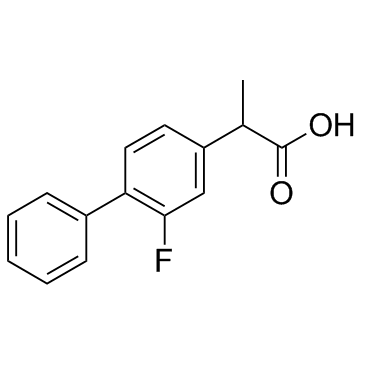
Flurbiprofen, a phenylalkanoic acid derivative, belongs to the class of drugs called nonsteroidal anti-inflammatory drugs (NSAIDs) with antipyretic and analgesic activity. It is primarily indicated as a pre-operative anti-miotic (in an ophthalmic solution) as well as orally for arthritis or dental pain. Oral formulations of flurbiprofen may be used for the symptomatic treatment of rheumatoid arthritis, osteoarthritis and anklylosing spondylitis. Flurbiprofen is structurally and pharmacologically related to fenoprofen, ibuprofen, and ketoprofen.
Physicochemical Properties
| Molecular Formula | C15H13FO2 |
| Molecular Weight | 244.2609 |
| Exact Mass | 244.089 |
| CAS # | 5104-49-4 |
| Related CAS # | Tarenflurbil;51543-40-9;Flurbiprofen-d3;1185133-81-6;Flurbiprofen-d5;215175-76-1;Flurbiprofen-13C,d3;2747917-55-9 |
| PubChem CID | 3394 |
| Appearance | White to light yellow solid powder |
| Density | 1.2±0.1 g/cm3 |
| Boiling Point | 376.2±30.0 °C at 760 mmHg |
| Melting Point | 110-112 °C(lit.) |
| Flash Point | 181.3±24.6 °C |
| Vapour Pressure | 0.0±0.9 mmHg at 25°C |
| Index of Refraction | 1.568 |
| LogP | 4.11 |
| Hydrogen Bond Donor Count | 1 |
| Hydrogen Bond Acceptor Count | 3 |
| Rotatable Bond Count | 3 |
| Heavy Atom Count | 18 |
| Complexity | 286 |
| Defined Atom Stereocenter Count | 0 |
| InChi Key | SYTBZMRGLBWNTM-UHFFFAOYSA-N |
| InChi Code | InChI=1S/C15H13FO2/c1-10(15(17)18)12-7-8-13(14(16)9-12)11-5-3-2-4-6-11/h2-10H,1H3,(H,17,18) |
| Chemical Name | 2-(3-fluoro-4-phenylphenyl)propanoic acid |
| Synonyms | Cebutid, dl-Flurbiprofen; Ansaid, Froben, Flurbiprofen, Antadys |
| HS Tariff Code | 2934.99.9001 |
| Storage |
Powder-20°C 3 years 4°C 2 years In solvent -80°C 6 months -20°C 1 month |
| Shipping Condition | Room temperature (This product is stable at ambient temperature for a few days during ordinary shipping and time spent in Customs) |
Biological Activity
| ln Vitro | In a concentration- and time-dependent manner, flurbiprofen (2–20 nM; 12-48 hours) strongly inhibits the growth of SW620 cells [1]. For 24 hours, flurbiprofen (10 nM) decreases COX-2 expression [1]. By blocking COX-2, flurbiprofen (10 nM; 24 hours) reduces the expression of inflammatory factors [1]. By blocking COX-2, flurbiprofen (10 nM; 24 hours) encourages apoptosis in colorectal cancer cells [1]. An experiment on cell proliferation [1] |
| ln Vivo | In rats with adrenalectomy, flurbiprofen (0.3–4.8 mg/kg; oral; 4-5 doses) exhibits immediate anti-inflammatory effects [2]. In mice with high-fat diets, flurbiprofen (10 mg/kg; intraperitoneal injection; daily; for 6 days) reduces obesity [3]. |
| Cell Assay |
Cell proliferation experiment [1] Cell Types: SW620 cell Tested Concentrations: 2 nM, 4 nM, 10 nM, 20 nM Incubation Duration: 12 hrs (hours), 24 hrs (hours), 48 hrs (hours) Experimental Results: Inhibition of colorectal cancer cell proliferation. Western Blot Analysis[1] Cell Types: SW620 Cell Tested Concentrations: 10 nM Incubation Duration: 24 hrs (hours) Experimental Results: The protein and mRNA levels of COX-2 were Dramatically diminished. RT-PCR[1] Cell Types: SW620 Cell Tested Concentrations: 10 nM Incubation Duration: 24 hrs (hours) Experimental Results: diminished COX-2 mRNA expression levels Cell apoptosis analysis[1] Cell Types: SW620 Cell Tested Concentrations: 10 nM Incubation Duration: 24 hrs (hours) Experimental Results: The expression of Bcl2 was Dramatically diminished, and the expression of Bax and cleaved-caspase3 was Dramatically increased, but there was no effect on total caspase-3. |
| Animal Protocol |
Animal/Disease Models: Rat[2] Doses: 0.3 mg/kg, 0.6 mg/kg, 1.2 mg/kg, 2.4 mg/kg, 4.8 mg/kg Route of Administration: po (po (oral gavage)) 4-5 times Experimental Results: Inhibition of acute inflammation. |
| ADME/Pharmacokinetics |
Absorption, Distribution and Excretion Fluribiprofen is rapidly and almost completely absorbed following oral administration. Peak plasma concentrations are reached 0.5 - 4 hours after oral administration. Flurbiprofen is poorly excreted into human milk. Following dosing with flurbiprofen, less than 3% of flurbiprofen is excreted unchanged in the urine, with about 70% of the dose eliminated in the urine as parent drug and metabolites. Renal elimination is a significant pathway of elimination of flurbiprofen metabolites. 14 L [Normal Healthy Adults] 12 L [Geriatric Arthritis Patients] 10 L [End Stage Renal Disease Patients] 14 L [Alcoholic Cirrhosis Patients] 0.12 L/kg Metabolism / Metabolites Hepatic. Cytochrome P450 2C9 plays an important role in the metabolism of flurbiprofen to its major metabolite, 4’-hydroxy-flurbiprofen. The 4’-hydroxy-flurbiprofen metabolite showed little anti-inflammatory activity in animal models of inflammation. Hepatic. Cytochrome P450 2C9 plays an important role in the metabolism of flurbiprofen to its major metabolite, 4’-hydroxy-flurbiprofen. The 4’-hydroxy-flurbiprofen metabolite showed little anti-inflammatory activity in animal models of inflammation. Route of Elimination: Flurbiprofen is poorly excreted into human milk. Following dosing with flurbiprofen, less than 3% of flurbiprofen is excreted unchanged in the urine, with about 70% of the dose eliminated in the urine as parent drug and metabolites. Renal elimination is a significant pathway of elimination of flurbiprofen metabolites. Half Life: R-flurbiprofen, 4.7 hours; S-flurbiprofen, 5.7 hours Biological Half-Life R-flurbiprofen, 4.7 hours; S-flurbiprofen, 5.7 hours |
| Toxicity/Toxicokinetics |
Toxicity Summary Similar to other NSAIAs, the anti-inflammatory effect of flurbiprofen occurs via reversible inhibition of cyclooxygenase (COX), the enzyme responsible for the conversion of arachidonic acid to prostaglandin G2 (PGG2) and PGG2 to prostaglandin H2 (PGH2) in the prostaglandin synthesis pathway. This effectively decreases the concentration of prostaglandins involved in inflammation, pain, swelling and fever. Flurbiprofen is a non-selective COX inhibitor and inhibits the activity of both COX-1 and -2. It is also one of the most potent NSAIAs in terms of prostaglandin inhibitory activity. Hepatotoxicity Prospective studies show that mild elevations in serum aminotransferase levels can occur in up to 15% of patients taking flurbiprofen, but these are generally transient, mild and asymptomatic, often resolving even with drug continuation. Marked aminotransferase elevations (>3 fold elevated) occur in Likelihood score: C (probable rare cause of clinically apparent liver injury). Effects During Pregnancy and Lactation ◉ Summary of Use during Lactation Because of the low levels of flurbiprofen in breastmilk and its short half-life it is unlikely to adversely affect the breastfed infant, especially if the infant is older than 2 months. Maternal use of flurbiprofen eye drops would not be expected to cause any adverse effects in breastfed infants. To substantially diminish the amount of drug that reaches the breastmilk after using eye drops, place pressure over the tear duct by the corner of the eye for 1 minute or more, then remove the excess solution with an absorbent tissue. ◉ Effects in Breastfed Infants A retrospective medical record review in Taiwan compared the full-term breastfed infants of women who received acetaminophen (n = 348) to those who received flurbiprofen (n = 132) for postpartum analgesia after a vaginal birth. There was no statistically significant difference in the percentage of infants with hyperbilirubinemia between those whose mothers received flurbiprofen (0.76%) and those whose mothers received acetaminophen(2.01%). A study of full-term, vaginally delivered breastfed neonates compared those whose mothers received acetaminophen (n = 348) to those whose mothers received flurbiprofen (n = 132) for postpartum pain. Seven (2%) newborns of acetaminophen users had hyperbilirubinemia and 1 (0.76%) newborn of the flurbiprofen users had hyperbilirubinemia. The differences was not statistically significant. ◉ Effects on Lactation and Breastmilk Relevant published information was not found as of the revision date. Protein Binding > 99% bound, primarily to albumin. Binds to a different primary binding site on albumin than anticoagulants, sulfonamides and phenytoin. Toxicity Data LD50: 10 mg/kg (Oral, Dog) (A308) |
| References |
[1]. Flurbiprofen suppresses the inflammation, proliferation, invasion and migration of colorectal cancer cells via COX2. Oncol Lett. 2020 Nov; 20(5): 132. [2]. The pharmacology of 2-(2-fluoro-4-biphenylyl)propionic acid (flurbiprofen). A potent non-steroidal anti-inflammatory drug. Agents Actions. 1973 Nov;3(4):210-6. [3]. Flurbiprofen ameliorated obesity by attenuating leptin resistance induced by endoplasmic reticulum stress. EMBO Mol Med, 2014. |
| Additional Infomation |
Pharmacodynamics Flurbiprofen, a nonsteroidal anti-inflammatory agent (NSAIA) of the propionic acid class, is structually and pharmacologically related to fenoprofen, ibuprofen, and ketoprofen, and has similar pharmacological actions to other prototypica NSAIAs. Flurbiprofen exhibits antiinflammatory, analgesic, and antipyretic activities. The commercially available flurbiprofen is a racemic mixture of (+)S- and (-) R-enantiomers. The S-enantiomer appears to possess most of the anti-inflammatory, while both enantiomers may possess analgesic activity. |
Solubility Data
| Solubility (In Vitro) | DMSO : ≥ 100 mg/mL (~409.40 mM) |
| Solubility (In Vivo) |
Solubility in Formulation 1: ≥ 2.5 mg/mL (10.23 mM) (saturation unknown) in 10% DMSO + 40% PEG300 + 5% Tween80 + 45% Saline (add these co-solvents sequentially from left to right, and one by one), clear solution. For example, if 1 mL of working solution is to be prepared, you can add 100 μL of 25.0 mg/mL clear DMSO stock solution to 400 μL PEG300 and mix evenly; then add 50 μL Tween-80 to the above solution and mix evenly; then add 450 μL normal saline to adjust the volume to 1 mL. Preparation of saline: Dissolve 0.9 g of sodium chloride in 100 mL ddH₂ O to obtain a clear solution. Solubility in Formulation 2: ≥ 2.5 mg/mL (10.23 mM) (saturation unknown) in 10% DMSO + 90% (20% SBE-β-CD in Saline) (add these co-solvents sequentially from left to right, and one by one), clear solution. For example, if 1 mL of working solution is to be prepared, you can add 100 μL of 25.0 mg/mL clear DMSO stock solution to 900 μL of 20% SBE-β-CD physiological saline solution and mix evenly. Preparation of 20% SBE-β-CD in Saline (4°C,1 week): Dissolve 2 g SBE-β-CD in 10 mL saline to obtain a clear solution. Solubility in Formulation 3: ≥ 2.5 mg/mL (10.23 mM) (saturation unknown) in 10% DMSO + 90% Corn Oil (add these co-solvents sequentially from left to right, and one by one), clear solution. For example, if 1 mL of working solution is to be prepared, you can add 100 μL of 25.0 mg/mL clear DMSO stock solution to 900 μL of corn oil and mix evenly. (Please use freshly prepared in vivo formulations for optimal results.) |
| Preparing Stock Solutions | 1 mg | 5 mg | 10 mg | |
| 1 mM | 4.0940 mL | 20.4700 mL | 40.9400 mL | |
| 5 mM | 0.8188 mL | 4.0940 mL | 8.1880 mL | |
| 10 mM | 0.4094 mL | 2.0470 mL | 4.0940 mL |