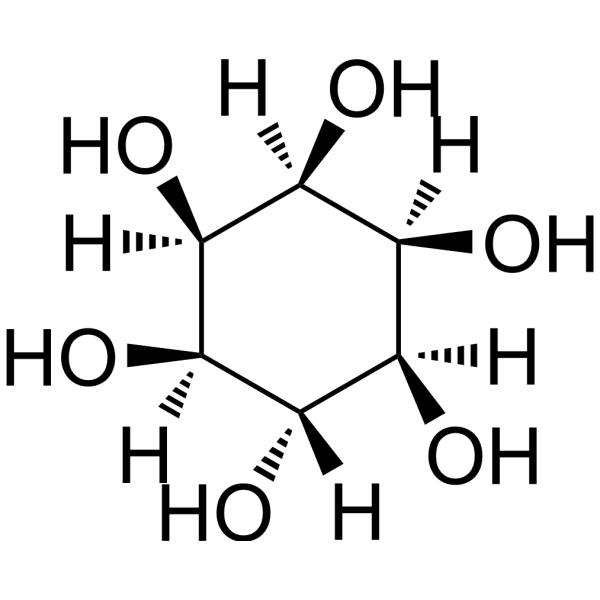
Physicochemical Properties
| Molecular Formula | C6H12O6 |
| Molecular Weight | 180.16 |
| Exact Mass | 180.063 |
| CAS # | 488-58-4 |
| PubChem CID | 892 |
| Appearance | White to off-white solid powder |
| Density | 2.0±0.1 g/cm3 |
| Boiling Point | 291.3±40.0 °C at 760 mmHg |
| Melting Point | 304°C(dec.)(lit.) |
| Flash Point | 143.4±21.9 °C |
| Vapour Pressure | 0.0±1.4 mmHg at 25°C |
| Index of Refraction | 1.784 |
| LogP | -2.11 |
| Hydrogen Bond Donor Count | 6 |
| Hydrogen Bond Acceptor Count | 6 |
| Rotatable Bond Count | 0 |
| Heavy Atom Count | 12 |
| Complexity | 104 |
| Defined Atom Stereocenter Count | 0 |
| InChi Key | CDAISMWEOUEBRE-UHFFFAOYSA-N |
| InChi Code | InChI=1S/C6H12O6/c7-1-2(8)4(10)6(12)5(11)3(1)9/h1-12H |
| Chemical Name | cyclohexane-1,2,3,4,5,6-hexol |
| HS Tariff Code | 2934.99.9001 |
| Storage |
Powder-20°C 3 years 4°C 2 years In solvent -80°C 6 months -20°C 1 month |
| Shipping Condition | Room temperature (This product is stable at ambient temperature for a few days during ordinary shipping and time spent in Customs) |
Biological Activity
| ln Vitro | Endogenous metabolites are those that the Kyoto Encyclopedia of Genes and Genomes has identified as products or substrates of the approximately 1900 metabolic enzymes that are encoded in human genome. Numerous of these metabolites have been shown to have harmful effects, as evidenced by the body of literature [1]. |
| ADME/Pharmacokinetics |
Absorption, Distribution and Excretion Inositol is absorbed from the small intestine. In patients with inositol deficiency, the maximal plasma concentration after oral administration of inositol is registered to be of 4 hours. Inositol is taken up by the tissues via sodium-dependent inositol co-transporter which also mediates glucose uptake. Oral ingestion of inositol is registered to generate a maximal plasma concentration of 36-45 mcg. Most of the administered dose is excreted in urine. The pharmacokinetic profile of inositol was studied in preterm infants and the estimated volume of distribution was reported to be 0.5115 L/kg. The pharmacokinetic profile of inositol was studied in preterm infants and the estimated clearance rate was reported to be 0.0679 L.kg/h. Metabolism / Metabolites It is thought that inositol is metabolized to phosphoinositol and then converted to phosphatylinositol-4,5-biphosphate which is a precursor of the second-messenger molecules. Inositol can be transformed to D-chiro-inositol via the actions of an epimerase. The normal modifications to inositol structure seem to be between all the different isomers. Biological Half-Life The pharmacokinetic profile of inositol was studied in preterm infants and the estimated elimination half-life was reported to be of 5.22 hours. |
| Toxicity/Toxicokinetics |
Protein Binding It is thought that inositol can be found bound to plasma proteins. |
| References |
[1]. Endogenous toxic metabolites and implications in cancer therapy. Oncogene. 2020 Aug;39(35):5709-5720. [2]. High cerebral scyllo-inositol: a new marker of brain metabolism disturbances induced by chronic alcoholism. MAGMA. 2004 Sep;17(1):47-61. |
| Additional Infomation |
Myo-inositol is an inositol having myo- configuration. It has a role as a member of compatible osmolytes, a nutrient, an EC 3.1.4.11 (phosphoinositide phospholipase C) inhibitor, a human metabolite, a Daphnia magna metabolite, a Saccharomyces cerevisiae metabolite, an Escherichia coli metabolite and a mouse metabolite. An isomer of glucose that has traditionally been considered to be a B vitamin although it has an uncertain status as a vitamin and a deficiency syndrome has not been identified in man. (From Martindale, The Extra Pharmacopoeia, 30th ed, p1379) Inositol phospholipids are important in signal transduction. Scyllitol has been investigated for the treatment of Alzheimer Disease. Inositol is a collection of nine different stereoisomers but the name is usually used to describe only the most common type of inositol, myo-inositol. Myo-inositol is the cis-1,2,3,5-trans-4,6-cyclohexanehexol and it is prepared from an aqueous extract of corn kernels by precipitation and hydrolysis of crude phytate. These molecules have structural similarities to glucose and are involved in cellular signaling. It is considered a pseudovitamin as it is a molecule that does not qualify to be an essential vitamin because even though its presence is vital in the body, a deficiency in this molecule does not translate into disease conditions. Inositol can be found as an ingredient of OTC products by Health Canada but all current product whose main ingredient is inositol are discontinued. By the FDA, inositol is considered in the list of specific substances affirmed as generally recognized as safe (GRAS). D-chiro-Inositol is under investigation in clinical trial NCT03201601 (Evaluation of the Mixture Myoinositol:D-chiro-inositol 3.6:1 in Women With Polycystic Ovary Syndrome). Myoinositol is a metabolite found in or produced by Escherichia coli (strain K12, MG1655). Inositol is a metabolite found in or produced by Escherichia coli (strain K12, MG1655). Inositol has been reported in Camellia sinensis, Maclura pomifera, and other organisms with data available. Scyllitol is a stereoisomer of inositol and a plant sugar alcohol found most abundantly in coconut palm trees, with potential amyloid plaque formation inhibitory activity. Following oral administration, scyllitol crosses the blood brain barrier and inhibits amyloid beta plaque formation in the brain through as of yet unknown mechanism(s). This may lead to reduced disease progression and improvement in cognitive function in patients with Alzheimer disease. Inositol is a natural sugar found in cell membrane phospholipids, plasma lipoproteins, and (as the phosphate form) in the nucleus with potential chemopreventive properties. As one of a number of intracellular phosphate compounds, inositol is involved in cell signaling and may stimulate tumor cell differentiation. (NCI04) D-chiro-inositol is an inositol isomer, that may potentially be used to increase insulin sensitivity and improve reproductive function. Upon oral administration, D-chiro-inositol may increase insulin sensitivity, improve glucose tolerance, and affect reproductive hormones and functions, and may modulate certain neurotransmitters. Myoinositol is a metabolite found in or produced by Saccharomyces cerevisiae. Drug Indication Inositol may be used in food without any limitation. As a drug, inositol is used as a nutrient supplement in special dietary foods and infant formula. As it presents a relevant role in ensuring oocyte fertility, inositol has been studied for its use in the management of polycystic ovaries. Inositol is also being researched for the treatment of diabetes, prevention of metabolic syndrome, aid agent for weight loss, treatment of depression, psychiatric disorder and anxiety disorder and for prevention of cancer. Mechanism of Action The mechanism of action of inositol in brain disorders is not fully understood but it is thought that it may be involved in neurotransmitter synthesis and it is a precursor to the phosphatidylinositol cycle. The change that occurs in the cycle simulates when the postsynaptic receptor is activated but without activating the receptor. This activity provokes a fake activation which regulated the activity of monoamines and other neurotransmitters. Reports have shown that insulin resistance plays a key role in the clinical development of PCOS. The presence of hyperinsulinemia can induce an excess in androgen production by stimulating ovaries to produce androgens and by reducing the sex hormone binding globulin serum levels. One of the mechanisms of insulin deficiency is thought to be related to a deficiency in inositol in the inositolphosphoglycans. The administration of inositol allows it to act as a direct messenger of the insulin signaling and improves glucose tissue uptake. This mechanism is extrapolated to its functions in diabetes treatment, metabolic syndrome, and weight loss. In cancer, the mechanism of action of inositol is not fully understood. It is hypothesized that the administration of inositol increases the level of lower-phosphate inositol phosphates why can affect cycle regulation, growth, and differentiation of malignant cells. On the other hand, the formation of inositol hexaphosphate after administration of inositol presents antioxidant characteristics by the chelation of ferric ions and suppression of hydroxyl radicals. |
Solubility Data
| Solubility (In Vitro) | May dissolve in DMSO (in most cases), if not, try other solvents such as H2O, Ethanol, or DMF with a minute amount of products to avoid loss of samples |
| Solubility (In Vivo) |
Note: Listed below are some common formulations that may be used to formulate products with low water solubility (e.g. < 1 mg/mL), you may test these formulations using a minute amount of products to avoid loss of samples. Injection Formulations (e.g. IP/IV/IM/SC) Injection Formulation 1: DMSO : Tween 80: Saline = 10 : 5 : 85 (i.e. 100 μL DMSO stock solution → 50 μL Tween 80 → 850 μL Saline) *Preparation of saline: Dissolve 0.9 g of sodium chloride in 100 mL ddH ₂ O to obtain a clear solution. Injection Formulation 2: DMSO : PEG300 :Tween 80 : Saline = 10 : 40 : 5 : 45 (i.e. 100 μL DMSO → 400 μLPEG300 → 50 μL Tween 80 → 450 μL Saline) Injection Formulation 3: DMSO : Corn oil = 10 : 90 (i.e. 100 μL DMSO → 900 μL Corn oil) Example: Take the Injection Formulation 3 (DMSO : Corn oil = 10 : 90) as an example, if 1 mL of 2.5 mg/mL working solution is to be prepared, you can take 100 μL 25 mg/mL DMSO stock solution and add to 900 μL corn oil, mix well to obtain a clear or suspension solution (2.5 mg/mL, ready for use in animals). Injection Formulation 4: DMSO : 20% SBE-β-CD in saline = 10 : 90 [i.e. 100 μL DMSO → 900 μL (20% SBE-β-CD in saline)] *Preparation of 20% SBE-β-CD in Saline (4°C,1 week): Dissolve 2 g SBE-β-CD in 10 mL saline to obtain a clear solution. Injection Formulation 5: 2-Hydroxypropyl-β-cyclodextrin : Saline = 50 : 50 (i.e. 500 μL 2-Hydroxypropyl-β-cyclodextrin → 500 μL Saline) Injection Formulation 6: DMSO : PEG300 : castor oil : Saline = 5 : 10 : 20 : 65 (i.e. 50 μL DMSO → 100 μLPEG300 → 200 μL castor oil → 650 μL Saline) Injection Formulation 7: Ethanol : Cremophor : Saline = 10: 10 : 80 (i.e. 100 μL Ethanol → 100 μL Cremophor → 800 μL Saline) Injection Formulation 8: Dissolve in Cremophor/Ethanol (50 : 50), then diluted by Saline Injection Formulation 9: EtOH : Corn oil = 10 : 90 (i.e. 100 μL EtOH → 900 μL Corn oil) Injection Formulation 10: EtOH : PEG300:Tween 80 : Saline = 10 : 40 : 5 : 45 (i.e. 100 μL EtOH → 400 μLPEG300 → 50 μL Tween 80 → 450 μL Saline) Oral Formulations Oral Formulation 1: Suspend in 0.5% CMC Na (carboxymethylcellulose sodium) Oral Formulation 2: Suspend in 0.5% Carboxymethyl cellulose Example: Take the Oral Formulation 1 (Suspend in 0.5% CMC Na) as an example, if 100 mL of 2.5 mg/mL working solution is to be prepared, you can first prepare 0.5% CMC Na solution by measuring 0.5 g CMC Na and dissolve it in 100 mL ddH2O to obtain a clear solution; then add 250 mg of the product to 100 mL 0.5% CMC Na solution, to make the suspension solution (2.5 mg/mL, ready for use in animals). Oral Formulation 3: Dissolved in PEG400 Oral Formulation 4: Suspend in 0.2% Carboxymethyl cellulose Oral Formulation 5: Dissolve in 0.25% Tween 80 and 0.5% Carboxymethyl cellulose Oral Formulation 6: Mixing with food powders Note: Please be aware that the above formulations are for reference only. InvivoChem strongly recommends customers to read literature methods/protocols carefully before determining which formulation you should use for in vivo studies, as different compounds have different solubility properties and have to be formulated differently. (Please use freshly prepared in vivo formulations for optimal results.) |
| Preparing Stock Solutions | 1 mg | 5 mg | 10 mg | |
| 1 mM | 5.5506 mL | 27.7531 mL | 55.5062 mL | |
| 5 mM | 1.1101 mL | 5.5506 mL | 11.1012 mL | |
| 10 mM | 0.5551 mL | 2.7753 mL | 5.5506 mL |