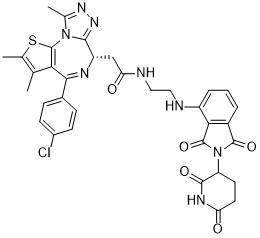
dBET57 is a novel BRD4 heterobifunctional small-molecule ligand (PROTAC) which exhibits significant and selective degradation of BRD4 BD1 but is inactive on BRD4 BD2.
Physicochemical Properties
| Molecular Formula | C34H31CLN8O5S |
| Molecular Weight | 699.178544282913 |
| Exact Mass | 698.182 |
| Elemental Analysis | C, 58.41; H, 4.47; Cl, 5.07; N, 16.03; O, 11.44; S, 4.59 |
| CAS # | 1883863-52-2 |
| Related CAS # | 1883863-52-2 |
| PubChem CID | 118912822 |
| Appearance | Typically exists as Light yellow to yellow solids at room temperature |
| LogP | 3.7 |
| Hydrogen Bond Donor Count | 3 |
| Hydrogen Bond Acceptor Count | 10 |
| Rotatable Bond Count | 8 |
| Heavy Atom Count | 49 |
| Complexity | 1380 |
| Defined Atom Stereocenter Count | 1 |
| SMILES | CC1=C(SC2=C1C(=N[C@H](C3=NN=C(N32)C)CC(=O)NCCNC4=CC=CC5=C4C(=O)N(C5=O)C6CCC(=O)NC6=O)C7=CC=C(C=C7)Cl)C |
| InChi Key | CZRLOIDJCMKJHE-UXMRNZNESA-N |
| InChi Code | InChI=1S/C34H31ClN8O5S/c1-16-17(2)49-34-27(16)29(19-7-9-20(35)10-8-19)38-23(30-41-40-18(3)42(30)34)15-26(45)37-14-13-36-22-6-4-5-21-28(22)33(48)43(32(21)47)24-11-12-25(44)39-31(24)46/h4-10,23-24,36H,11-15H2,1-3H3,(H,37,45)(H,39,44,46)/t23-,24?/m0/s1 |
| Chemical Name | 2-((S)-4-(4-chlorophenyl)-2,3,9-trimethyl-6H-thieno[3,2-f][1,2,4]triazolo[4,3-a][1,4]diazepin-6-yl)-N-(2-((2-(2,6-dioxopiperidin-3-yl)-1,3-dioxoisoindolin-4-yl)amino)ethyl)acetamide |
| Synonyms | dBET57;dBET-57; dBET57; 1883863-52-2; 2-((S)-4-(4-chlorophenyl)-2,3,9-trimethyl-6H-thieno[3,2-f][1,2,4]triazolo[4,3-a][1,4]diazepin-6-yl)-N-(2-((2-(2,6-dioxopiperidin-3-yl)-1,3-dioxoisoindolin-4-yl)amino)ethyl)acetamide; 2-[(9S)-7-(4-chlorophenyl)-4,5,13-trimethyl-3-thia-1,8,11,12-tetrazatricyclo[8.3.0.02,6]trideca-2(6),4,7,10,12-pentaen-9-yl]-N-[2-[[2-(2,6-dioxopiperidin-3-yl)-1,3-dioxoisoindol-4-yl]amino]ethyl]acetamide; dBET57?; CHEMBL5180012; SCHEMBL17553391; TQP1624; dBET 57 |
| HS Tariff Code | 2934.99.9001 |
| Storage |
Powder-20°C 3 years 4°C 2 years In solvent -80°C 6 months -20°C 1 month Note: This product requires protection from light (avoid light exposure) during transportation and storage. |
| Shipping Condition | Room temperature (This product is stable at ambient temperature for a few days during ordinary shipping and time spent in Customs) |
Biological Activity
| Targets | BRD4BD1 (DC50/5h = 500 nM)[1]; DC50: half-maximal degradation concentration, at the half-maximal degradation concentration that degrades 50% of the target protein. |
| ln Vitro | We found that dBET6 (DC50/5h ~ 10 nM, with DC50/5h referring to half-maximal degradation after 5 hours of treatment), dBET23 (DC50/5h ~ 50 nM) and dBET70 (DC50/5h ~ 5 nM) exhibit the most potent effects on BRD4BD1 protein levels, followed by dBET1 (8) (DC50/5h ~ 500 nM) and dBET57 (DC50/5h ~ 500 nM) (Fig. 3a and Supplementary Fig. 4). For BRD4BD2, dBET70 (DC50/5h ~ 5 nM) has the most pronounced effects, followed by dBET6 (DC50/5h ~ 50 nM), dBET23 (DC50/5h > 1 μM) and dBET1 (DC50/5h ~ 1 μM). dBET57 , which exhibits significant degradation of BRD4BD1, is inactive on BRD4BD2 (Fig. 3b and Supplementary Fig. 4). The cellular activity is thus largely proportional to the observed cooperativity factors (Supplementary Fig. 3), and dBET57 was found remarkably selective for BRD4BD1 in biochemical and cellular assays (Fig. 2e and Fig. 3a, b).[1] |
| Enzyme Assay | We also note that molecules with short linkers, such as dBET57, would not be able to dimerize CRBN and BRD4 in the conformation observed in the CRBN-dBET23-BRD4BD1 structure since a minimum of 8 carbons would be required to bridge the E3-moeity with the target-moiety and dBET57 comprises a 2-carbon linker (Supplementary Fig. 5c). We therefore asked whether degrader molecules incompatible with the observed binding mode, such as dBET57 or dBET1, would bind in a different overall conformation. To explore potential differences in binding, we conducted mutational analysis. A set of single amino acid point mutations was introduced in CRBN and BRD4BD1 to obtain a mutational signature of binding. These CRBN mutations were previously shown to bind thalidomide with comparable affinities, except for the IMiD-binding deficient (IBD) control (CRBNP353G W386A)17. When comparing the mutational signatures of different degraders, we find that while dBET6 and 23 share similar profiles (Fig. 4a – c and Supplementary Fig. 2 and and5),5), the mutational signatures of dBET1 and dBET57 are distinct (Fig. 4d – f and Supplementary Fig. 5), consistent with distinct binding surfaces of dBET6/23 and dBET57 (Fig. 4b, e). This suggests that different degrader molecules – depending on linker length and linkage position – result in distinct binding conformations of CRBN-BRD4 complex formation. |
| References |
[1]. Plasticity in binding confers selectivity in ligand-induced protein degradation. Nat Chem Biol. 2018 Jul;14(7):706-714. |
| Additional Infomation |
Heterobifunctional small molecule degraders that induce protein degradation through ligase-mediated ubiquitination have shown considerable promise as a new pharmacological modality. However, we currently lack a detailed understanding of the molecular basis for target recruitment and selectivity, which is critically required to enable rational design of degraders. Here we utilize comprehensive characterization of the ligand dependent CRBN/BRD4 interaction to demonstrate that binding between proteins that have not evolved to interact is plastic. Multiple X-ray crystal structures show that plasticity results in several distinct low energy binding conformations, which are selectively bound by ligands. We demonstrate that computational protein-protein docking can reveal the underlying inter-protein contacts and inform the design of a BRD4 selective degrader that can discriminate between highly homologous BET bromodomains. Our findings that plastic inter-protein contacts confer selectivity for ligand-induced protein dimerization provide a conceptual framework for the development of heterobifunctional ligands.[1] PROTACs or heterobifunctional degrader molecules (hereafter referred to as degraders) typically comprise an E3 ligase binding scaffold (hereafter E3-moiety), often an analogue of thalidomide, or a ligand to the von Hippel-Lindau tumour suppressor (VHL) protein, attached through a linker to another small molecule (hereafter target-moiety) that binds a target protein of interest. Recruitment of this target protein to the E3 ubiquitin ligase facilitates ubiquitination and subsequent degradation of the target protein. This principle has been successfully applied to several targets including the Bromodomain and Extra Terminal (BET) family (BRD2, BRD3, BRD4), RIPK2, BCR-ABL, FKBP12, BRD9, and ERRα and represents a promising new pharmacologic modality now widely explored in chemical biology and drug discovery. |
Solubility Data
| Solubility (In Vitro) | DMSO : ~250 mg/mL (~357.56 mM) |
| Solubility (In Vivo) |
Solubility in Formulation 1: ≥ 2.08 mg/mL (2.97 mM) (saturation unknown) in 10% DMSO + 40% PEG300 +5% Tween-80 + 45% Saline (add these co-solvents sequentially from left to right, and one by one), clear solution. For example, if 1 mL of working solution is to be prepared, you can add 100 μL of 20.8 mg/mL clear DMSO stock solution to 400 μL PEG300 and mix evenly; then add 50 μL Tween-80 + to the above solution and mix evenly; then add 450 μL normal saline to adjust the volume to 1 mL. Preparation of saline: Dissolve 0.9 g of sodium chloride in 100 mL ddH₂ O to obtain a clear solution. (Please use freshly prepared in vivo formulations for optimal results.) |
| Preparing Stock Solutions | 1 mg | 5 mg | 10 mg | |
| 1 mM | 1.4302 mL | 7.1512 mL | 14.3025 mL | |
| 5 mM | 0.2860 mL | 1.4302 mL | 2.8605 mL | |
| 10 mM | 0.1430 mL | 0.7151 mL | 1.4302 mL |