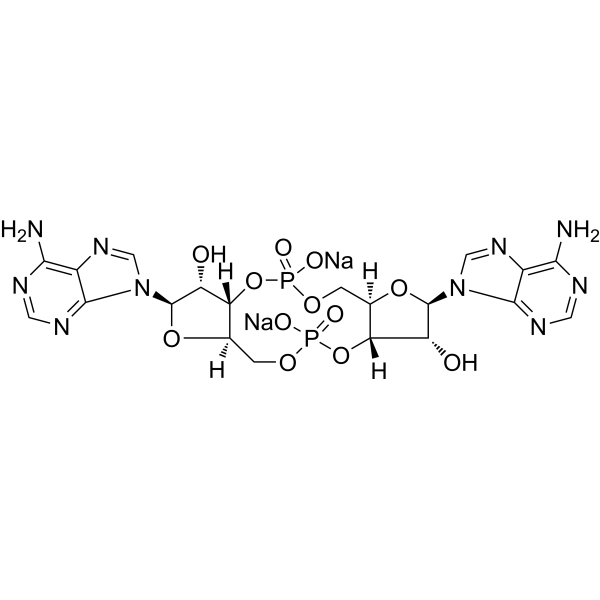
Physicochemical Properties
| Molecular Formula | C20H25N10NAO12P2 |
| Molecular Weight | 682.409595251083 |
| Exact Mass | 702.068 |
| CAS # | 2734909-87-4 |
| Related CAS # | c-di-AMP diammonium;c-di-AMP;54447-84-6 |
| PubChem CID | 122714672 |
| Appearance | White to off-white solid powder |
| Hydrogen Bond Donor Count | 4 |
| Hydrogen Bond Acceptor Count | 20 |
| Rotatable Bond Count | 2 |
| Heavy Atom Count | 46 |
| Complexity | 1070 |
| Defined Atom Stereocenter Count | 8 |
| SMILES | O[C@@H]1[C@]2([H])OP(OC[C@@]3([H])O[C@@H](N4C=NC5=C(N=CN=C45)N)[C@H](O)[C@]3([H])OP(O)(=O)OC[C@@]2([H])O[C@H]1N1C=NC2=C(N=CN=C12)N)(O)=O.[NaH] |
| InChi Key | IXWPEIRAKLMJQW-VEQUCWRQSA-L |
| InChi Code | InChI=1S/C20H24N10O12P2.2Na/c21-15-9-17(25-3-23-15)29(5-27-9)19-11(31)13-7(39-19)1-37-43(33,34)42-14-8(2-38-44(35,36)41-13)40-20(12(14)32)30-6-28-10-16(22)24-4-26-18(10)30;;/h3-8,11-14,19-20,31-32H,1-2H2,(H,33,34)(H,35,36)(H2,21,23,25)(H2,22,24,26);;/q;2*+1/p-2/t7-,8-,11-,12-,13-,14-,19-,20-;;/m1../s1 |
| Chemical Name | disodium;(1S,6R,8R,9R,10S,15R,17R,18R)-8,17-bis(6-aminopurin-9-yl)-3,12-dioxido-3,12-dioxo-2,4,7,11,13,16-hexaoxa-3λ5,12λ5-diphosphatricyclo[13.3.0.06,10]octadecane-9,18-diol |
| HS Tariff Code | 2934.99.9001 |
| Storage |
Powder-20°C 3 years 4°C 2 years In solvent -80°C 6 months -20°C 1 month Note: (1). This product requires protection from light (avoid light exposure) during transportation and storage.(2). Please store this product in a sealed and protected environment (e.g. under nitrogen), avoid exposure to moisture. |
| Shipping Condition | Room temperature (This product is stable at ambient temperature for a few days during ordinary shipping and time spent in Customs) |
Biological Activity
| ln Vitro | In many Gram-positive bacteria, the manufacture of cell walls, potassium channels, DNA repair, and the formation of biofilms are all regulated by c-di-AMP (cyclic diadenylate) sodium signaling. A number of well-known human pathogenic bacteria, such as Staphylococcus aureus, Listeria monocytogenes, Streptococcus pyogenes, and Mycobacterium spp., depend on sodium c-di-AMP for cell growth, survival, and virulence. It's quite significant [1]. When combined with model antigens like OVA or β-Gal, c-di-AMP sodium functions as a strong mucosal adjuvant that stimulates cellular and humoral responses [4]. |
| References |
[1]. c-di-AMP: An Essential Molecule in the Signaling Pathways that Regulate the Viability and Virulenceof Gram-Positive Bacteria. Genes (Basel). 2017 Aug 7;8(8). [2]. Recombinant BCG With Bacterial Signaling Molecule Cyclic di-AMP as Endogenous AdjuvantInduces Elevated Immune Responses After Mycobacterium tuberculosis Infection. Front Immunol. 2019 Jul 3;10:1519. [3]. The Combination Vaccine Adjuvant System Alum/c-di-AMP Results in Quantitative and QualitativeEnhanced Immune Responses Post Immunization. Front Cell Infect Microbiol. 2019 Feb 19;9:31. [4]. Intranasal delivery of influenza rNP adjuvanted with c-di-AMP induces strong humoral and cellularimmune responses and provides protection against virus challenge. PLoS One. 2014 Aug 20;9(8):e104824. |
Solubility Data
| Solubility (In Vitro) |
DMSO : ~270 mg/mL (~384.41 mM) H2O : ≥ 50 mg/mL (~71.19 mM) |
| Solubility (In Vivo) |
Solubility in Formulation 1: ≥ 6.75 mg/mL (9.61 mM) (saturation unknown) in 10% DMSO + 40% PEG300 + 5% Tween80 + 45% Saline (add these co-solvents sequentially from left to right, and one by one), clear solution. For example, if 1 mL of working solution is to be prepared, you can add 100 μL of 67.5 mg/mL clear DMSO stock solution to 400 μL PEG300 and mix evenly; then add 50 μL Tween-80 to the above solution and mix evenly; then add 450 μL normal saline to adjust the volume to 1 mL. Preparation of saline: Dissolve 0.9 g of sodium chloride in 100 mL ddH₂ O to obtain a clear solution. Solubility in Formulation 2: ≥ 6.75 mg/mL (9.61 mM) (saturation unknown) in 10% DMSO + 90% (20% SBE-β-CD in Saline) (add these co-solvents sequentially from left to right, and one by one), clear solution. For example, if 1 mL of working solution is to be prepared, you can add 100 μL of 67.5 mg/mL clear DMSO stock solution to 900 μL of 20% SBE-β-CD physiological saline solution and mix evenly. Preparation of 20% SBE-β-CD in Saline (4°C,1 week): Dissolve 2 g SBE-β-CD in 10 mL saline to obtain a clear solution. Solubility in Formulation 3: ≥ 6.75 mg/mL (9.61 mM) (saturation unknown) in 10% DMSO + 90% Corn Oil (add these co-solvents sequentially from left to right, and one by one), clear solution. For example, if 1 mL of working solution is to be prepared, you can add 100 μL of 67.5 mg/mL clear DMSO stock solution to 900 μL of corn oil and mix evenly. (Please use freshly prepared in vivo formulations for optimal results.) |
| Preparing Stock Solutions | 1 mg | 5 mg | 10 mg | |
| 1 mM | 1.4654 mL | 7.3270 mL | 14.6539 mL | |
| 5 mM | 0.2931 mL | 1.4654 mL | 2.9308 mL | |
| 10 mM | 0.1465 mL | 0.7327 mL | 1.4654 mL |