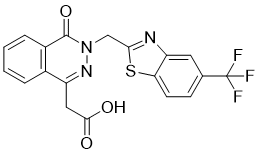
Zopolrestat (CP-73850; CP73850) is a novel and potent aldose reductase inhibitor (IC50 = 3.1 nM) with the potential for the treatment of diabetic nephropathy and diabetes.
Physicochemical Properties
| Molecular Formula | C19H12F3N3O3S |
| Molecular Weight | 419.3782 |
| Exact Mass | 419.055 |
| CAS # | 110703-94-1 |
| PubChem CID | 1613 |
| Appearance | White to off-white solid powder |
| Density | 1.58g/cm3 |
| Boiling Point | 598.7ºC at 760mmHg |
| Flash Point | 315.9ºC |
| Vapour Pressure | 3.5E-15mmHg at 25°C |
| Index of Refraction | 1.683 |
| LogP | 3.7 |
| Hydrogen Bond Donor Count | 1 |
| Hydrogen Bond Acceptor Count | 9 |
| Rotatable Bond Count | 4 |
| Heavy Atom Count | 29 |
| Complexity | 702 |
| Defined Atom Stereocenter Count | 0 |
| InChi Key | BCSVCWVQNOXFGL-UHFFFAOYSA-N |
| InChi Code | InChI=1S/C19H12F3N3O3S/c20-19(21,22)10-5-6-15-14(7-10)23-16(29-15)9-25-18(28)12-4-2-1-3-11(12)13(24-25)8-17(26)27/h1-7H,8-9H2,(H,26,27) |
| Chemical Name | 2-(4-oxo-3-((5-(trifluoromethyl)benzo[d]thiazol-2-yl)methyl)-3,4-dihydrophthalazin-1-yl)acetic acid |
| Synonyms | CP-73850 CP73850 CP 73850 |
| HS Tariff Code | 2934.99.9001 |
| Storage |
Powder-20°C 3 years 4°C 2 years In solvent -80°C 6 months -20°C 1 month Note: This product requires protection from light (avoid light exposure) during transportation and storage. |
| Shipping Condition | Room temperature (This product is stable at ambient temperature for a few days during ordinary shipping and time spent in Customs) |
Biological Activity
| ln Vitro | Zopolrestat is an effective inhibitor of human and rat enzymes that degrade glyceraldehyde and glucose [1]. |
| ln Vivo | In diabetic rats, zoleprestat (oral; 2.5 mg/kg–50 mg/kg; once daily for 5 days, followed by 7 days of recovery) enhances galactosemia and normalizes renal blood flow while preventing sorbitol accumulation in the renal cortex [1]. |
| Animal Protocol |
Animal/Disease Models: Male SD (Sprague-Dawley) rats (made diabetic by iv injection of streptozotocin)[1]. Doses: 2.5 mg/kg-50 mg/kg Route of Administration: Po; once-a-day for 5 days Experimental Results: Its ED50s in reversing already elevated sorbitol accumulation in rat sciatic nerve, retina, and lens in a chronic test were 1.9, 17.6, and 18.4 mg/kg, respectively. |
| References |
[1]. Novel, potent aldose reductase inhibitors: 3,4-dihydro-4-oxo-3-[[5-(trifluoromethyl)-2-benzothiazolyl] methyl]-1-phthalazineacetic acid (zopolrestat) and congeners. J Med Chem. 1991;34(1):108-122. |
Solubility Data
| Solubility (In Vitro) | DMSO : ~100 mg/mL (~238.45 mM) |
| Solubility (In Vivo) |
Solubility in Formulation 1: ≥ 0.83 mg/mL (1.98 mM) (saturation unknown) in 10% DMSO + 40% PEG300 + 5% Tween80 + 45% Saline (add these co-solvents sequentially from left to right, and one by one), clear solution. For example, if 1 mL of working solution is to be prepared, you can add 100 μL of 8.3 mg/mL clear DMSO stock solution to 400 μL of PEG300 and mix evenly; then add 50 μL of Tween-80 to the above solution and mix evenly; then add 450 μL of normal saline to adjust the volume to 1 mL. Preparation of saline: Dissolve 0.9 g of sodium chloride in 100 mL ddH₂ O to obtain a clear solution. Solubility in Formulation 2: ≥ 0.83 mg/mL (1.98 mM) (saturation unknown) in 10% DMSO + 90% (20% SBE-β-CD in Saline) (add these co-solvents sequentially from left to right, and one by one), clear solution. For example, if 1 mL of working solution is to be prepared, you can add 100 μL of 8.3 mg/mL clear DMSO stock solution to 900 μL of 20% SBE-β-CD physiological saline solution and mix evenly. Preparation of 20% SBE-β-CD in Saline (4°C,1 week): Dissolve 2 g SBE-β-CD in 10 mL saline to obtain a clear solution. Solubility in Formulation 3: ≥ 0.83 mg/mL (1.98 mM) (saturation unknown) in 10% DMSO + 90% Corn Oil (add these co-solvents sequentially from left to right, and one by one), clear solution. For example, if 1 mL of working solution is to be prepared, you can add 100 μL of 8.3 mg/mL clear DMSO stock solution to 900 μL of corn oil and mix evenly. Solubility in Formulation 4: 20 mg/mL (47.69 mM) in 50% PEG300 50% Saline (add these co-solvents sequentially from left to right, and one by one), suspension solution; with ultrasonication. Preparation of saline: Dissolve 0.9 g of sodium chloride in 100 mL ddH₂ O to obtain a clear solution. (Please use freshly prepared in vivo formulations for optimal results.) |
| Preparing Stock Solutions | 1 mg | 5 mg | 10 mg | |
| 1 mM | 2.3845 mL | 11.9224 mL | 23.8447 mL | |
| 5 mM | 0.4769 mL | 2.3845 mL | 4.7689 mL | |
| 10 mM | 0.2384 mL | 1.1922 mL | 2.3845 mL |