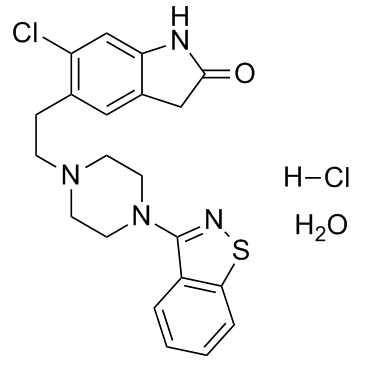
Ziprasidone HCl hydrate (CP88059) is a combined 5-HT (serotonin) and dopamine receptor antagonist that is licensed for the treatment of schizophrenia, has antipsychotic activity.
Physicochemical Properties
| Molecular Formula | C21H24CL2N4O2S |
| Molecular Weight | 467.409 |
| Exact Mass | 466.099 |
| Elemental Analysis | C, 53.96; H, 5.18; Cl, 15.17; N, 11.99; O, 6.85; S, 6.86 |
| CAS # | 138982-67-9 |
| Related CAS # | Ziprasidone; 146939-27-7; Ziprasidone-d8; 1126745-58-1; Ziprasidone hydrochloride;122883-93-6; Ziprasidone mesylate trihydrate; 199191-69-0 |
| PubChem CID | 60853 |
| Appearance | Pink to red solid powder |
| Boiling Point | 554.8ºC at 760 mmHg |
| Melting Point | 300°C |
| Vapour Pressure | 2.38E-12mmHg at 25°C |
| LogP | 4.687 |
| Hydrogen Bond Donor Count | 3 |
| Hydrogen Bond Acceptor Count | 6 |
| Rotatable Bond Count | 4 |
| Heavy Atom Count | 30 |
| Complexity | 573 |
| Defined Atom Stereocenter Count | 0 |
| SMILES | ClC1C([H])=C2C(C([H])([H])C(N2[H])=O)=C([H])C=1C([H])([H])C([H])([H])N1C([H])([H])C([H])([H])N(C2C3=C([H])C([H])=C([H])C([H])=C3SN=2)C([H])([H])C1([H])[H] |
| InChi Key | ZCBZSCBNOOIHFP-UHFFFAOYSA-N |
| InChi Code | InChI=1S/C21H21ClN4OS.ClH.H2O/c22-17-13-18-15(12-20(27)23-18)11-14(17)5-6-25-7-9-26(10-8-25)21-16-3-1-2-4-19(16)28-24-21;;/h1-4,11,13H,5-10,12H2,(H,23,27);1H;1H2 |
| Chemical Name | 5-[2-[4-(1,2-benzothiazol-3-yl)piperazin-1-yl]ethyl]-6-chloro-1,3-dihydroindol-2-one;hydrate;hydrochloride |
| Synonyms | Ziprasidone HCl; Ziprasidone HCl hydrate; CP-88,059; CP-88,059-01; CP88059; CP-88059; CP 88059; CP88059 hydrochloride |
| HS Tariff Code | 2934.99.9001 |
| Storage |
Powder-20°C 3 years 4°C 2 years In solvent -80°C 6 months -20°C 1 month Note: Please store this product in a sealed and protected environment (e.g. under nitrogen), avoid exposure to moisture and light. |
| Shipping Condition | Room temperature (This product is stable at ambient temperature for a few days during ordinary shipping and time spent in Customs) |
Biological Activity
| Targets | Rat 5-HT2A ( Ki = 0.42 nM ); Rat 5-HT1A Receptor ( Ki = 3.4 nM ); Rat D2 Receptor ( Ki = 4.8 nM ) |
| ln Vitro | Ziprasidone hydrochloride monohydrate (0-500 nM, 150 seconds) blocks wild-type hERG currents [2]. Cell Viability Assay[2] Cell Line: HEK-293 Cell Concentration: 0-500 nM Incubation Time: 150 sec Results: Blocks wild-type hERG current (IC50 = 120 nm) in a voltage- and concentration-dependent manner. |
| ln Vivo | Ziprasidone hydrochloride monohydrate (oral gavage; 20 mg/kg; once daily; 7 weeks) results in weight loss, lower physical activity levels, higher resting energy expenditure, and increased thermogenesis in the cold [3] . Animal model: 8-week-old female Sprague-Dawley rats, weighing 200 to 250 g[3] Dosage: 20 mg/kg Administration method: oral gavage; 20 mg/kg; once a day; 7-week results: significant weight loss (P = 0.031), had lower levels of physical activity (P = 0.016), had higher resting energy expenditure (P < 0.001), and showed greater thermogenic capacity when cold (P < 0.001). |
| Toxicity/Toxicokinetics |
Effects During Pregnancy and Lactation ◉ Summary of Use during Lactation Because there is little published experience with ziprasidone during breastfeeding, other antipsychotic agents may be preferred, especially while nursing a newborn or preterm infant. A safety scoring system finds ziprasidone possible to use cautiously during breastfeeding. Infants breastfed during maternal use of ziprasidone should be monitored for excess sedation, irritability, poor feeding, and extrapyramidal symptoms, such as tremors and abnormal muscle movements. ◉ Effects in Breastfed Infants A woman took ziprasidone 40 mg and citalopram 60 mg daily throughout pregnancy and postpartum. She breastfed extensively, except for occasional formula feedings by others. At 6 months of age, a pediatrician found the infant to be healthy with normal growth and development. Patients enlisted in the National Pregnancy Registry for Atypical Antipsychotics who were taking a second-generation antipsychotic drug while breastfeeding (n = 576) were compared to control breastfeeding patients who were not treated with a second-generation antipsychotic (n = 818). Of the patients who were taking a second-generation antipsychotic drug, 60.4% were on more than one psychotropic. A review of the pediatric medical records, no adverse effects were noted among infants exposed or not exposed to second-generation antipsychotic monotherapy or to polytherapy. The number of women taking ziprasidone was not reported. ◉ Effects on Lactation and Breastmilk Prolactin elevation has occurred during ziprasidone treatment, and galactorrhea has been reported, often in adolescents. However, prolactin elevation might be more transient and less severe than with phenothiazines. The prolactin level in a mother with established lactation may not affect her ability to breastfeed. Patients enlisted in the National Pregnancy Registry for Atypical Antipsychotics who were taking a second-generation antipsychotic drug while breastfeeding (n = 576) were compared to control breastfeeding patients who had primarily diagnoses of major depressive disorder and anxiety disorders, most often treated with SSRI or SNRI antidepressants, but not with a second-generation antipsychotic (n = 818). Among women on a second-generation antipsychotic, 60.4% were on more than one psychotropic compared with 24.4% among women in the control group. Of the women on a second-generation antipsychotic, 59.3% reported “ever breastfeeding” compared to 88.2% of women in the control group. At 3 months postpartum, 23% of women on a second-generation antipsychotic were exclusively breastfeeding compared to 47% of women in the control group. The number of women taking ziprasidone was not reported. |
| References |
[1]. 5-HT(1A) receptor activation contributes to ziprasidone-induced dopamine release in the rat prefrontal cortex. Biol Psychiatry. 2000;48(3):229-237. [2]. Block of hERG channel by ziprasidone: biophysical properties and molecular determinants. Biochem Pharmacol. 2006 Jan 12;71(3):278-86. [3]. The effect of ziprasidone on body weight and energy expenditure in female rats. Metabolism. 2012 Jun;61(6):787-93. |
| Additional Infomation | See also: Ziprasidone Hydrochloride (annotation moved to). |
Solubility Data
| Solubility (In Vitro) | DMSO: ~25 mg/mL (~53.5 mM) |
| Solubility (In Vivo) |
Solubility in Formulation 1: ≥ 2.5 mg/mL (5.35 mM) (saturation unknown) in 10% DMSO + 40% PEG300 + 5% Tween80 + 45% Saline (add these co-solvents sequentially from left to right, and one by one), clear solution. For example, if 1 mL of working solution is to be prepared, you can add 100 μL of 25.0 mg/mL clear DMSO stock solution to 400 μL PEG300 and mix evenly; then add 50 μL Tween-80 to the above solution and mix evenly; then add 450 μL normal saline to adjust the volume to 1 mL. Preparation of saline: Dissolve 0.9 g of sodium chloride in 100 mL ddH₂ O to obtain a clear solution. Solubility in Formulation 2: 2.5 mg/mL (5.35 mM) in 10% DMSO + 90% (20% SBE-β-CD in Saline) (add these co-solvents sequentially from left to right, and one by one), suspension solution; with ultrasonication. For example, if 1 mL of working solution is to be prepared, you can add 100 μL of 25.0 mg/mL clear DMSO stock solution to 900 μL of 20% SBE-β-CD physiological saline solution and mix evenly. Preparation of 20% SBE-β-CD in Saline (4°C,1 week): Dissolve 2 g SBE-β-CD in 10 mL saline to obtain a clear solution. (Please use freshly prepared in vivo formulations for optimal results.) |
| Preparing Stock Solutions | 1 mg | 5 mg | 10 mg | |
| 1 mM | 2.1394 mL | 10.6972 mL | 21.3945 mL | |
| 5 mM | 0.4279 mL | 2.1394 mL | 4.2789 mL | |
| 10 mM | 0.2139 mL | 1.0697 mL | 2.1394 mL |