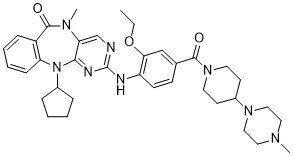
XMD17-109 (XMD-17-109), a pyrimido-diazepinone analog, is a novel, potent, specific, cell-permeable and ATP-competitive inhibitor of ERK-5 with important biological/anticancer activity. In HEK293 cells, it has an EC50 of 4.2 μM and inhibits ERK-5. In cellular assays, XMD17-109 is able to prevent ERK5 from becoming autophosphorylated. The pharmacokinetic characteristics of XMD17-109 when administered to mice orally and intravenously are as follows: the oral bioavailability is 90%, the oral clearance is 15745 h*ng/mL, the plasma clearance is 8.64 mL/min/Kg, and the T1/2 is 8.2 h.
Physicochemical Properties
| Molecular Formula | C36H46N8O3 | |
| Molecular Weight | 638.81 | |
| Exact Mass | 638.369 | |
| Elemental Analysis | C, 67.69; H, 7.26; N, 17.54; O, 7.51 | |
| CAS # | 1435488-37-1 | |
| Related CAS # |
|
|
| PubChem CID | 71604307 | |
| Appearance | White to beige solid powder | |
| Density | 1.3±0.1 g/cm3 | |
| Boiling Point | 831.6±75.0 °C at 760 mmHg | |
| Flash Point | 456.8±37.1 °C | |
| Vapour Pressure | 0.0±3.0 mmHg at 25°C | |
| Index of Refraction | 1.640 | |
| LogP | 2.39 | |
| Hydrogen Bond Donor Count | 1 | |
| Hydrogen Bond Acceptor Count | 9 | |
| Rotatable Bond Count | 7 | |
| Heavy Atom Count | 47 | |
| Complexity | 1060 | |
| Defined Atom Stereocenter Count | 0 | |
| SMILES | O=C1C2=C(C=CC=C2)N(C3CCCC3)C4=NC(NC5=C(OCC)C=C(C(N6CCC(N7CCN(C)CC7)CC6)=O)C=C5)=NC=C4N1C |
|
| InChi Key | XVBGRTMNFNMINE-UHFFFAOYSA-N | |
| InChi Code | InChI=1S/C36H46N8O3/c1-4-47-32-23-25(34(45)43-17-15-26(16-18-43)42-21-19-40(2)20-22-42)13-14-29(32)38-36-37-24-31-33(39-36)44(27-9-5-6-10-27)30-12-8-7-11-28(30)35(46)41(31)3/h7-8,11-14,23-24,26-27H,4-6,9-10,15-22H2,1-3H3,(H,37,38,39) | |
| Chemical Name | 11-cyclopentyl-2-[2-ethoxy-4-[4-(4-methylpiperazin-1-yl)piperidine-1-carbonyl]anilino]-5-methylpyrimido[4,5-b][1,4]benzodiazepin-6-one | |
| Synonyms |
|
|
| HS Tariff Code | 2934.99.9001 | |
| Storage |
Powder-20°C 3 years 4°C 2 years In solvent -80°C 6 months -20°C 1 month |
|
| Shipping Condition | Room temperature (This product is stable at ambient temperature for a few days during ordinary shipping and time spent in Customs) |
Biological Activity
| Targets | ERK5 (IC50 = 162 nM); LRRK2[G2019S] (IC50 = 339 nM) | ||
| ln Vitro | XMD17-109 (Compound 26) blocks pidermal growth factor-induced ERK5 autophosphorylation in cells with an EC50 of 0.09 ± 0.03 μM and inhibits ERK5 biochemically with an IC50 of 0.162 0.006 M. Additionally, XMD17-109 blocks LRRK2[G2019S] with an IC50 value of 339 nM[1]. By significantly dose-dependently reducing the mobility shifted phosphorylated ERK5 bands from sorbitol stimulated cells, XMD17-109 demonstrates low nanomolar cellular activity. At 30 M and an EC50 of 4.2 μM, XMD17-109 completely blocks ERK5-mediated AP1 transcriptional activity[2]. | ||
| ln Vivo |
|
||
| Enzyme Assay | In kinase buffer (50 mM Tris-HCl, pH 7.5, 0.1 mM EGTA, 1 mM 2-mercaptoethanol) with 200 ng of pure active ERK5 and the specified amount of inhibitor, kinase activity was assessed in an assay volume of 40 μL. 10 mM magnesium acetate, 50 μM [γ-32P]-ATP (500 cpm/pmol), and 250 μM PIMtide (ARKKRRHPSGPPTA) were added as substrates to begin the reaction. Assays were conducted for 20 min at 30 °C, followed by the application of the reaction mixture onto p81 paper and the measurement of the incorporated radioactivity as previously described. | ||
| Cell Assay | HeLa cells are maintained in 10% FBS, 2 mM l-glutamine, 50 U/mL penicillin G, and 50 μg/mL streptomycin-supplemented DMEM. Before use HeLa cells are serum starved for 16 h in DMEM supplemented with 2 mM l-glutamine, 50 U/mL penicillin G, and 50 μg/mL streptomycin. After that, HeLa cells are exposed to ERK5-IN-1 at the indicated concentrations for 1 hour before being stimulated with 0.5mol/L sorbitol for 30 minutes. Triton lysis buffer, which contains 20 μg of protein per well and contains 50 mM Tris-HCl, pH 7.5, 1 mM EGTA, 1 mM EDTA, 1 mM sodium orthovanadate, 50 mM sodium fluoride, and 1 mM sodium pyrophosphate, as well as 0.27 mol/L sucrose and 1 M microcystin-LR, is used to lyse cells. Standard procedures are used to run samples on 8% polyacrylamide gels. Proteins are transferred onto nitrocellulose membranes, and specific proteins are found using immunoblotting. | ||
| Animal Protocol |
|
||
| References |
[1]. Structural determinants for ERK5 (MAPK7) and leucine rich repeat kinase 2 activities of benzo[e]pyrimido-[5,4-b]diazepine-6(11H)-ones. Eur J Med Chem. 2013;70:758-67. [2]. X-ray Crystal Structure of ERK5 (MAPK7) in Complex with a Specific Inhibitor. Journal of Medicinal Chemistry (2013), 56(11), 4413-4421. [3]. Extracellular signal-regulated kinase 5 promotes acute cellular and systemic inflammation. Sci Signal. 2015 Aug 25;8(391):ra86. |
Solubility Data
| Solubility (In Vitro) |
|
|||
| Solubility (In Vivo) |
Solubility in Formulation 1: ≥ 2.5 mg/mL (3.91 mM) (saturation unknown) in 10% DMSO + 40% PEG300 + 5% Tween80 + 45% Saline (add these co-solvents sequentially from left to right, and one by one), clear solution. For example, if 1 mL of working solution is to be prepared, you can add 100 μL of 25.0 mg/mL clear DMSO stock solution to 400 μL PEG300 and mix evenly; then add 50 μL Tween-80 to the above solution and mix evenly; then add 450 μL normal saline to adjust the volume to 1 mL. Preparation of saline: Dissolve 0.9 g of sodium chloride in 100 mL ddH₂ O to obtain a clear solution. Solubility in Formulation 2: ≥ 2.5 mg/mL (3.91 mM) (saturation unknown) in 10% DMSO + 90% (20% SBE-β-CD in Saline) (add these co-solvents sequentially from left to right, and one by one), clear solution. For example, if 1 mL of working solution is to be prepared, you can add 100 μL of 25.0 mg/mL clear DMSO stock solution to 900 μL of 20% SBE-β-CD physiological saline solution and mix evenly. Preparation of 20% SBE-β-CD in Saline (4°C,1 week): Dissolve 2 g SBE-β-CD in 10 mL saline to obtain a clear solution. Solubility in Formulation 3: ≥ 2.5 mg/mL (3.91 mM) (saturation unknown) in 10% DMSO + 90% Corn Oil (add these co-solvents sequentially from left to right, and one by one), clear solution. For example, if 1 mL of working solution is to be prepared, you can add 100 μL of 25.0 mg/mL clear DMSO stock solution to 900 μL of corn oil and mix evenly. (Please use freshly prepared in vivo formulations for optimal results.) |
| Preparing Stock Solutions | 1 mg | 5 mg | 10 mg | |
| 1 mM | 1.5654 mL | 7.8271 mL | 15.6541 mL | |
| 5 mM | 0.3131 mL | 1.5654 mL | 3.1308 mL | |
| 10 mM | 0.1565 mL | 0.7827 mL | 1.5654 mL |