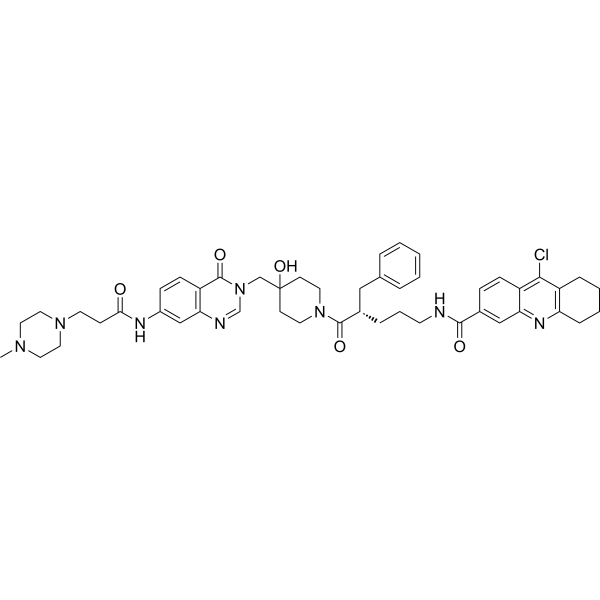
Physicochemical Properties
| Molecular Formula | C48H57CLN8O5 |
| Molecular Weight | 861.4698 |
| Exact Mass | 860.41 |
| Elemental Analysis | C, 66.92; H, 6.67; Cl, 4.11; N, 13.01; O, 9.29 |
| CAS # | 2417089-74-6 |
| Related CAS # | 2417089-73-5 2417089-74-6 (S-isomer);2417089-75-7 (R-isomer); |
| PubChem CID | 153002269 |
| Appearance | Off-white to light yellow solid powder |
| LogP | 4.8 |
| Hydrogen Bond Donor Count | 3 |
| Hydrogen Bond Acceptor Count | 9 |
| Rotatable Bond Count | 14 |
| Heavy Atom Count | 62 |
| Complexity | 1560 |
| Defined Atom Stereocenter Count | 1 |
| SMILES | CN1CCN(CC1)CCC(=O)NC2=CC3=C(C=C2)C(=O)N(C=N3)CC4(CCN(CC4)C(=O)[C@@H](CCCNC(=O)C5=CC6=C(C=C5)C(=C7CCCCC7=N6)Cl)CC8=CC=CC=C8)O |
| InChi Key | UYJWYMWIVMCGQZ-DHUJRADRSA-N |
| InChi Code | InChI=1S/C48H57ClN8O5/c1-54-24-26-55(27-25-54)21-17-43(58)52-36-14-16-39-41(30-36)51-32-57(47(39)61)31-48(62)18-22-56(23-19-48)46(60)35(28-33-8-3-2-4-9-33)10-7-20-50-45(59)34-13-15-38-42(29-34)53-40-12-6-5-11-37(40)44(38)49/h2-4,8-9,13-16,29-30,32,35,62H,5-7,10-12,17-28,31H2,1H3,(H,50,59)(H,52,58)/t35-/m0/s1 |
| Chemical Name | N-[(4S)-4-benzyl-5-[4-hydroxy-4-[[7-[3-(4-methylpiperazin-1-yl)propanoylamino]-4-oxoquinazolin-3-yl]methyl]piperidin-1-yl]-5-oxopentyl]-9-chloro-5,6,7,8-tetrahydroacridine-3-carboxamide |
| Synonyms | XL177A; XL-177A; XL 177A; XL177; XL-177; XL 177; |
| HS Tariff Code | 2934.99.9001 |
| Storage |
Powder-20°C 3 years 4°C 2 years In solvent -80°C 6 months -20°C 1 month |
| Shipping Condition | Room temperature (This product is stable at ambient temperature for a few days during ordinary shipping and time spent in Customs) |
Biological Activity
| ln Vitro | XL177A is a strong conjugator of USP7 that stabilizes p53 in cells. The primary mechanism by which XL177A reduces insulin growth is through p53 oscillation. In the human proteome and DUBome, XL177A identifies the catalytic cysteine C223 of USP7 [1]. In MCF7 cells, XL177A (1 μM) causes total G1 arrest after 24 hours [1]. Results of inducing HDM2 breakdown in less than two seconds: elevated amounts of p21 protein, but not of p53 or p21 [1]. MDM2 protein levels were in line with DMSO benchmarks. |
| References |
[1]. Selective USP7 inhibition elicits cancer cell killing through a p53-dependent mechanism. Sci Rep.2020 Mar 24;10(1):5324. |
Solubility Data
| Solubility (In Vitro) | DMSO : ~25 mg/mL (~29.02 mM) |
| Solubility (In Vivo) |
Solubility in Formulation 1: ≥ 2.08 mg/mL (2.41 mM) (saturation unknown) in 10% DMSO + 40% PEG300 + 5% Tween80 + 45% Saline (add these co-solvents sequentially from left to right, and one by one), clear solution. For example, if 1 mL of working solution is to be prepared, you can add 100 μL of 20.8 mg/mL clear DMSO stock solution to 400 μL PEG300 and mix evenly; then add 50 μL Tween-80 to the above solution and mix evenly; then add 450 μL normal saline to adjust the volume to 1 mL. Preparation of saline: Dissolve 0.9 g of sodium chloride in 100 mL ddH₂ O to obtain a clear solution. Solubility in Formulation 2: ≥ 2.08 mg/mL (2.41 mM) (saturation unknown) in 10% DMSO + 90% Corn Oil (add these co-solvents sequentially from left to right, and one by one), clear solution. For example, if 1 mL of working solution is to be prepared, you can add 100 μL of 20.8 mg/mL clear DMSO stock solution to 900 μL of corn oil and mix evenly. (Please use freshly prepared in vivo formulations for optimal results.) |
| Preparing Stock Solutions | 1 mg | 5 mg | 10 mg | |
| 1 mM | 1.1608 mL | 5.8040 mL | 11.6081 mL | |
| 5 mM | 0.2322 mL | 1.1608 mL | 2.3216 mL | |
| 10 mM | 0.1161 mL | 0.5804 mL | 1.1608 mL |