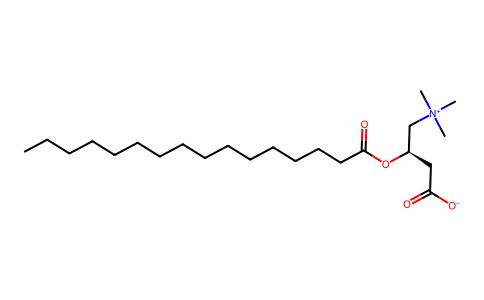
Physicochemical Properties
| Molecular Formula | C23H45NO4 |
| Molecular Weight | 399.61 |
| Exact Mass | 399.335 |
| Elemental Analysis | C, 69.13; H, 11.35; N, 3.51; O, 16.01 |
| CAS # | 2364-67-2 |
| Related CAS # | 28330-02-1; 2364-67-2; 6865-14-1; 18877-64-0; 1935-18-8 |
| PubChem CID | 11953816 |
| Appearance | White to off-white solid powder |
| LogP | 4.225 |
| Hydrogen Bond Donor Count | 0 |
| Hydrogen Bond Acceptor Count | 4 |
| Rotatable Bond Count | 19 |
| Heavy Atom Count | 28 |
| Complexity | 398 |
| Defined Atom Stereocenter Count | 1 |
| SMILES | CCCCCCCCCCCCCCCC(O[C@H](CC([O-])=O)C[N+](C)(C)C)=O |
| InChi Key | XOMRRQXKHMYMOC-OAQYLSRUSA-N |
| InChi Code | InChI=1S/C23H45NO4/c1-5-6-7-8-9-10-11-12-13-14-15-16-17-18-23(27)28-21(19-22(25)26)20-24(2,3)4/h21H,5-20H2,1-4H3/t21-/m1/s1 |
| Chemical Name | (3R)-3-hexadecanoyloxy-4-(trimethylazaniumyl)butanoate |
| Synonyms | L-Carnitine palmitoyl ester; palmitoyl carnitine; L-Palmitoylcarnitine; Palmitoyl-L-carnitine; 2364-67-2; O-palmitoyl-L-carnitine; Hexadecanoyl-L-carnitine; Palmityl-L-carnitine; L-Carnitine palmitoyl ester; Hexadecanoyl-L-carnitine; Palmitoyl-L-carnitine |
| HS Tariff Code | 2934.99.9001 |
| Storage |
Powder-20°C 3 years 4°C 2 years In solvent -80°C 6 months -20°C 1 month |
| Shipping Condition | Room temperature (This product is stable at ambient temperature for a few days during ordinary shipping and time spent in Customs) |
Biological Activity
| Targets | Kir6.2 Human Endogenous Metabolite |
| ln Vitro | Sarcolemmal adenosine 5'-triphosphate-sensitive K+ channels (K(ATP)) are dramatically up-regulated by a membrane phospholipid, phosphatidyl-inositol-4,5-bisphosphate (PIP2). During ischaemia, L-palmitoylcarnitine(L-PC), a fatty acid metabolite, accumulates in the sarcolemma and deranges the membrane lipid environment. We therefore investigated whether alteration of the membrane lipid environment by L-palmitoylcarnitine/L-PC modulates the K(ATP) channel activity in inside-out patches from guinea-pig ventricular myocytes. L-PC (1 microM) inhibited KATP channel activity, without affecting the single channel conductance, through interaction with Kir6.2. L-PC simultaneously enhanced the ATP sensitivity of the channel [concentration for half-maximal inhibition (IC50) fell from 62.0+/-2.7 to 30.3+/-5.5 microM]. In contrast, PIP2 attenuated the ATP sensitivity (IC50 343.6+/-54.4 microM) and restored Ca2+-induced inactivation of KATP channels (94.1+/-13.7% of the control current immediately before the Ca2+-induced inactivation). Pretreatment of the patch membrane with 1 microM L-PC, however, reduced the magnitude of the PIP2-induced recovery to 22.7+/-6.3% of the control (P<0.01 vs. 94.1+/-13.7% in the absence of L-PC). Conversely, after the PIP2-induced recovery, L-PC's inhibitory action was attenuated, but L-PC partly reversed the PIP2-mediated decrease in the ATP sensitivity (IC50 fell from 310+/-19.2 to 93.1+/-9.8 microM). Thus, interaction between L-PC and PIP2 in the plasma membrane appears to regulate K(ATP) channels [1]. |
| ln Vivo | Palmitoyl-l-carnitine (PC) or L-palmitoylcarnitine, an ischemic metabolite, causes cellular Na+ and Ca2+ overload and cardiac dysfunction. This study determined whether ranolazine [(±)-1-piperazineacetamide, N-(2,6-dimethylphenyl)-4-[2-hydroxy-3-(2-methoxyphenoxy)propyl]-] attenuates PC-induced Na+ current and ventricular contractile dysfunction of the isolated heart. PC/L-palmitoylcarnitine (4 μM, 30 min) increased late Na+ current by 1034 ± 349% in guinea pig isolated ventricular myocytes; ranolazine (10 μM) and tetrodotoxin (TTX, 3 μM) significantly attenuated this effect of PC. PC increased left ventricular end-diastolic pressure (LVEDP), coronary perfusion pressure (CPP), wall stiffness, and cardiac lactate and adenosine release from the isolated heart. Ranolazine (10 μM) significantly reduced the PC-induced increase in LVEDP by 72 ± 6% (n = 6, p < 0.001), reduced left ventricular wall stiffness, and attenuated the PC-induced increase of CPP by 53 ± 10% (n = 6–7, p < 0.05). Ranolazine (10 μM) reduced the PC-induced increases of lactate and adenosine release by 70 ± 8 and 81 ± 5%, respectively (n = 6, p ≤ 0.05 for both). TTX (2 μM) significantly (p < 0.05) reduced PC-induced increases of CPP and LVEDP. Pretreatment of isolated myocytes or hearts with the free radical scavenger tiron (4,5-dihydroxy-1,3-benzenedisulfonic acid, disodium salt) (1 mM) significantly reduced the effects of PC to cause increases of late Na+ current and LVEDP, respectively, but unlike ranolazine or TTX, tiron did not reverse increases of late Na+ current and LVEDP caused by PC. In summary, ranolazine and TTX, inhibitors of the late Na+ current, attenuated the PC-induced ventricular contractile dysfunction and increase of coronary resistance in the guinea pig isolated heart [2]. |
| Cell Assay |
Truncation of Kir6.2 complementary deoxyribonucleic acid (cDNA) and expression of recombinant Kir6.2∆36 channel in COS7 cells [1] Kir6.2∆36, in which the last 36 amino acids were truncated from the C-terminus, was constructed by the polymerase chain reaction (PCR), inserting a stop codon at the appropriate position. The resulting PCR product was verified by sequencing. cDNAs of Kir6.2∆36 and human CD8 antigen were subcloned into the pCI and pIRES vectors (Promega, USA), respectively. Mixtures containing the above vectors: 0.4 Kir6.2∆36 and 0.4 CD8 (µg/dish), were co-transfected into COS7 cells with Lipofectamine reagent and Opti-MEM (Gibco/BRL). After transfection (48 h), successfully transfected cells were identified with anti-CD8 antibody-coated beads. Electrophysiology [1] Single ventricular cells or Kir6.2∆36 channel-expressing COS7 cells on a glass cover-slip were transferred into a recording chamber and superfused with normal Tyrode’s solution containing (in mM): 5.4 KCl, 143 NaCl, 0.3 NaH2PO4, 0.5 MgCl2, 1.8 CaCl2, 5.0 4-(2- hydroxyethyl)-1-piperazineethanesulphonic acid (HEPES)/NaOH (pH 7.4 adjusted by NaOH). The electrode resistance of the patch pipettes was 3–5 MΩ when filled with normal Tyrode’s solution. After the gigaohm seal had been obtained at room temperature (22–25 °C), the patch membrane was excised in a high-K+ solution (in mM): 150 KCl, 0.5 ethyleneglycol-bis-(β-aminoethylether)- N,N,N′,N′-tetraacetic acid (EGTA), and 5.0 HEPES (pH 7.4 adjusted by KOH). |
| Animal Protocol | This study determined whether ranolazine [(+/-)-1-piperazineacetamide, N-(2,6-dimethylphenyl)-4-[2-hydroxy-3-(2-methoxyphenoxy)propyl]-] attenuates PC (L-palmitoylcarnitine)-induced Na(+) current and ventricular contractile dysfunction of the isolated heart. PC/L-palmitoylcarnitine (4 microM, 30 min) increased late Na(+) current by 1034 +/- 349% in guinea pig isolated ventricular myocytes; ranolazine (10 microM) and tetrodotoxin (TTX, 3 microM) significantly attenuated this effect of PC. PC/L-palmitoylcarnitine increased left ventricular end-diastolic pressure (LVEDP), coronary perfusion pressure (CPP), wall stiffness, and cardiac lactate and adenosine release from the isolated heart [2]. |
| Toxicity/Toxicokinetics | mouse LD50 subcutaneous 1 gm/kg Acta Biologica et Medica Germanica., 26(1237), 1971 [PMID:5153312] |
| References |
[1]. Alteration of the membrane lipid environment by L-palmitoylcarnitine modulates K(ATP) channels in guinea-pig ventricular myocytes. Pflugers Arch. 2000;441(2-3):200-207. [2]. The Late Na+ Current (INa) Inhibitor Ranolazine Attenuates Effects of Palmitoyl-L-Carnitine to Increase Late INa and Cause Ventricular Diastolic Dysfunction. J Pharmacol Exp Ther. 2009 Aug;330(2):550-7. |
| Additional Infomation |
O-palmitoyl-L-carnitine is an O-acyl-L-carnitine in which the acyl group is specified as palmitoyl (hexadecanoyl). It has a role as an EC 3.6.3.9 (Na(+)/K(+)-transporting ATPase) inhibitor, a human metabolite and a mouse metabolite. It is an O-palmitoylcarnitine, a saturated fatty acyl-L-carnitine and a long-chain fatty acyl-L-carnitine. It is functionally related to a hexadecanoic acid. L-Palmitoylcarnitine is a metabolite found in or produced by Escherichia coli (strain K12, MG1655). L-Palmitoylcarnitine has been reported in Homo sapiens and Apis cerana with data available. L-Palmitoylcarnitine is a metabolite found in or produced by Saccharomyces cerevisiae. Hexadecanoylcarnitine is a metabolite found in or produced by Saccharomyces cerevisiae. A long-chain fatty acid ester of carnitine which facilitates the transfer of long-chain fatty acids from cytoplasm into mitochondria during the oxidation of fatty acids. |
Solubility Data
| Solubility (In Vitro) | May dissolve in DMSO (in most cases), if not, try other solvents such as H2O, Ethanol, or DMF with a minute amount of products to avoid loss of samples |
| Solubility (In Vivo) |
Note: Listed below are some common formulations that may be used to formulate products with low water solubility (e.g. < 1 mg/mL), you may test these formulations using a minute amount of products to avoid loss of samples. Injection Formulations (e.g. IP/IV/IM/SC) Injection Formulation 1: DMSO : Tween 80: Saline = 10 : 5 : 85 (i.e. 100 μL DMSO stock solution → 50 μL Tween 80 → 850 μL Saline) *Preparation of saline: Dissolve 0.9 g of sodium chloride in 100 mL ddH ₂ O to obtain a clear solution. Injection Formulation 2: DMSO : PEG300 :Tween 80 : Saline = 10 : 40 : 5 : 45 (i.e. 100 μL DMSO → 400 μLPEG300 → 50 μL Tween 80 → 450 μL Saline) Injection Formulation 3: DMSO : Corn oil = 10 : 90 (i.e. 100 μL DMSO → 900 μL Corn oil) Example: Take the Injection Formulation 3 (DMSO : Corn oil = 10 : 90) as an example, if 1 mL of 2.5 mg/mL working solution is to be prepared, you can take 100 μL 25 mg/mL DMSO stock solution and add to 900 μL corn oil, mix well to obtain a clear or suspension solution (2.5 mg/mL, ready for use in animals). Injection Formulation 4: DMSO : 20% SBE-β-CD in saline = 10 : 90 [i.e. 100 μL DMSO → 900 μL (20% SBE-β-CD in saline)] *Preparation of 20% SBE-β-CD in Saline (4°C,1 week): Dissolve 2 g SBE-β-CD in 10 mL saline to obtain a clear solution. Injection Formulation 5: 2-Hydroxypropyl-β-cyclodextrin : Saline = 50 : 50 (i.e. 500 μL 2-Hydroxypropyl-β-cyclodextrin → 500 μL Saline) Injection Formulation 6: DMSO : PEG300 : castor oil : Saline = 5 : 10 : 20 : 65 (i.e. 50 μL DMSO → 100 μLPEG300 → 200 μL castor oil → 650 μL Saline) Injection Formulation 7: Ethanol : Cremophor : Saline = 10: 10 : 80 (i.e. 100 μL Ethanol → 100 μL Cremophor → 800 μL Saline) Injection Formulation 8: Dissolve in Cremophor/Ethanol (50 : 50), then diluted by Saline Injection Formulation 9: EtOH : Corn oil = 10 : 90 (i.e. 100 μL EtOH → 900 μL Corn oil) Injection Formulation 10: EtOH : PEG300:Tween 80 : Saline = 10 : 40 : 5 : 45 (i.e. 100 μL EtOH → 400 μLPEG300 → 50 μL Tween 80 → 450 μL Saline) Oral Formulations Oral Formulation 1: Suspend in 0.5% CMC Na (carboxymethylcellulose sodium) Oral Formulation 2: Suspend in 0.5% Carboxymethyl cellulose Example: Take the Oral Formulation 1 (Suspend in 0.5% CMC Na) as an example, if 100 mL of 2.5 mg/mL working solution is to be prepared, you can first prepare 0.5% CMC Na solution by measuring 0.5 g CMC Na and dissolve it in 100 mL ddH2O to obtain a clear solution; then add 250 mg of the product to 100 mL 0.5% CMC Na solution, to make the suspension solution (2.5 mg/mL, ready for use in animals). Oral Formulation 3: Dissolved in PEG400 Oral Formulation 4: Suspend in 0.2% Carboxymethyl cellulose Oral Formulation 5: Dissolve in 0.25% Tween 80 and 0.5% Carboxymethyl cellulose Oral Formulation 6: Mixing with food powders Note: Please be aware that the above formulations are for reference only. InvivoChem strongly recommends customers to read literature methods/protocols carefully before determining which formulation you should use for in vivo studies, as different compounds have different solubility properties and have to be formulated differently. (Please use freshly prepared in vivo formulations for optimal results.) |
| Preparing Stock Solutions | 1 mg | 5 mg | 10 mg | |
| 1 mM | 2.5024 mL | 12.5122 mL | 25.0244 mL | |
| 5 mM | 0.5005 mL | 2.5024 mL | 5.0049 mL | |
| 10 mM | 0.2502 mL | 1.2512 mL | 2.5024 mL |