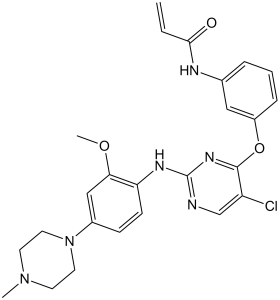
WZ4002 (WZ-4002) is a covalent/irreversible and mutant-selective EGFR (e.g. L858R/T790M) inhibitor with potential antitumor activity. In the BaF3 cell line, it inhibits EGFR(L858R)/(T790M) with IC50s of 2 nM/8 nM.
Physicochemical Properties
| Molecular Formula | C25H27CLN6O3 | |
| Molecular Weight | 494.18 | |
| Exact Mass | 494.183 | |
| Elemental Analysis | C, 60.66; H, 5.50; Cl, 7.16; N, 16.98; O, 9.70 | |
| CAS # | 1213269-23-8 | |
| Related CAS # |
|
|
| PubChem CID | 44607530 | |
| Appearance | White to beige solid powder | |
| Density | 1.3±0.1 g/cm3 | |
| Index of Refraction | 1.648 | |
| LogP | 3.48 | |
| Hydrogen Bond Donor Count | 2 | |
| Hydrogen Bond Acceptor Count | 8 | |
| Rotatable Bond Count | 8 | |
| Heavy Atom Count | 35 | |
| Complexity | 694 | |
| Defined Atom Stereocenter Count | 0 | |
| SMILES | ClC1=C([H])N=C(N=C1OC1=C([H])C([H])=C([H])C(=C1[H])N([H])C(C([H])=C([H])[H])=O)N([H])C1C([H])=C([H])C(=C([H])C=1OC([H])([H])[H])N1C([H])([H])C([H])([H])N(C([H])([H])[H])C([H])([H])C1([H])[H] |
|
| InChi Key | ITTRLTNMFYIYPA-UHFFFAOYSA-N | |
| InChi Code | InChI=1S/C25H27ClN6O3/c1-4-23(33)28-17-6-5-7-19(14-17)35-24-20(26)16-27-25(30-24)29-21-9-8-18(15-22(21)34-3)32-12-10-31(2)11-13-32/h4-9,14-16H,1,10-13H2,2-3H3,(H,28,33)(H,27,29,30) | |
| Chemical Name | N-[3-[5-chloro-2-[2-methoxy-4-(4-methylpiperazin-1-yl)anilino]pyrimidin-4-yl]oxyphenyl]prop-2-enamide | |
| Synonyms | WZ-4002; WZ 4002; WZ4002 | |
| HS Tariff Code | 2934.99.9001 | |
| Storage |
Powder-20°C 3 years 4°C 2 years In solvent -80°C 6 months -20°C 1 month |
|
| Shipping Condition | Room temperature (This product is stable at ambient temperature for a few days during ordinary shipping and time spent in Customs) |
Biological Activity
| Targets |
EGFR L858R (IC50 = 2 nM); EGFR L858R/T790M (IC50 = 8 nM); EGFR E746_A750 (IC50 = 3 nM); EGFR E746_A750/T790M (IC50 = 2 nM) WZ4002 potently inhibits EGFR T790M mutant (IC₅₀ = 2.0 nM), EGFR L858R/T790M double mutant (IC₅₀ = 2.9 nM), and EGFR exon 19 deletion mutant (IC₅₀ = 5.2 nM). It shows lower activity against wild-type EGFR (IC₅₀ = 160 nM) [1] WZ4002 has no significant inhibitory effect on HER2, HER4, VEGFR2, or PDGFRβ (IC₅₀ > 1000 nM) [1] |
| ln Vitro |
WZ4002 has an IC50 of 2 and 6 nM against the other EGFR genotypes, E746_A750 and E746_A750/T790M. Furthermore, WZ4002 has an IC50 of 32 nM for suppressing widetype ERBB2. WZ4002 prevents EGFR phosphorylation in NIH-3T3 cells expressing various EGFR T790M mutant alleles and inhibits EGFR, AKT, and ERK1/2 phosphorylation in NSCLC cell lines. Dissociation constant measurements for WZ4002 are performed on kinases that showed more than 95% inhibition at 10 μM in comparison to the DMSO control. WZ4002 is more selective for EGFR than WZ3146 because it has an ortho-methoxy group at the C2-aniline substituent. When compared to quinazoline inhibitors, WZ4002 is 100 times less effective at preventing WT EGFR phosphorylation. Likewise, WZ4002 more effectively inhibits the EGFR kinase activity of the recombinant L858R/T790M protein than does WT EGFR, whereas HKI-272 and gefitinib have the opposite effect.[1] Third-generation EGFR TKI WZ4002 also completely suppresses the phosphorylated EGFR of Src TKI-resistant H1975 cells and HCC827 cells.[2] WZ4002 dose-dependently inhibited the proliferation of EGFR T790M-positive non-small cell lung cancer (NSCLC) cell lines, including NCI-H1975 (EGFR L858R/T790M, IC₅₀ = 23 nM), PC-9/GR (EGFR del19/T790M, IC₅₀ = 18 nM), and HCC827/T790M (EGFR del19/T790M, IC₅₀ = 21 nM). It blocked mutant EGFR phosphorylation and downstream AKT/ERK1/2 signaling at concentrations ≥ 30 nM [1] WZ4002 induced apoptosis in NCI-H1975 cells with an EC₅₀ of 45 nM, upregulating cleaved caspase-3, -7, and PARP expression. It also suppressed clonogenicity of gefitinib-resistant NSCLC cells (PC-9/GR) with an IC₅₀ of 25 nM [2] In EGFR-mutant NSCLC cells co-expressing MET, WZ4002 (50 nM) combined with a MET inhibitor synergistically inhibited cell proliferation, reducing viability by ~80% compared to single-agent treatment [2] |
| ln Vivo |
WZ4002 treatment causes significant tumor regressions in both T790M-containing murine models in a 2-week efficacy study when compared to vehicle alone.[1] The mean reductions in tracer uptake caused by treatment with low-dose and high-dose WZ4002 are 26% and 36%, respectively.[3] WZ4002 significantly inhibited tumor growth in nude mice bearing NCI-H1975 xenografts when administered orally at 25 mg/kg/day for 21 days. Tumor volume was reduced by ~82% compared to the control group, and intratumoral EGFR T790M phosphorylation was almost completely blocked [1] WZ4002 prolonged median survival of nude mice bearing PC-9/GR xenografts by 60% when given orally at 30 mg/kg/day for 28 days. It also downregulated Ki-67 (proliferation marker) expression in tumor tissues by ~70% [2] In a mouse model of EGFR-mutant NSCLC brain metastasis, WZ4002 (40 mg/kg/day, oral) penetrated the blood-brain barrier, reducing the number of brain metastatic nodules by ~55% [3] |
| Enzyme Assay |
In vitro inhibitory enzyme kinetic assays are carried out in a 96-well format utilizing the ATP/NADH coupled assay system with recombinant EGFR L858R/T790M and WT protein. To find out how inhibiting it is, WZ4002 is added. Recombinant EGFR (wild-type, T790M, L858R/T790M, and exon 19 deletion mutants) kinase domains were individually incubated with ATP and specific peptide substrates in the presence of serial dilutions of WZ4002. Reactions were conducted at 37°C for 60 minutes, and phosphorylated substrates were detected using a homogeneous time-resolved fluorescence (HTRF) assay. Inhibition rates were calculated by comparing fluorescence intensity with vehicle controls, and IC₅₀ values were derived from dose-response curves [1] Recombinant HER2, VEGFR2, and PDGFRβ kinase domains were tested using the same protocol to assess selectivity. Reaction conditions were identical, and IC₅₀ values were determined to confirm preferential targeting of EGFR mutants [1] |
| Cell Assay |
EGFR delE746_A750/T790M was found to be present in the NSCLC, Ba/F3, NIH-3T3, and PC9GR4 cells through direct sequencing. The MTS assay is used in assays for cell growth and proliferation. The Quick Change Site-Directed Mutagenesis kit is used to carry out site-directed mutagenesis. NCI-H1975, PC-9/GR, and HCC827/T790M cells were seeded in 96-well plates at 5×10³ cells/well and treated with WZ4002 (1-200 nM) for 72 hours. Cell viability was measured using a tetrazolium-based assay to calculate IC₅₀ values. For Western blot analysis, cells were treated with 20-80 nM drug, lysed, and probed with antibodies against phosphorylated EGFR, AKT, ERK1/2, and GAPDH [1] NCI-H1975 and PC-9/GR cells were treated with WZ4002 (20-100 nM) for 48 hours. Apoptosis was detected by Annexin V-FITC/PI staining, and cleaved caspase-3/-7/PARP expression was analyzed by Western blot. Clonogenic assays were performed by treating cells with 10-50 nM drug for 14 days, followed by fixation, staining, and colony counting [2] EGFR-mutant NSCLC cells co-expressing MET were seeded in 96-well plates and treated with WZ4002 (10-100 nM) alone or in combination with a MET inhibitor (20 nM) for 72 hours. Cell viability was assessed by MTT assay to evaluate synergistic effects [2] |
| Animal Protocol |
In order to induce the expression of mutant EGFR, cohorts of EGFR TL/CCSP-rtTA and EGFR TD/CCSP-rtTA are placed on a doxycycline diet at 5 weeks of age. After six to eight weeks on a doxycycline diet, these mice undergo MRI to record and measure the incidence of lung cancer before being assigned to different treatment study cohorts. Every treatment group consists of a minimum of three mice. Following that, mice are given either vehicle (NMP 13 (10% 1-methyl-2-pyrrolidinone: 90% PEG-300) or WZ4002 at a daily gavage dose of 25 mg/kg. These mice receive a second round of MRIs after two weeks of treatment in order to track how well the medication is working. Tumor burden measurements and MRIs are carried out. Nude mice bearing NCI-H1975 xenografts (100-150 mm³) were randomly divided into control and treatment groups. WZ4002 was suspended in 0.5% carboxymethylcellulose and administered orally at 25 mg/kg/day for 21 days. Tumor volume was measured every 3 days, and mice were euthanized to collect tumors for Western blot analysis of EGFR phosphorylation [1] Nude mice bearing PC-9/GR xenografts were treated with WZ4002 orally at 30 mg/kg/day for 28 days. Survival time was recorded daily, and tumor tissues were processed for immunohistochemical staining of Ki-67 [2] Nude mice were injected with EGFR-mutant NSCLC cells via the intracardiac route to establish a brain metastasis model. Two days later, mice were treated with WZ4002 orally at 40 mg/kg/day for 24 days. Mice were euthanized, and brains were harvested to count metastatic nodules and analyze drug penetration by liquid chromatography-tandem mass spectrometry (LC-MS/MS) [3] |
| ADME/Pharmacokinetics |
WZ4002 had an oral bioavailability of ~78% in mice after a single dose of 25 mg/kg. The plasma half-life was approximately 9.2 hours, and the maximum plasma concentration (Cmax) was 4.8 μg/mL achieved at 1.5 hours post-administration [1] In rats, oral administration of WZ4002 at 30 mg/kg resulted in an AUC₀-24h of 56.3 μg·h/mL. The drug penetrated the blood-brain barrier effectively, with a brain-to-plasma concentration ratio of ~0.8 [3] |
| Toxicity/Toxicokinetics |
Mice treated with WZ4002 at 25 mg/kg/day for 21 days showed mild weight loss (~8%) but no significant liver or kidney toxicity. Serum ALT, AST, and creatinine levels were within normal ranges [1] The plasma protein binding rate of WZ4002 was ~94% in human plasma as determined by equilibrium dialysis [2] |
| References |
[1]. Nature . 2009 Dec 24;462(7276):1070-4. [2]. Lab Invest . 2012 Mar;92(3):371-83. [3]. J Nucl Med . 2012 Mar;53(3):443-50. |
| Additional Infomation |
WZ4002 is a pyrimidine compound having a 2-methoxy-4-(4-methylpiperazin-1-yl)anilino group at the 2-position, a 3-(acryloylamino)phenoxy group at the 4-position, and a chloro substituent at the 5-position. It has a role as a tyrosine kinase inhibitor and an antineoplastic agent. It is a member of pyrimidines, a member of piperazines and an organochlorine compound. EGFR Mutant-selective Inhibitor WZ4002 is an inhibitor of the epidermal growth factor receptor (EGFR) mutant form T790M, with potential antineoplastic activity. Upon administration, EGFR mutant-selective inhibitor WZ4002 specifically targets, binds to and inhibits EGFR T790M, which prevents EGFR T790M mutant-mediated signaling and leads to cell death in EGFR T790M mutant-expressing tumor cells. EGFR, a receptor tyrosine kinase mutated in many tumor cell types, plays a key role in tumor cell proliferation and tumor vascularization. WZ4002 is an irreversible third-generation EGFR tyrosine kinase inhibitor that covalently binds to the ATP-binding site of mutant EGFR (via cysteine 797), selectively blocking signaling in EGFR-mutant tumors while sparing wild-type EGFR [1] It was developed to overcome T790M-mediated resistance to first-generation EGFR inhibitors (e.g., gefitinib, erlotinib) in NSCLC patients [1] WZ4002 exhibits potential for treating brain metastases due to its ability to cross the blood-brain barrier, addressing a critical unmet need in the treatment of advanced EGFR-mutant NSCLC [3] |
Solubility Data
| Solubility (In Vitro) |
|
|||
| Solubility (In Vivo) |
|
| Preparing Stock Solutions | 1 mg | 5 mg | 10 mg | |
| 1 mM | 2.0236 mL | 10.1178 mL | 20.2355 mL | |
| 5 mM | 0.4047 mL | 2.0236 mL | 4.0471 mL | |
| 10 mM | 0.2024 mL | 1.0118 mL | 2.0236 mL |