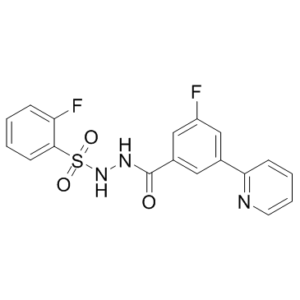
WM-1119 (WM1119) is a novel, highly potent, and selective inhibitor of histone acetyltransferase KAT6A/B (lysine acetyltransferase) with potential anticancer activity. It competes with Ac-CoA by binding to the Ac-CoA binding site, and has a high oral bioavailability (F) of 56% in rats. WM-1119 inhibits KAT6A with an IC50 value of of 0.25 μM, and a KD value of 2 nM for KAT6A. WM-1119 induces cell cycle exit and cellular senescence without causing DNA damage. Senescence is INK4A/ARF-dependent and is accompanied by changes in gene expression that are typical of loss of KAT6A function. WM-1119, which has increased bioavailability, arrests the progression of lymphoma in mice.
Physicochemical Properties
| Molecular Formula | C18H13F2N3O3S | |
| Molecular Weight | 389.37592959404 | |
| Exact Mass | 389.064 | |
| CAS # | 2055397-28-7 | |
| Related CAS # |
|
|
| PubChem CID | 133080719 | |
| Appearance | Off-white to light yellow solid powder | |
| LogP | 2.8 | |
| Hydrogen Bond Donor Count | 2 | |
| Hydrogen Bond Acceptor Count | 7 | |
| Rotatable Bond Count | 5 | |
| Heavy Atom Count | 27 | |
| Complexity | 614 | |
| Defined Atom Stereocenter Count | 0 | |
| SMILES | S(C1C=CC=CC=1F)(NNC(C1C=C(C=C(C2C=CC=CN=2)C=1)F)=O)(=O)=O |
|
| InChi Key | QLXULUNLCRKWRD-UHFFFAOYSA-N | |
| InChi Code | InChI=1S/C18H13F2N3O3S/c19-14-10-12(16-6-3-4-8-21-16)9-13(11-14)18(24)22-23-27(25,26)17-7-2-1-5-15(17)20/h1-11,23H,(H,22,24) | |
| Chemical Name | 3-fluoro-N'-(2-fluorophenyl)sulfonyl-5-pyridin-2-ylbenzohydrazide | |
| Synonyms |
|
|
| HS Tariff Code | 2934.99.9001 | |
| Storage |
Powder-20°C 3 years 4°C 2 years In solvent -80°C 6 months -20°C 1 month |
|
| Shipping Condition | Room temperature (This product is stable at ambient temperature for a few days during ordinary shipping and time spent in Customs) |
Biological Activity
| ln Vitro | Without causing damage to DNA, WM-1119 triggers cell cycle exit and cellular senescence. Compared to KAT5 or KAT7, WM-1119 is 1,100- and 250-fold more active against KAT6A, respectively. As a result, it exhibits higher specificity for KAT6A than WM-8014. When MEFs are treated with WM-1119, they experience a G1 cell cycle arrest and a senescence phenotype resembling that of WM-8014. WM-1119 exhibits significantly higher activity in this cell-based assay compared to WM-8014, and at 1 μM, it can induce cell cycle arrest. As anticipated based on decreased protein binding, WM-1119 (IC50=0.25 μM) is nine times more potent than WM-8014 (IC50=2.3 μM) in suppressing the growth of EMRK1184 lymphoma cells in vitro[1]. | ||
| ln Vivo | With the exception of one mouse that does not respond, the cohorts that get WM-1119 four times a day have stopped the growth of their tumors by day 14. The spleen weights of the four times daily treated WM-1119 treatment group are significantly less than those of the vehicle-treated group. While administering WM-1119 three times a day reduces the tumour burden and spleen weight significantly, it is not as effective as administering it four times a day. WM-1119 is well-tolerated in mice; no widespread negative effects are seen, and there is no evidence of weight loss. Four times a day of WM-1119 treatment significantly reduces the proportion and total quantity of tumor cells[1]. | ||
| Animal Protocol |
|
||
| References |
[1]. Inhibitors of histone acetyltransferases KAT6A/B induce senescence and arrest tumour growth. Nature. 2018 Aug;560(7717):253-257. |
Solubility Data
| Solubility (In Vitro) |
|
|||
| Solubility (In Vivo) |
Solubility in Formulation 1: ≥ 2.5 mg/mL (6.42 mM) (saturation unknown) in 10% DMSO + 90% (20% SBE-β-CD in Saline) (add these co-solvents sequentially from left to right, and one by one), clear solution. For example, if 1 mL of working solution is to be prepared, you can add 100 μL of 25.0 mg/mL clear DMSO stock solution to 900 μL of 20% SBE-β-CD physiological saline solution and mix evenly. Preparation of 20% SBE-β-CD in Saline (4°C,1 week): Dissolve 2 g SBE-β-CD in 10 mL saline to obtain a clear solution. Solubility in Formulation 2: ≥ 2.08 mg/mL (5.34 mM) (saturation unknown) in 10% DMSO + 40% PEG300 + 5% Tween80 + 45% Saline (add these co-solvents sequentially from left to right, and one by one), clear solution. For example, if 1 mL of working solution is to be prepared, you can add 100 μL of 20.8 mg/mL clear DMSO stock solution to 400 μL PEG300 and mix evenly; then add 50 μL Tween-80 to the above solution and mix evenly; then add 450 μL normal saline to adjust the volume to 1 mL. Preparation of saline: Dissolve 0.9 g of sodium chloride in 100 mL ddH₂ O to obtain a clear solution. Solubility in Formulation 3: ≥ 2.08 mg/mL (5.34 mM) (saturation unknown) in 10% DMSO + 90% Corn Oil (add these co-solvents sequentially from left to right, and one by one), clear solution. For example, if 1 mL of working solution is to be prepared, you can add 100 μL of 20.8 mg/mL clear DMSO stock solution to 900 μL of corn oil and mix evenly. (Please use freshly prepared in vivo formulations for optimal results.) |
| Preparing Stock Solutions | 1 mg | 5 mg | 10 mg | |
| 1 mM | 2.5682 mL | 12.8409 mL | 25.6819 mL | |
| 5 mM | 0.5136 mL | 2.5682 mL | 5.1364 mL | |
| 10 mM | 0.2568 mL | 1.2841 mL | 2.5682 mL |