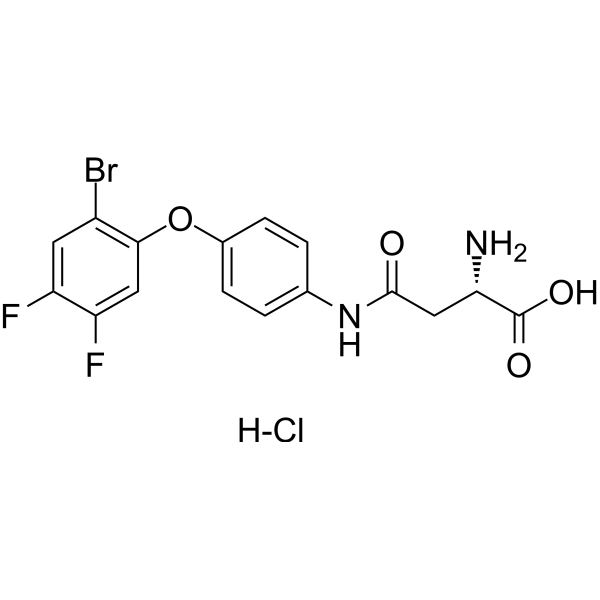
Physicochemical Properties
| Molecular Formula | C16H14BRCLF2N2O4 |
| Molecular Weight | 451.65 |
| Exact Mass | 449.979 |
| CAS # | 2450268-84-3 |
| Related CAS # | WAY-213613;868359-05-1 |
| PubChem CID | 139290995 |
| Appearance | White to off-white solid powder |
| Hydrogen Bond Donor Count | 4 |
| Hydrogen Bond Acceptor Count | 7 |
| Rotatable Bond Count | 6 |
| Heavy Atom Count | 26 |
| Complexity | 477 |
| Defined Atom Stereocenter Count | 1 |
| SMILES | C1(=CC(Br)=C(C=C1F)OC1C=CC(NC(=O)C[C@@H](C(=O)O)N)=CC=1)F.Cl |
| InChi Key | IBCWXGJQAQXHPZ-ZOWNYOTGSA-N |
| InChi Code | InChI=1S/C16H13BrF2N2O4.ClH/c17-10-5-11(18)12(19)6-14(10)25-9-3-1-8(2-4-9)21-15(22)7-13(20)16(23)24;/h1-6,13H,7,20H2,(H,21,22)(H,23,24);1H/t13-;/m0./s1 |
| Chemical Name | (2S)-2-amino-4-[4-(2-bromo-4,5-difluorophenoxy)anilino]-4-oxobutanoic acid;hydrochloride |
| HS Tariff Code | 2934.99.9001 |
| Storage |
Powder-20°C 3 years 4°C 2 years In solvent -80°C 6 months -20°C 1 month Note: Please store this product in a sealed and protected environment, avoid exposure to moisture. |
| Shipping Condition | Room temperature (This product is stable at ambient temperature for a few days during ordinary shipping and time spent in Customs) |
Biological Activity
| Targets | EAAT2 |
| ln Vitro | With IC50 values of 5004 nM, 85 nM, and 3787 nM, respectively, WAY-213613 hydrochloride (0-100 μM) exhibits inhibitory activity against human EAAT1, EAAT2, and EAAT3 isoforms[1]. With Ki values of 15 nM, 41 nM, and 55 nM, WAY-213613 hydrochloride (3,30,300 nM) inhibits synaptosome L-[3H] glutamate absorption [1]. When EAAT1-, EAAT2-, or EAAT3 is injected into oocytes, WAY-213613 hydrochloride (0-100 μM) blocks glutamate-induced currents in a concentration-dependent manner (IC50 values: 48, 0.13, and 4.0 μM, respectively)[1]. With strong selectivity for ionophilic receptors and EAAT2, WAY-213613 hydrochloride (0.5-50 μM) exerts inhibiting effects on NMDA stimulation responses [1]. |
| References |
[1]. Characterization of novel aryl-ether, biaryl, and fluorene aspartic acid and diaminopropionic acid analogs as potent inhibitors of the high-affinity glutamate transporter EAAT2. Mol Pharmacol. 2005 Oct;68(4):974-82. Epub 2005 Jul 13. [2]. A small molecule p75NTR ligand, LM11A-31, reverses cholinergic neurite dystrophy in Alzheimer's disease mouse models with mid- to late-stage disease progression. PLoS One. 2014 Aug 25;9(8):e102136. |
Solubility Data
| Solubility (In Vitro) |
DMSO: 50 mg/mL (110.71 mM) H2O: < 0.1 mg/mL |
| Solubility (In Vivo) |
Solubility in Formulation 1: ≥ 2.5 mg/mL (5.54 mM) (saturation unknown) in 10% DMSO + 40% PEG300 + 5% Tween80 + 45% Saline (add these co-solvents sequentially from left to right, and one by one), clear solution. For example, if 1 mL of working solution is to be prepared, you can add 100 μL of 25.0 mg/mL clear DMSO stock solution to 400 μL PEG300 and mix evenly; then add 50 μL Tween-80 to the above solution and mix evenly; then add 450 μL normal saline to adjust the volume to 1 mL. Preparation of saline: Dissolve 0.9 g of sodium chloride in 100 mL ddH₂ O to obtain a clear solution. Solubility in Formulation 2: ≥ 2.5 mg/mL (5.54 mM) (saturation unknown) in 10% DMSO + 90% (20% SBE-β-CD in Saline) (add these co-solvents sequentially from left to right, and one by one), clear solution. For example, if 1 mL of working solution is to be prepared, you can add 100 μL of 25.0 mg/mL clear DMSO stock solution to 900 μL of 20% SBE-β-CD physiological saline solution and mix evenly. Preparation of 20% SBE-β-CD in Saline (4°C,1 week): Dissolve 2 g SBE-β-CD in 10 mL saline to obtain a clear solution. Solubility in Formulation 3: ≥ 2.5 mg/mL (5.54 mM) (saturation unknown) in 10% DMSO + 90% Corn Oil (add these co-solvents sequentially from left to right, and one by one), clear solution. For example, if 1 mL of working solution is to be prepared, you can add 100 μL of 25.0 mg/mL clear DMSO stock solution to 900 μL of corn oil and mix evenly. (Please use freshly prepared in vivo formulations for optimal results.) |
| Preparing Stock Solutions | 1 mg | 5 mg | 10 mg | |
| 1 mM | 2.2141 mL | 11.0705 mL | 22.1410 mL | |
| 5 mM | 0.4428 mL | 2.2141 mL | 4.4282 mL | |
| 10 mM | 0.2214 mL | 1.1071 mL | 2.2141 mL |