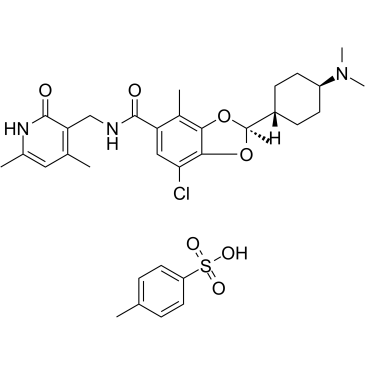
Valemetostat tosylate (DS3201; DS3201b; Ezharmia), the tosylate salt of Valemetostat, is an investigational and orally bioavailable dual EZH1/2 inhibitor with potential anticancer activity. As of September 2022, Valemetostat has been approved for treatment of aggressive ATL in Japan.
Physicochemical Properties
| Molecular Formula | C33H42CLN3O7S |
| Molecular Weight | 660.220487117767 |
| Exact Mass | 659.243 |
| CAS # | 1809336-93-3 |
| Related CAS # | Valemetostat;1809336-39-7 |
| PubChem CID | 126482037 |
| Appearance | White to yellow solid powder |
| Hydrogen Bond Donor Count | 3 |
| Hydrogen Bond Acceptor Count | 8 |
| Rotatable Bond Count | 6 |
| Heavy Atom Count | 45 |
| Complexity | 1090 |
| Defined Atom Stereocenter Count | 1 |
| SMILES | ClC1=CC(C(NCC2C(NC(C)=CC=2C)=O)=O)=C(C)C2=C1O[C@](C)(C1CCC(CC1)N(C)C)O2.S(C1C=CC(C)=CC=1)(=O)(=O)O |
| InChi Key | JSBKGJUYSLVFPF-RRKMXGHKSA-N |
| InChi Code | InChI=1S/C26H34ClN3O4.C7H8O3S/c1-14-11-15(2)29-25(32)20(14)13-28-24(31)19-12-21(27)23-22(16(19)3)33-26(4,34-23)17-7-9-18(10-8-17)30(5)6;1-6-2-4-7(5-3-6)11(8,9)10/h11-12,17-18H,7-10,13H2,1-6H3,(H,28,31)(H,29,32);2-5H,1H3,(H,8,9,10)/t17?,18?,26-;/m1./s1 |
| Chemical Name | (2R)-7-chloro-2-[4-(dimethylamino)cyclohexyl]-N-[(4,6-dimethyl-2-oxo-1H-pyridin-3-yl)methyl]-2,4-dimethyl-1,3-benzodioxole-5-carboxamide;4-methylbenzenesulfonic acid |
| Synonyms | DS-3201 tosylateDS3201 tosylate Ezharmia |
| HS Tariff Code | 2934.99.9001 |
| Storage |
Powder-20°C 3 years 4°C 2 years In solvent -80°C 6 months -20°C 1 month Note: Please store this product in a sealed and protected environment, avoid exposure to moisture. |
| Shipping Condition | Room temperature (This product is stable at ambient temperature for a few days during ordinary shipping and time spent in Customs) |
Biological Activity
| ln Vitro | With IC50 values less than 10 nM, valemetostat tosylate (1-1000 nM) substantially and selectively inhibits EZH1 and EZH2 [3]. H3K27me3 is efficiently increased and unintentional increases are prevented by valemetostat tosylate (100 nM; 7 d) [3]. 0.1-100 nM; 7 d) Uses low-dose therapy to effectively block the H3K27me3 pore size model in sensitive cells [3]. |
| Animal Protocol |
Animal/Disease Models: Male C57BL/6J mice performed chronic and acute running exercise or no exercise [1] Doses: 0.01 mg/g. Route of Administration: intraperitoneal (ip) injection; 0.01 mg/g; 30 minutes before the start of running. Experimental Results: H3K27me3 levels increased Dramatically after exercise, EZH1 levels diminished slightly, EZH2 levels increased, and phosphorylated AMPK levels increased. Inhibits myonuclear H3K27me3 accumulation during training and leads to failure of adaptive changes. |
| References |
[1]. Daiichi Sankyo’s EZH1/2 Dual Inhibitor Valemetostat (DS-3201) Receives SAKIGAKE Designation for Treatment of Patients with Relapsed/Refractory Peripheral T-Cell Lymphoma from Japan MHLW. [2]. Shimizu J, Kawano F. Exercise-induced histone H3 trimethylation at lysine 27 facilitates the adaptation of skeletal muscle to exercise in mice. J Physiol. 2022 Jul;600(14):3331-3353. [3]. Targeting Excessive EZH1 and EZH2 Activities for Abnormal Histone Methylation and Transcription Network in Malignant Lymphomas. Cell Rep. 2019 Nov 19;29(8):2321-2337.e7. |
| Additional Infomation | Valemetostat Tosylate is the tosylate form of valemetostat, an orally available selective inhibitor of the histone lysine methyltransferases enhancer of zeste homolog 1 (EZH1) and 2 (EZH2), with potential antineoplastic activity. Upon oral administration, valemetostat selectively inhibits the activity of both wild-type and mutated forms of EZH1 and EZH2. Inhibition of EZH1/2 specifically prevents the methylation of lysine 27 on histone H3 (H3K27). This decrease in histone methylation alters gene expression patterns associated with cancer pathways, enhances transcription of certain target genes, and results in decreased proliferation of EZH1/2-expressing cancer cells. EZH1/2, histone lysine methyltransferase (HMT) class enzymes and catalytic subunits of the polycomb repressive complex 2 (PRC2), are overexpressed or mutated in a variety of cancer cells and play key roles in tumor cell proliferation, progression, stem cell self-renewal and migration. |
Solubility Data
| Solubility (In Vitro) | DMSO : ~100 mg/mL (~151.46 mM) |
| Solubility (In Vivo) |
Solubility in Formulation 1: ≥ 2.08 mg/mL (3.15 mM) (saturation unknown) in 10% DMSO + 40% PEG300 + 5% Tween80 + 45% Saline (add these co-solvents sequentially from left to right, and one by one), clear solution. For example, if 1 mL of working solution is to be prepared, you can add 100 μL of 20.8 mg/mL clear DMSO stock solution to 400 μL PEG300 and mix evenly; then add 50 μL Tween-80 to the above solution and mix evenly; then add 450 μL normal saline to adjust the volume to 1 mL. Preparation of saline: Dissolve 0.9 g of sodium chloride in 100 mL ddH₂ O to obtain a clear solution. Solubility in Formulation 2: ≥ 2.08 mg/mL (3.15 mM) (saturation unknown) in 10% DMSO + 90% (20% SBE-β-CD in Saline) (add these co-solvents sequentially from left to right, and one by one), clear solution. For example, if 1 mL of working solution is to be prepared, you can add 100 μL of 20.8 mg/mL clear DMSO stock solution to 900 μL of 20% SBE-β-CD physiological saline solution and mix evenly. Preparation of 20% SBE-β-CD in Saline (4°C,1 week): Dissolve 2 g SBE-β-CD in 10 mL saline to obtain a clear solution. Solubility in Formulation 3: ≥ 2.08 mg/mL (3.15 mM) (saturation unknown) in 10% DMSO + 90% Corn Oil (add these co-solvents sequentially from left to right, and one by one), clear solution. For example, if 1 mL of working solution is to be prepared, you can add 100 μL of 20.8 mg/mL clear DMSO stock solution to 900 μL of corn oil and mix evenly. (Please use freshly prepared in vivo formulations for optimal results.) |
| Preparing Stock Solutions | 1 mg | 5 mg | 10 mg | |
| 1 mM | 1.5146 mL | 7.5732 mL | 15.1465 mL | |
| 5 mM | 0.3029 mL | 1.5146 mL | 3.0293 mL | |
| 10 mM | 0.1515 mL | 0.7573 mL | 1.5146 mL |