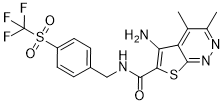
VU0467154 (VU-0467154) is a novel and potent M4 PAM (positive allosteric modulator) with the potential to be used as a novel approach for the treatment of psychotic symptoms associated with schizophrenia and other neuropsychiatric disorders. Acting on muscarinic acetylcholine receptor (mAChR). VU0467154 exhibits robust APD-like and cognitive enhancing activity in rodents. Selective M4 PAMs could provide a therapeutic strategy for the treatment of HD.
Physicochemical Properties
| Molecular Formula | C17H15F3N4O3S2 |
| Molecular Weight | 444.451211214066 |
| Exact Mass | 444.054 |
| CAS # | 1451993-15-9 |
| Related CAS # | 1451993-15-9; |
| PubChem CID | 73774630 |
| Appearance | Light yellow to yellow solid powder |
| LogP | 5.166 |
| Hydrogen Bond Donor Count | 2 |
| Hydrogen Bond Acceptor Count | 10 |
| Rotatable Bond Count | 4 |
| Heavy Atom Count | 29 |
| Complexity | 708 |
| Defined Atom Stereocenter Count | 0 |
| InChi Key | UDSFKIFLJPECRN-UHFFFAOYSA-N |
| InChi Code | InChI=1S/C17H15F3N4O3S2/c1-8-9(2)23-24-16-12(8)13(21)14(28-16)15(25)22-7-10-3-5-11(6-4-10)29(26,27)17(18,19)20/h3-6H,7,21H2,1-2H3,(H,22,25) |
| Chemical Name | 5-amino-3,4-dimethyl-N-[[4-(trifluoromethylsulfonyl)phenyl]methyl]thieno[2,3-c]pyridazine-6-carboxamide |
| HS Tariff Code | 2934.99.9001 |
| Storage |
Powder-20°C 3 years 4°C 2 years In solvent -80°C 6 months -20°C 1 month |
| Shipping Condition | Room temperature (This product is stable at ambient temperature for a few days during ordinary shipping and time spent in Customs) |
Biological Activity
| ln Vitro | VU0467154 is a muscarinic acetylcholine receptor (mAChR) positive allosteric modulator that has pEC50s of 7.75, 6.2, and 6.2 for rat, human, and cynomolgus monkey (cyno) M4 receptors, respectively. It can greatly increase the responsiveness to ACh. 6. In rats and humans, VU0467154 did not increase ACh responses in M1, M2, M3, or M5 [1]. |
| ln Vivo | Rats' amphetamine-induced hyperlocomotion is reversed by VU0467154 (1–56.6 mg/kg, oral or intraperitoneal injection). In wild-type mice, VU0467154 (0.3-30 mg/kg, ip) reverses the hyperlocomotion caused by amphetamine and MK-801, but not in M4 KO mice. In wild-type mice, VU0467154 alone also improves the learning of context- and cue-mediated fear conditioning [1]. |
| References |
[1]. Selective activation of M4 muscarinic acetylcholine receptors reverses MK-801-induced behavioral impairments and enhances associative learning in rodents. ACS Chem Neurosci. 2014 Oct 15;5(10):920-42. |
Solubility Data
| Solubility (In Vitro) | DMSO : ~13.89 mg/mL (~31.25 mM) |
| Solubility (In Vivo) |
Solubility in Formulation 1: 1.39 mg/mL (3.13 mM) in 10% DMSO + 40% PEG300 +5% Tween-80 + 45% Saline (add these co-solvents sequentially from left to right, and one by one), suspension solution; with sonication. For example, if 1 mL of working solution is to be prepared, you can add 100 μL of 13.9 mg/mL clear DMSO stock solution to 400 μL PEG300 and mix evenly; then add 50 μL Tween-80 + to the above solution and mix evenly; then add 450 μL normal saline to adjust the volume to 1 mL. Preparation of saline: Dissolve 0.9 g of sodium chloride in 100 mL ddH₂ O to obtain a clear solution. (Please use freshly prepared in vivo formulations for optimal results.) |
| Preparing Stock Solutions | 1 mg | 5 mg | 10 mg | |
| 1 mM | 2.2500 mL | 11.2499 mL | 22.4997 mL | |
| 5 mM | 0.4500 mL | 2.2500 mL | 4.4999 mL | |
| 10 mM | 0.2250 mL | 1.1250 mL | 2.2500 mL |