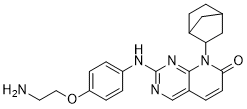
Physicochemical Properties
| Molecular Formula | C22H25N5O2 |
| Molecular Weight | 391.466204404831 |
| Exact Mass | 391.2 |
| CAS # | 1430218-51-1 |
| PubChem CID | 89510076 |
| Appearance | Light yellow to yellow solid powder |
| Density | 1.3±0.1 g/cm3 |
| Boiling Point | 611.9±65.0 °C at 760 mmHg |
| Flash Point | 323.9±34.3 °C |
| Vapour Pressure | 0.0±1.8 mmHg at 25°C |
| Index of Refraction | 1.679 |
| LogP | 1.87 |
| Hydrogen Bond Donor Count | 2 |
| Hydrogen Bond Acceptor Count | 6 |
| Rotatable Bond Count | 6 |
| Heavy Atom Count | 29 |
| Complexity | 620 |
| Defined Atom Stereocenter Count | 0 |
| InChi Key | RCSLGYIVHUXZCI-UHFFFAOYSA-N |
| InChi Code | InChI=1S/C22H25N5O2/c23-9-10-29-18-6-4-17(5-7-18)25-22-24-13-16-3-8-20(28)27(21(16)26-22)19-12-14-1-2-15(19)11-14/h3-8,13-15,19H,1-2,9-12,23H2,(H,24,25,26) |
| Chemical Name | 2-[4-(2-Aminoethoxy)anilino]-8-(3-bicyclo[2.2.1]heptanyl)pyrido[2,3-d]pyrimidin-7-one |
| Synonyms | VI16832 VI 16832 VI-16832 |
| HS Tariff Code | 2934.99.9001 |
| Storage |
Powder-20°C 3 years 4°C 2 years In solvent -80°C 6 months -20°C 1 month |
| Shipping Condition | Room temperature (This product is stable at ambient temperature for a few days during ordinary shipping and time spent in Customs) |
Biological Activity
| ln Vitro | VI 16832 is a type I kinase inhibitor with a broad spectrum [1]. More than 8500 phosphopeptides were found by phosphoproteomic analysis of VI 16832-enriched fractions in MV4-11, HCT116, or 435S cells. These correspond to 212 distinct protein kinase superfamily members, or around 1700 distinct phosphopeptide compounds. The overall number of discovered phosphorylation sites on protein kinases was greatly increased by analysis of VI 16832 retained proteins from three cancer cell lines. When calculating the total phosphopeptide intensities to determine the quantity of protein enriched in VI 16832, protein kinases accounted for more than 80% of the total [2]. |
| References |
[1]. Proteomic Analysis Defines Kinase Taxonomies Specific for Subtypes of Breast Cancer. Apr. 1, 2017. [2]. Large-scale Proteomics Analysis of the Human Kinome. Mol Cell Proteomics. 2009 Jul; 8(7): 1751-1764. |
Solubility Data
| Solubility (In Vitro) | DMSO : ~33.33 mg/mL (~85.14 mM) |
| Solubility (In Vivo) |
Solubility in Formulation 1: ≥ 2.5 mg/mL (6.39 mM) (saturation unknown) in 10% DMSO + 40% PEG300 +5% Tween-80 + 45% Saline (add these co-solvents sequentially from left to right, and one by one), clear solution. For example, if 1 mL of working solution is to be prepared, you can add 100 μL of 25.0 mg/mL clear DMSO stock solution to 400 μL PEG300 and mix evenly; then add 50 μL Tween-80 + to the above solution and mix evenly; then add 450 μL normal saline to adjust the volume to 1 mL. Preparation of saline: Dissolve 0.9 g of sodium chloride in 100 mL ddH₂ O to obtain a clear solution. (Please use freshly prepared in vivo formulations for optimal results.) |
| Preparing Stock Solutions | 1 mg | 5 mg | 10 mg | |
| 1 mM | 2.5545 mL | 12.7724 mL | 25.5447 mL | |
| 5 mM | 0.5109 mL | 2.5545 mL | 5.1089 mL | |
| 10 mM | 0.2554 mL | 1.2772 mL | 2.5545 mL |