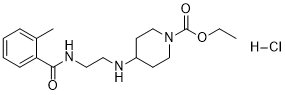
VU0357017 HCI (formerly CID-25010775) is a potent and highly selective M1 agonists that appear to act at an allosteric site to activate the receptor with EC50 of 477 ± 172 nM and pEC50 of 6.37 ± 0.15). VU0357017 is a highly selective M1 agonist implies that these substances are more likely to function as allosteric agonists rather than at the highly conserved orthosteric site on M1.In a rodent model of contextual fear conditioning, optimized compounds like VU0357017 have strong in vivo efficacy in reversing scopolamine-induced deficits and offer excellent brain exposure following systemic dosing.
Physicochemical Properties
| Molecular Formula | C18H28CLN3O3 | |
| Molecular Weight | 369.89 | |
| Exact Mass | 369.182 | |
| Elemental Analysis | C, 58.45; H, 7.63; Cl, 9.58; N, 11.36; O, 12.98 | |
| CAS # | 1135242-13-5 | |
| Related CAS # |
|
|
| PubChem CID | 25010775 | |
| Appearance | White to off-white solid powder | |
| LogP | 3.64 | |
| Hydrogen Bond Donor Count | 3 | |
| Hydrogen Bond Acceptor Count | 4 | |
| Rotatable Bond Count | 7 | |
| Heavy Atom Count | 25 | |
| Complexity | 408 | |
| Defined Atom Stereocenter Count | 0 | |
| SMILES | Cl[H].O(C([H])([H])C([H])([H])[H])C(N1C([H])([H])C([H])([H])C([H])(C([H])([H])C1([H])[H])N([H])C([H])([H])C([H])([H])N([H])C(C1=C([H])C([H])=C([H])C([H])=C1C([H])([H])[H])=O)=O |
|
| InChi Key | XKJQVUIXSBOCPP-UHFFFAOYSA-N | |
| InChi Code | InChI=1S/C18H27N3O3.ClH/c1-3-24-18(23)21-12-8-15(9-13-21)19-10-11-20-17(22)16-7-5-4-6-14(16)2;/h4-7,15,19H,3,8-13H2,1-2H3,(H,20,22);1H | |
| Chemical Name | ethyl 4-[2-[(2-methylbenzoyl)amino]ethylamino]piperidine-1-carboxylate;hydrochloride | |
| Synonyms |
|
|
| HS Tariff Code | 2934.99.9001 | |
| Storage |
Powder-20°C 3 years 4°C 2 years In solvent -80°C 6 months -20°C 1 month Note: Please store this product in a sealed and protected environment, avoid exposure to moisture. |
|
| Shipping Condition | Room temperature (This product is stable at ambient temperature for a few days during ordinary shipping and time spent in Customs) |
Biological Activity
| Targets | M1 mAChR ( IC50 = 477 nM ); M1 mAChR ( Ki = 9.91 μM ) |
| ln Vitro | In vitroactivity: VU0357017 is an M1-selective agonist that acts at an allosteric site to appear to activate M1. Based on competition binding experiment, the Ki values of VU0357017 are 9.91 (rM1), 21.4 (rM2), 55.3 (rM3), 35 (rM4), and 50 (rM5), in that order. Being a highly selective M1 agonist, VU0357017 indicates that these substances are more likely to function as allosteric agonists than at the highly conserved orthosteric site on M1. |
| ln Vivo | VU0357017 significantly enhances hippocampal-dependent learning in rats. In rats, VU0357017 improves contextual fear conditioning and Morris water maze performance. |
| Animal Protocol |
Male Sprague−Dawley rats (380-420 g) were pretreated with scopolamine 1, 3, 10 mg/kg A single i.p. |
| References |
[1]. Chemical modification of the M(1) agonist VU0364572 reveals molecular switches in pharmacology and a bitopic binding mode. ACS Chem Neurosci. 2012 Dec 19;3(12):1025-36. [2]. Discovery and characterization of novel subtype-selective allosteric agonists for the investigation of M(1) receptor function in the central nervous system. ACS Chem Neurosci. 2010;1(2):104-121. [3]. Novel allosteric agonists of M1 muscarinic acetylcholine receptors induce brain region-specific responses that correspond with behavioral effects in animal models. J Neurosci. 2012 Jun 20;32(25):8532-44. |
Solubility Data
| Solubility (In Vitro) |
DMSO: 25~38 mg/mL (67.6~102.7 mM) Water: ~10 mg/mL Ethanol: ~2 mg/mL |
| Solubility (In Vivo) |
Solubility in Formulation 1: ≥ 2.5 mg/mL (6.76 mM) (saturation unknown) in 10% DMSO + 40% PEG300 + 5% Tween80 + 45% Saline (add these co-solvents sequentially from left to right, and one by one), clear solution. For example, if 1 mL of working solution is to be prepared, you can add 100 μL of 25.0 mg/mL clear DMSO stock solution to 400 μL PEG300 and mix evenly; then add 50 μL Tween-80 to the above solution and mix evenly; then add 450 μL normal saline to adjust the volume to 1 mL. Preparation of saline: Dissolve 0.9 g of sodium chloride in 100 mL ddH₂ O to obtain a clear solution. Solubility in Formulation 2: ≥ 2.5 mg/mL (6.76 mM) (saturation unknown) in 10% DMSO + 90% (20% SBE-β-CD in Saline) (add these co-solvents sequentially from left to right, and one by one), clear solution. For example, if 1 mL of working solution is to be prepared, you can add 100 μL of 25.0 mg/mL clear DMSO stock solution to 900 μL of 20% SBE-β-CD physiological saline solution and mix evenly. Preparation of 20% SBE-β-CD in Saline (4°C,1 week): Dissolve 2 g SBE-β-CD in 10 mL saline to obtain a clear solution. Solubility in Formulation 3: ≥ 2.5 mg/mL (6.76 mM) (saturation unknown) in 10% DMSO + 90% Corn Oil (add these co-solvents sequentially from left to right, and one by one), clear solution. For example, if 1 mL of working solution is to be prepared, you can add 100 μL of 25.0 mg/mL clear DMSO stock solution to 900 μL of corn oil and mix evenly. Solubility in Formulation 4: 33.33 mg/mL (90.11 mM) in PBS (add these co-solvents sequentially from left to right, and one by one), clear solution; with ultrasonication. (Please use freshly prepared in vivo formulations for optimal results.) |
| Preparing Stock Solutions | 1 mg | 5 mg | 10 mg | |
| 1 mM | 2.7035 mL | 13.5175 mL | 27.0351 mL | |
| 5 mM | 0.5407 mL | 2.7035 mL | 5.4070 mL | |
| 10 mM | 0.2704 mL | 1.3518 mL | 2.7035 mL |