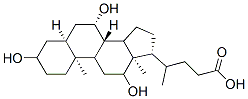
Ursocholic acid (UCA), a bile acid and the 7β-hydroxyepimer of cholic acid, is found predominantly in bile of mammals, and can be transformed into deoxycholic acid by the intestinal microflora in mice.
Physicochemical Properties
| Molecular Formula | C₂₄H₄₀O₅ |
| Molecular Weight | 408.57 |
| Exact Mass | 408.288 |
| CAS # | 2955-27-3 |
| PubChem CID | 122340 |
| Appearance | White to off-white solid powder |
| Density | 1.184g/cm3 |
| Boiling Point | 583.9ºC at 760mmHg |
| Flash Point | 321ºC |
| LogP | 3.448 |
| Hydrogen Bond Donor Count | 4 |
| Hydrogen Bond Acceptor Count | 5 |
| Rotatable Bond Count | 4 |
| Heavy Atom Count | 29 |
| Complexity | 637 |
| Defined Atom Stereocenter Count | 11 |
| SMILES | C[C@H](CCC(=O)O)[C@H]1CC[C@@H]2[C@@]1([C@H](C[C@H]3[C@H]2[C@H](C[C@H]4[C@@]3(CC[C@H](C4)O)C)O)O)C |
| InChi Key | BHQCQFFYRZLCQQ-UTLSPDKDSA-N |
| InChi Code | InChI=1S/C24H40O5/c1-13(4-7-21(28)29)16-5-6-17-22-18(12-20(27)24(16,17)3)23(2)9-8-15(25)10-14(23)11-19(22)26/h13-20,22,25-27H,4-12H2,1-3H3,(H,28,29)/t13-,14+,15-,16-,17+,18+,19+,20+,22+,23+,24-/m1/s1 |
| Chemical Name | (4R)-4-[(3R,5S,7S,8R,9S,10S,12S,13R,14S,17R)-3,7,12-trihydroxy-10,13-dimethyl-2,3,4,5,6,7,8,9,11,12,14,15,16,17-tetradecahydro-1H-cyclopenta[a]phenanthren-17-yl]pentanoic acid |
| Synonyms | 7-Epicholic acid Ursodeoxycholic Acid EP Impurity D 3alpha,7beta,12alpha-Trihydroxy-5beta-cholanic acid 3a,7b,12a-Trihydroxycholanate (3α,5β,7β,12α)-3,7,12-Trihydroxycholan-24-oic Acid |
| HS Tariff Code | 2934.99.9001 |
| Storage |
Powder-20°C 3 years 4°C 2 years In solvent -80°C 6 months -20°C 1 month |
| Shipping Condition | Room temperature (This product is stable at ambient temperature for a few days during ordinary shipping and time spent in Customs) |
Biological Activity
| References |
[1]. Formation of ursodeoxycholic acid from chenodeoxycholic acid by a 7 beta-hydroxysteroid dehydrogenase-elaborating Eubacterium aerofaciens strain cocultured with 7 alpha-hydroxysteroid dehydrogenase-elaborating organisms. Appl Environ Microbiol. 1982 Nov;44(5):1187-95. [2]. Ursodeoxycholic acid, an inhibitor of hepatocyte nuclear factor 1α, did not increase the systemic exposure of pitavastatin. Int J Clin Pharmacol Ther. 2014 Nov;52(11):981-5. [3]. Ursodeoxycholic acid: mechanism of action and novel clinical applications. Hepatology Research 38.2 (2008): 123-131. [4]. Ursodeoxycholic acid attenuates 5‑fluorouracil‑induced mucositis in a rat model. Oncology letters 16.2 (2018): 2585-2590. [5]. Ursodeoxycholic acid increases differentiation and mineralization and neutralizes the damaging effects of bilirubin on osteoblastic cells. Liver international 33.7 (2013): 1029-1038. |
| Additional Infomation |
Ursocholic acid is a bile acid that is 5beta-cholan-24-oic acid bearing three hydroxy substituents at positions 3alpha, 7beta and 12alpha. It has a role as a human urinary metabolite and an EC 1.1.1.159 (7alpha-hydroxysteroid dehydrogenase) inhibitor. It is a bile acid, a 3alpha-hydroxy steroid, a 12alpha-hydroxy steroid, a C24-steroid, a trihydroxy-5beta-cholanic acid and a 7beta-hydroxy steroid. It is a conjugate acid of an ursocholate. See also: Ursocholate (annotation moved to). |
Solubility Data
| Solubility (In Vitro) |
DMSO : ~100 mg/mL (~244.76 mM) H2O : < 0.1 mg/mL |
| Solubility (In Vivo) |
Solubility in Formulation 1: ≥ 2.5 mg/mL (6.12 mM) (saturation unknown) in 10% DMSO + 40% PEG300 + 5% Tween80 + 45% Saline (add these co-solvents sequentially from left to right, and one by one), clear solution. For example, if 1 mL of working solution is to be prepared, you can add 100 μL of 25.0 mg/mL clear DMSO stock solution to 400 μL PEG300 and mix evenly; then add 50 μL Tween-80 to the above solution and mix evenly; then add 450 μL normal saline to adjust the volume to 1 mL. Preparation of saline: Dissolve 0.9 g of sodium chloride in 100 mL ddH₂ O to obtain a clear solution. Solubility in Formulation 2: ≥ 2.5 mg/mL (6.12 mM) (saturation unknown) in 10% DMSO + 90% (20% SBE-β-CD in Saline) (add these co-solvents sequentially from left to right, and one by one), clear solution. For example, if 1 mL of working solution is to be prepared, you can add 100 μL of 25.0 mg/mL clear DMSO stock solution to 900 μL of 20% SBE-β-CD physiological saline solution and mix evenly. Preparation of 20% SBE-β-CD in Saline (4°C,1 week): Dissolve 2 g SBE-β-CD in 10 mL saline to obtain a clear solution. Solubility in Formulation 3: ≥ 2.5 mg/mL (6.12 mM) (saturation unknown) in 10% DMSO + 90% Corn Oil (add these co-solvents sequentially from left to right, and one by one), clear solution. For example, if 1 mL of working solution is to be prepared, you can add 100 μL of 25.0 mg/mL clear DMSO stock solution to 900 μL of corn oil and mix evenly. (Please use freshly prepared in vivo formulations for optimal results.) |
| Preparing Stock Solutions | 1 mg | 5 mg | 10 mg | |
| 1 mM | 2.4476 mL | 12.2378 mL | 24.4756 mL | |
| 5 mM | 0.4895 mL | 2.4476 mL | 4.8951 mL | |
| 10 mM | 0.2448 mL | 1.2238 mL | 2.4476 mL |