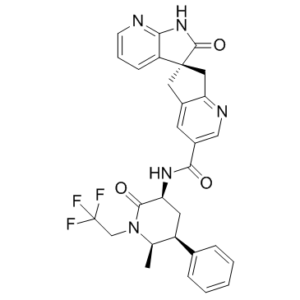
Ubrogepant (formerly known as MK-1602; MK1602; Ubrelvy) is a novel, potent, orally bioavailable antagonist of calcitonin gene-related peptide receptor (CGRP) approved in 2019 for the acute treatment of migraine with or without aura in adults. Ubrogepant was about to move into phase 2 development at the time of implementation. In order to facilitate exposure-response modeling, DBS (dried blood spots) was used to gather PK data close to an acute migraine event. A spontaneous event, which typically takes place outside of a clinic visit, was the clinical endpoint. Facilitating DBS in an outpatient setting was, therefore, a novel aspect of this trial. The first method's suitability for additional clinical evaluations was determined by in vitro and bioanalytical tests. In a phase 1 (healthy subjects) and phase 2 (target patient population) study, a quantitative relationship between blood and plasma concentrations from concurrently collected samples was established using graphical and population PK approaches. The Food and Drug Administration was given access to this comprehensive data for regulatory comment. After receiving regulatory approval, DBS was ready to be used in additional clinical trials. To identify the sources of variability influencing DBS collection in the outpatient context, population PK modeling was applied. The knowledge gained from this program has influenced Merck & Co., Inc.'s (Kenilworth, NJ) more comprehensive integrated strategy for DBS implementation in clinical trials and research to increase the accuracy of PK data obtained in an outpatient setting.
Physicochemical Properties
| Molecular Formula | C29H26F3N5O3 |
| Molecular Weight | 549.54364 |
| Exact Mass | 549.199 |
| Elemental Analysis | C, 63.38; H, 4.77; F, 10.37; N, 12.74; O, 8.73 |
| CAS # | 1374248-77-7 |
| PubChem CID | 68748835 |
| Appearance | White to off-white solid powder |
| Density | 1.45±0.1 g/cm3(Predicted) |
| Boiling Point | 729.4±60.0 °C(Predicted) |
| LogP | 4.128 |
| Hydrogen Bond Donor Count | 2 |
| Hydrogen Bond Acceptor Count | 8 |
| Rotatable Bond Count | 4 |
| Heavy Atom Count | 40 |
| Complexity | 1000 |
| Defined Atom Stereocenter Count | 4 |
| SMILES | O=C(C1=CN=C2C(C[C@@]3(C4=CC=CN=C4NC3=O)C2)=C1)N[C@@H]5C(N(CC(F)(F)F)[C@H](C)[C@H](C6=CC=CC=C6)C5)=O |
| InChi Key | DDOOFTLHJSMHLN-ZQHRPCGSSA-N |
| InChi Code | InChI=1S/C29H26F3N5O3/c1-16-20(17-6-3-2-4-7-17)11-22(26(39)37(16)15-29(30,31)32)35-25(38)19-10-18-12-28(13-23(18)34-14-19)21-8-5-9-33-24(21)36-27(28)40/h2-10,14,16,20,22H,11-13,15H2,1H3,(H,35,38)(H,33,36,40)/t16-,20-,22+,28+/m1/s1 |
| Chemical Name | (3S)-N-[(3S,5S,6R)-6-methyl-2-oxo-5-phenyl-1-(2,2,2-trifluoroethyl)piperidin-3-yl]-2-oxospiro[1H-pyrrolo[2,3-b]pyridine-3,6'-5,7-dihydrocyclopenta[b]pyridine]-3'-carboxamide |
| Synonyms | Ubrogepant; MK1602; MK-1602; 1374248-77-7; Ubrelvy; Ubrogepant anhydrous; UNII-AD0O8X2QJR; AD0O8X2QJR; DTXSID00160178;MK1602; trade name: Ubrelvy |
| HS Tariff Code | 2934.99.9001 |
| Storage |
Powder-20°C 3 years 4°C 2 years In solvent -80°C 6 months -20°C 1 month |
| Shipping Condition | Room temperature (This product is stable at ambient temperature for a few days during ordinary shipping and time spent in Customs) |
Biological Activity
| Targets | CGRP receptor ( IC50 = 0.081 nM ) |
| ln Vitro | Ubrogepant is a Calcitonin Gene-related Peptide Receptor Antagonist. The mechanism of action of ubrogepant is as a Calcitonin Gene-related Peptide Receptor Antagonist. Ubrogepant is a small molecule inhibitor of the calcitonin gene-related peptide (CGRP) receptor that blocks the action of CGRP, a potent vasodilator believed to play a role in migraine headaches. |
| ln Vivo | Merck & Co., Inc. (Kenilworth, New Jersey) has recently published an integrated strategy for implementation of dried blood spots (DBS) in late-stage trials for population pharmacokinetic (PK) modeling. We applied this strategy for another late-stage clinical program: ubrogepant (MK-1602), a novel oral calcitonin gene-related peptide receptor antagonist for acute treatment of migraine. At the time of implementation, ubrogepant was entering phase 2 development. DBS was implemented to acquire PK information proximal to an acute migraine event to enable exposure-response modeling. The clinical endpoint was a spontaneous event, which generally occurs outside a clinic visit. Thus, an innovative feature of this trial was facilitating DBS in an outpatient setting. In vitro and bioanalytical tests established initial method feasibility and suitability for further evaluations in the clinic. A quantitative relationship was developed between blood and plasma concentrations from concurrently collected samples in a phase 1 (healthy subjects) and phase 2 (target patient population) study using graphical and population PK approaches. This integrated information was presented to the Food and Drug Administration for regulatory input. Following regulatory concurrence, DBS was poised for use in further clinical studies. Population PK modeling was used to dissect sources of variability contributing to DBS collection in the outpatient setting. What has been learned from this program has informed the broader integrated strategy of Merck & Co., Inc. (Kenilworth, NJ) for DBS implementation in clinical trials and research to improve the precision of PK data collected in an outpatient setting.[1] |
| ADME/Pharmacokinetics |
Absorption, Distribution and Excretion Following oral administration, Tmax occurs between 0.7 and 1.5 h. When administered with a high-fat meal, Tmax is delayed by approximately 2 hours and Cmax was reduced by 22% with no significant changes to the AUC. Ubrogepant exhibits dose-proportional pharmacokinetics throughout the entirety of its recommended dosing range. The main route of elimination is fecal/biliary, while renal excretion is comparatively minor - following administration of a single oral dose to healthy subjects, approximately 42% of the dose was recovered unchanged in the feces and 6% was recovered unchanged in the urine. The apparent central volume of distribution following oral administration is approximately 350 L. The apparent oral clearance of ubrogepant is approximately 87 L/h. Metabolism / Metabolites Ubrogepant is eliminated primarily via metabolism, the majority of which is mediated by CYP3A4. Two circulating glucuronide conjugates, along with unchanged parent drug, were found to be the most abundant circulating components in human plasma. The glucuronide metabolites reportedly carry 6000-fold less activity at CGRP receptors and are therefore considered to be pharmacologically inert. Biological Half-Life Ubrogepant has an elimination half-life of 5-7 hours. |
| Toxicity/Toxicokinetics |
Hepatotoxicity In preregistration controlled trials of ubrogepant in several thousand patients, mild-to-moderate serum aminotransferase elevations arose in a small percentage of patients (1% to 2%) and overall rates were not different from those in placebo recipients. In the controlled trials and subsequently with general use, there have been no reports of clinically apparent liver injury attributed to ubrogepant. In contrast, telcagepant, the initial oral CGRP receptor antagonist evaluated as therapy for migraine headaches, was abandoned during development because of several instances of clinically apparent liver injury in recipients that was characterized by marked elevations in serum aminotransferase levels and symptoms of fatigue, nausea and abdominal discomfort arising within 2 to 4 weeks of starting therapy which rapidly resolved with prompt stopping of therapy. Similar episodes have not been reported with ubrogepant. Likelihood score: E (unlikely cause of clinically apparent acute liver injury). Effects During Pregnancy and Lactation ◉ Summary of Use during Lactation There is no published experience with ubrogepant during breastfeeding. Ubrogepant is 87% protein bound, so levels in milk are likely low. If ubrogepant is required by the mother of an older infant, it is not a reason to discontinue breastfeeding, but until more data become available, an alternate drug may be preferred, especially while nursing a newborn or preterm infant. ◉ Effects in Breastfed Infants Relevant published information was not found as of the revision date. ◉ Effects on Lactation and Breastmilk Relevant published information was not found as of the revision date. Protein Binding Ubrogepant is 87% protein-bound _in vitro_, although the specific proteins to which ubrogepant binds have not been elucidated. |
| References |
[1]. Population PK Analyses of Ubrogepant (MK-1602), a CGRP Receptor Antagonist: Enriching In-Clinic Plasma PK Sampling With Outpatient Dried Blood Spot Sampling. J Clin Pharmacol. 2017 Nov 14. doi: 10.1002/jcph.1021. |
| Additional Infomation |
Pharmacodynamics Ubrogepant acutely treats migraine headache pain by blocking the activity of a key transmitter involved in migraine pathogenesis. Exposure to ubrogepant can be significantly increased in patients with severe hepatic or renal insufficiency - dose adjustments are required for these patients in order to avoid excessive exposure, and ubrogepant is not recommended in patients with end-stage renal disease. |
Solubility Data
| Solubility (In Vitro) |
DMSO: 100~250 mg/mL (182~454.9 mM) Ethanol: ~50 mg/mL |
| Solubility (In Vivo) |
Solubility in Formulation 1: ≥ 6.25 mg/mL (11.37 mM) (saturation unknown) in 10% DMSO + 90% (20% SBE-β-CD in Saline) (add these co-solvents sequentially from left to right, and one by one), clear solution. For example, if 1 mL of working solution is to be prepared, you can add 100 μL of 62.5 mg/mL clear DMSO stock solution to 900 μL of 20% SBE-β-CD physiological saline solution and mix evenly. Preparation of 20% SBE-β-CD in Saline (4°C,1 week): Dissolve 2 g SBE-β-CD in 10 mL saline to obtain a clear solution. Solubility in Formulation 2: ≥ 6.25 mg/mL (11.37 mM) (saturation unknown) in 10% DMSO + 90% Corn Oil (add these co-solvents sequentially from left to right, and one by one), clear solution. For example, if 1 mL of working solution is to be prepared, you can add 100 μL of 62.5 mg/mL clear DMSO stock solution to 900 μL corn oil and mix evenly. Solubility in Formulation 3: ≥ 5 mg/mL (9.10 mM) (saturation unknown) in 10% DMSO + 40% PEG300 + 5% Tween80 + 45% Saline (add these co-solvents sequentially from left to right, and one by one), clear solution. For example, if 1 mL of working solution is to be prepared, you can add 100 μL of 50.0 mg/mL clear DMSO stock solution to 400 μL PEG300 and mix evenly; then add 50 μL Tween-80 to the above solution and mix evenly; then add 450 μL normal saline to adjust the volume to 1 mL. Preparation of saline: Dissolve 0.9 g of sodium chloride in 100 mL ddH₂ O to obtain a clear solution. Solubility in Formulation 4: 5%DMSO + 40%PEG300 + 5%Tween 80 + 50%ddH2O: 5.0mg/ml (9.10mM) (Please use freshly prepared in vivo formulations for optimal results.) |
| Preparing Stock Solutions | 1 mg | 5 mg | 10 mg | |
| 1 mM | 1.8197 mL | 9.0985 mL | 18.1970 mL | |
| 5 mM | 0.3639 mL | 1.8197 mL | 3.6394 mL | |
| 10 mM | 0.1820 mL | 0.9099 mL | 1.8197 mL |