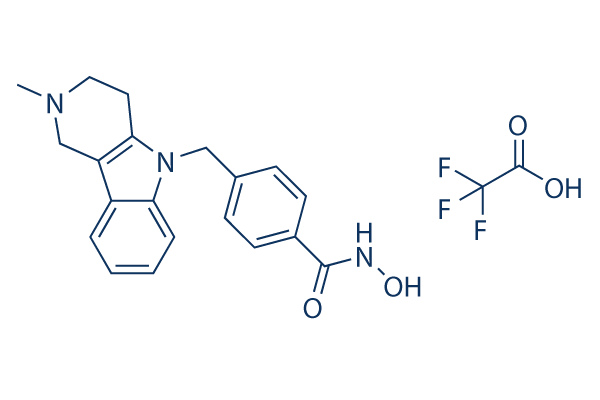
Tubastatin A (TubA, AG-CR13900) TFA, the trifluoroacetic acid salt of TubA, is an inhibitor of HDAC6 with anticancer and anti-inflammatory activity. Tubastatin A also conferred dose-dependent protection in primary cortical neuron cultures against glutathione depletion-induced oxidative stress.
Physicochemical Properties
| Molecular Formula | C20H21N3O2 |
| Molecular Weight | 335.39964 |
| Exact Mass | 335.163 |
| Elemental Analysis | C, 58.79; H, 4.93; F, 12.68; N, 9.35; O, 14.24 |
| CAS # | 1239262-52-2 |
| Related CAS # | Tubastatin A Hydrochloride;1310693-92-5;Tubastatin A;1252003-15-8 |
| PubChem CID | 50898504 |
| Appearance | Typically exists as solid at room temperature |
| Density | 1.3±0.1 g/cm3 |
| Index of Refraction | 1.668 |
| LogP | 2.14 |
| Hydrogen Bond Donor Count | 3 |
| Hydrogen Bond Acceptor Count | 8 |
| Rotatable Bond Count | 3 |
| Heavy Atom Count | 32 |
| Complexity | 561 |
| Defined Atom Stereocenter Count | 0 |
| SMILES | O=C(NO)C1=CC=C(CN2C3=C(CN(C)CC3)C4=C2C=CC=C4)C=C1.O=C(O)C(F)(F)F |
| InChi Key | AVAOVICSJJIYRZ-UHFFFAOYSA-N |
| InChi Code | InChI=1S/C20H21N3O2.C2HF3O2/c1-22-11-10-19-17(13-22)16-4-2-3-5-18(16)23(19)12-14-6-8-15(9-7-14)20(24)21-25;3-2(4,5)1(6)7/h2-9,25H,10-13H2,1H3,(H,21,24);(H,6,7) |
| Chemical Name | N-hydroxy-4-[(2-methyl-3,4-dihydro-1H-pyrido[4,3-b]indol-5-yl)methyl]benzamide;2,2,2-trifluoroacetic acid |
| Synonyms | 1239262-52-2; N-Hydroxy-4-((2-methyl-3,4-dihydro-1H-pyrido[4,3-b]indol-5(2H)-yl)methyl)benzamide 2,2,2-trifluoroacetate; Tubastatin A TFA; Tubastatin TFA salt; Tubastatin A (TFA); N-hydroxy-4-[(2-methyl-3,4-dihydro-1H-pyrido[4,3-b]indol-5-yl)methyl]benzamide;2,2,2-trifluoroacetic acid; Tubastatin A (trifluoroacetate salt); Benzamide, N-hydroxy-4-[(1,2,3,4-tetrahydro-2-methyl-5H-pyrido[4,3-b]indol-5-yl)methyl]-, 2,2,2-trifluoroacetate (1:1); |
| HS Tariff Code | 2934.99.9001 |
| Storage |
Powder-20°C 3 years 4°C 2 years In solvent -80°C 6 months -20°C 1 month |
| Shipping Condition | Room temperature (This product is stable at ambient temperature for a few days during ordinary shipping and time spent in Customs) |
Biological Activity
| Targets | DAC6 ( IC50 = 15 nM ); HDAC8 ( IC50 = 854 nM ); HDAC1 ( IC50 = 16400 nM ) | ||
| ln Vitro | With the exception of HDAC8, where it displays about 57-fold selectivity, tubastatin A exhibits > 1000-fold selectivity against all 11 HDAC isoforms and is highly selective for all 11. Tubastatin A shows dose-dependent protection against homocysteic acid (HCA)-induced neuronal cell death in assays for HCA-induced neurodegeneration, beginning at 5 μM and reaching nearly full protection at 10 μM[1]. In vitro, Foxp3+ T-regulatory cells (Tregs) reduce T cell proliferation more when exposed to 100 ng/mL with tubastatin A[2]. When alpha-tubulin is hyperacetylated early in the myogenic process, tubastatin A administration in CC12 cells would hinder myotube formation; nevertheless, myotube elongation happens when alpha-tubulin is hyperacetylated in myotubes[3]. According to a recent study, treating mouse ovarian cancer cell lines MOSE-E and MOSE-L with tubastatin A enhances cell flexibility as shown by atomic force microscopy (AFM) tests without significantly altering the actin microfilament or microtubule networks[4]. | ||
| ln Vivo | Daily therapy of Tubastatin A at 0.5 mg/kg inhibits HDAC6 to enhance Tregs suppressive activity in mouse models of inflammation and autoimmunity, including numerous kinds of experimental colitis and completely major histocompatibility complex (MHC)-incompatible cardiac allograft rejection[2]. | ||
| Animal Protocol |
|
||
| References |
[1]. Histone deacetylase 6 and heat shock protein 90 control the functions of Foxp3(+) T-regulatory cells. Mol Cell Biol. 2011 May;31(10):2066-78. [2]. Rational Design and Simple Chemistry Yield a Superior, Neuroprotective HDAC6 Inhibitor, Tubastatin A J. Am. Chem. Soc., 2010, 132 (31), pp 10842-10846. [3]. Dysferlin interacts with histone deacetylase 6 and increases alpha-tubulin acetylation. PLoS One. 2011;6(12):e28563. [4]. Actin filaments play a primary role for structural integrity and viscoelastic response in cells. Integr Biol (Camb). 2012 May;4(5):540-9. [5]. HDAC6 Inhibition Promotes Transcription Factor EB Activation and Is Protective in Experimental Kidney Disease. Front Pharmacol. 2018 Feb 1;9:34. [6]. Target deconvolution of HDAC pharmacopoeia reveals MBLAC2 as common off-target. Nat Chem Biol. 2022 Apr 28. |
||
| Additional Infomation |
Tubastatin A is a pyridoindole that is 1,2,3,4-tetrahydro-5H-pyrido[4,3-b]indole which is substituted on the tetrahydropyridine nitrogen by a methyl group and on the indole nitrogen by a p-[N-(hydroxy)aminocarbonyl]benzyl group. It is a histone deacetylase 6 (HDAC6) inhibitor that is selective against all the other isozymes (1000-fold) except HDAC8 (57-fold). It has a role as an EC 3.5.1.98 (histone deacetylase) inhibitor. It is a pyridoindole, a hydroxamic acid and a tertiary amino compound. Structure-based drug design combined with homology modeling techniques were used to develop potent inhibitors of HDAC6 that display superior selectivity for the HDAC6 isozyme compared to other inhibitors. These inhibitors can be assembled in a few synthetic steps, and thus are readily scaled up for in vivo studies. An optimized compound from this series, designated Tubastatin A, was tested in primary cortical neuron cultures in which it was found to induce elevated levels of acetylated alpha-tubulin, but not histone, consistent with its HDAC6 selectivity. Tubastatin A also conferred dose-dependent protection in primary cortical neuron cultures against glutathione depletion-induced oxidative stress. Importantly, when given alone at all concentrations tested, this hydroxamate-containing HDAC6-selective compound displayed no neuronal toxicity, thus, forecasting the potential application of this agent and its analogues to neurodegenerative conditions.[1] Dysferlin is a multi-C2 domain transmembrane protein involved in a plethora of cellular functions, most notably in skeletal muscle membrane repair, but also in myogenesis, cellular adhesion and intercellular calcium signaling. We previously showed that dysferlin interacts with alpha-tubulin and microtubules in muscle cells. Microtubules are heavily reorganized during myogenesis to sustain growth and elongation of the nascent muscle fiber. Microtubule function is regulated by post-translational modifications, such as acetylation of its alpha-tubulin subunit, which is modulated by the histone deacetylase 6 (HDAC6) enzyme. In this study, we identified HDAC6 as a novel dysferlin-binding partner. Dysferlin prevents HDAC6 from deacetylating alpha-tubulin by physically binding to both the enzyme, via its C2D domain, and to the substrate, alpha-tubulin, via its C2A and C2B domains. We further show that dysferlin expression promotes alpha-tubulin acetylation, as well as increased microtubule resistance to, and recovery from, Nocodazole- and cold-induced depolymerization. By selectively inhibiting HDAC6 using Tubastatin A, we demonstrate that myotube formation was impaired when alpha-tubulin was hyperacetylated early in the myogenic process; however, myotube elongation occurred when alpha-tubulin was hyperacetylated in myotubes. This study suggests a novel role for dysferlin in myogenesis and identifies HDAC6 as a novel dysferlin-interacting protein.[3] |
Solubility Data
| Solubility (In Vitro) | May dissolve in DMSO (in most cases), if not, try other solvents such as H2O, Ethanol, or DMF with a minute amount of products to avoid loss of samples |
| Solubility (In Vivo) |
Note: Listed below are some common formulations that may be used to formulate products with low water solubility (e.g. < 1 mg/mL), you may test these formulations using a minute amount of products to avoid loss of samples. Injection Formulations (e.g. IP/IV/IM/SC) Injection Formulation 1: DMSO : Tween 80: Saline = 10 : 5 : 85 (i.e. 100 μL DMSO stock solution → 50 μL Tween 80 → 850 μL Saline) *Preparation of saline: Dissolve 0.9 g of sodium chloride in 100 mL ddH ₂ O to obtain a clear solution. Injection Formulation 2: DMSO : PEG300 :Tween 80 : Saline = 10 : 40 : 5 : 45 (i.e. 100 μL DMSO → 400 μLPEG300 → 50 μL Tween 80 → 450 μL Saline) Injection Formulation 3: DMSO : Corn oil = 10 : 90 (i.e. 100 μL DMSO → 900 μL Corn oil) Example: Take the Injection Formulation 3 (DMSO : Corn oil = 10 : 90) as an example, if 1 mL of 2.5 mg/mL working solution is to be prepared, you can take 100 μL 25 mg/mL DMSO stock solution and add to 900 μL corn oil, mix well to obtain a clear or suspension solution (2.5 mg/mL, ready for use in animals). Injection Formulation 4: DMSO : 20% SBE-β-CD in saline = 10 : 90 [i.e. 100 μL DMSO → 900 μL (20% SBE-β-CD in saline)] *Preparation of 20% SBE-β-CD in Saline (4°C,1 week): Dissolve 2 g SBE-β-CD in 10 mL saline to obtain a clear solution. Injection Formulation 5: 2-Hydroxypropyl-β-cyclodextrin : Saline = 50 : 50 (i.e. 500 μL 2-Hydroxypropyl-β-cyclodextrin → 500 μL Saline) Injection Formulation 6: DMSO : PEG300 : castor oil : Saline = 5 : 10 : 20 : 65 (i.e. 50 μL DMSO → 100 μLPEG300 → 200 μL castor oil → 650 μL Saline) Injection Formulation 7: Ethanol : Cremophor : Saline = 10: 10 : 80 (i.e. 100 μL Ethanol → 100 μL Cremophor → 800 μL Saline) Injection Formulation 8: Dissolve in Cremophor/Ethanol (50 : 50), then diluted by Saline Injection Formulation 9: EtOH : Corn oil = 10 : 90 (i.e. 100 μL EtOH → 900 μL Corn oil) Injection Formulation 10: EtOH : PEG300:Tween 80 : Saline = 10 : 40 : 5 : 45 (i.e. 100 μL EtOH → 400 μLPEG300 → 50 μL Tween 80 → 450 μL Saline) Oral Formulations Oral Formulation 1: Suspend in 0.5% CMC Na (carboxymethylcellulose sodium) Oral Formulation 2: Suspend in 0.5% Carboxymethyl cellulose Example: Take the Oral Formulation 1 (Suspend in 0.5% CMC Na) as an example, if 100 mL of 2.5 mg/mL working solution is to be prepared, you can first prepare 0.5% CMC Na solution by measuring 0.5 g CMC Na and dissolve it in 100 mL ddH2O to obtain a clear solution; then add 250 mg of the product to 100 mL 0.5% CMC Na solution, to make the suspension solution (2.5 mg/mL, ready for use in animals). Oral Formulation 3: Dissolved in PEG400 Oral Formulation 4: Suspend in 0.2% Carboxymethyl cellulose Oral Formulation 5: Dissolve in 0.25% Tween 80 and 0.5% Carboxymethyl cellulose Oral Formulation 6: Mixing with food powders Note: Please be aware that the above formulations are for reference only. InvivoChem strongly recommends customers to read literature methods/protocols carefully before determining which formulation you should use for in vivo studies, as different compounds have different solubility properties and have to be formulated differently. (Please use freshly prepared in vivo formulations for optimal results.) |
| Preparing Stock Solutions | 1 mg | 5 mg | 10 mg | |
| 1 mM | 2.9815 mL | 14.9076 mL | 29.8151 mL | |
| 5 mM | 0.5963 mL | 2.9815 mL | 5.9630 mL | |
| 10 mM | 0.2982 mL | 1.4908 mL | 2.9815 mL |