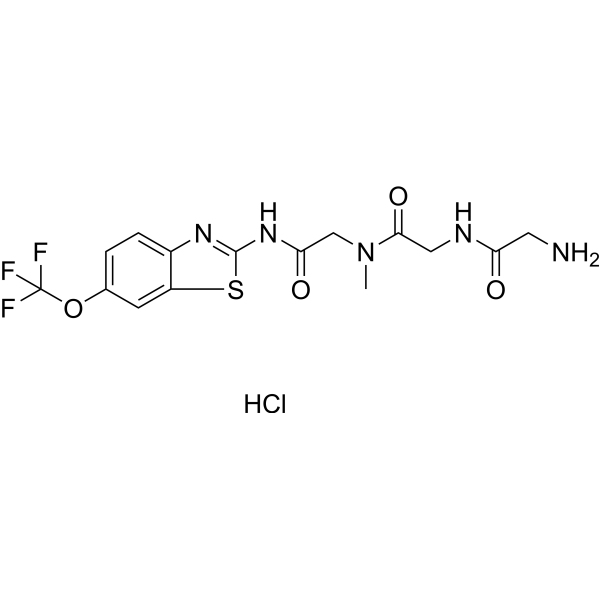
Physicochemical Properties
| Molecular Formula | C15H17CLF3N5O4S |
| Molecular Weight | 455.84 |
| Exact Mass | 455.064187 |
| Elemental Analysis | C, 39.52; H, 3.76; Cl, 7.78; F, 12.50; N, 15.36; O, 14.04; S, 7.03 |
| CAS # | 1926204-76-3 |
| Related CAS # | Troriluzole;1926203-09-9 |
| Appearance | Typically exists as solids at room temperature |
| SMILES | N(C1=NC2=CC=C(OC(F)(F)F)C=C2S1)C(=O)CN(C)C(=O)CNC(=O)CN.Cl |
| Synonyms | BHV-4157 hydrochloride; Troriluzole hydrochloride; BHV4157 hydrochloride; 1926204-76-3; BQ5F77DZS3; Troriluzole hydrochloride [USAN]; UNII-BQ5F77DZS3; BHV-4157; Glycinamide, glycylglycyl-N2-methyl-N-(6-(trifluoromethoxy)-2-benzothiazolyl)-, hydrochloride (1:1); |
| HS Tariff Code | 2934.99.9001 |
| Storage |
Powder-20°C 3 years 4°C 2 years In solvent -80°C 6 months -20°C 1 month |
| Shipping Condition | Room temperature (This product is stable at ambient temperature for a few days during ordinary shipping and time spent in Customs) |
Biological Activity
| Targets | Troriluzole (BHV-4157) functions as a glutamate transporter enhancer, specifically modulating excitatory amino acid transporter 2 (EAAT2) to promote glutamate uptake, thereby reducing extracellular glutamate levels and mitigating excitotoxicity. This mechanism targets the glutamatergic system to restore neurotransmitter balance.[1] |
| ln Vitro |
In Vitro: [1] In primary rat cortical neuron cultures, Troriluzole (BHV-4157) demonstrated significant neuroprotective effects against glutamate-induced cytotoxicity, as evidenced by improved cell viability in MTT assays. Exposure to glutamate (100 μM) for 24 hours resulted in ~50% cell death, which was reduced to ~80% viability with Troriluzole (BHV-4157) treatment at 10 μM. Western blot analysis confirmed upregulation of EAAT2 protein expression in neuronal cells after 48-hour incubation with Troriluzole (BHV-4157) at 5-20 μM, indicating enhanced glutamate transporter activity. |
| ln Vivo |
In Vivo: [1] In a rat model of anxiety (elevated plus maze test), oral administration of Troriluzole (BHV-4157) at 10-30 mg/kg once daily for 7 days significantly reduced anxiety-like behaviors, with a 40% increase in open-arm time compared to controls, demonstrating efficacy in generalized anxiety disorder (GAD) models. In transgenic mouse models of Alzheimer's disease (e.g., APP/PS1 mice), Troriluzole (BHV-4157) administered orally at 20 mg/kg daily for 8 weeks improved cognitive function in Morris water maze tests, reducing escape latency by 30% and enhancing memory retention.[2] |
| Animal Protocol |
Animal Protocol: [1] Troriluzole (BHV-4157) was dissolved in a vehicle solution (e.g., saline with 0.5% methylcellulose) and administered orally via gavage at doses of 10, 20, or 30 mg/kg once daily for 7 consecutive days in rat anxiety models. Behavioral assessments were conducted 1 hour post-dose. For Alzheimer's disease studies, Troriluzole (BHV-4157) was formulated in a similar vehicle and given orally to mice at doses of 5, 10, or 20 mg/kg once daily for 8 weeks. Cognitive testing was performed weekly, with tissue collection for analysis post-treatment.[2] |
| ADME/Pharmacokinetics |
ADME/Pharmacokinetics: [1] Troriluzole (BHV-4157) showed good oral bioavailability of ~60% in rats, with peak plasma concentrations (Cmax) achieved within 2 hours post-administration and a half-life of approximately 4 hours. It is rapidly metabolized to riluzole, the active metabolite, which exhibits linear pharmacokinetics and distributes widely to the brain, with brain-to-plasma ratios of 0.5-0.8. |
| Toxicity/Toxicokinetics |
Toxicity/Toxicokinetics: [1] In repeat-dose toxicity studies, Troriluzole (BHV-4157) was well-tolerated in rats at doses up to 100 mg/kg/day for 28 days, with no observed adverse effects on liver or kidney function based on serum biochemistry. Plasma protein binding was moderate (~70%), and no significant drug-drug interactions were identified in cytochrome P450 inhibition assays. |
| References |
[1]. Novel investigational therapeutics for generalized anxiety disorder (GAD). Expert Opin Investig Drugs. 2019 Nov;28(11):1003-1012. [2]. Clinical trials of new drugs for Alzheimer disease. J Biomed Sci. 2020 Jan 6;27(1):18. |
| Additional Infomation |
Additional Info: [1] Troriluzole (BHV-4157) is a prodrug of riluzole designed to enhance central nervous system delivery, with a novel mechanism targeting glutamate dysregulation in anxiety disorders. Phase 2 clinical trials for generalized anxiety disorder showed significant symptom reduction compared to placebo. It is under investigation for Alzheimer's disease due to its neuroprotective properties, with ongoing clinical trials focusing on cognitive improvement and safety in elderly patients. No FDA warnings have been issued, and it holds potential as a disease-modifying therapy.[2] |
Solubility Data
| Solubility (In Vitro) | May dissolve in DMSO (in most cases), if not, try other solvents such as H2O, Ethanol, or DMF with a minute amount of products to avoid loss of samples |
| Solubility (In Vivo) |
Note: Listed below are some common formulations that may be used to formulate products with low water solubility (e.g. < 1 mg/mL), you may test these formulations using a minute amount of products to avoid loss of samples. Injection Formulations (e.g. IP/IV/IM/SC) Injection Formulation 1: DMSO : Tween 80: Saline = 10 : 5 : 85 (i.e. 100 μL DMSO stock solution → 50 μL Tween 80 → 850 μL Saline) *Preparation of saline: Dissolve 0.9 g of sodium chloride in 100 mL ddH ₂ O to obtain a clear solution. Injection Formulation 2: DMSO : PEG300 :Tween 80 : Saline = 10 : 40 : 5 : 45 (i.e. 100 μL DMSO → 400 μLPEG300 → 50 μL Tween 80 → 450 μL Saline) Injection Formulation 3: DMSO : Corn oil = 10 : 90 (i.e. 100 μL DMSO → 900 μL Corn oil) Example: Take the Injection Formulation 3 (DMSO : Corn oil = 10 : 90) as an example, if 1 mL of 2.5 mg/mL working solution is to be prepared, you can take 100 μL 25 mg/mL DMSO stock solution and add to 900 μL corn oil, mix well to obtain a clear or suspension solution (2.5 mg/mL, ready for use in animals). Injection Formulation 4: DMSO : 20% SBE-β-CD in saline = 10 : 90 [i.e. 100 μL DMSO → 900 μL (20% SBE-β-CD in saline)] *Preparation of 20% SBE-β-CD in Saline (4°C,1 week): Dissolve 2 g SBE-β-CD in 10 mL saline to obtain a clear solution. Injection Formulation 5: 2-Hydroxypropyl-β-cyclodextrin : Saline = 50 : 50 (i.e. 500 μL 2-Hydroxypropyl-β-cyclodextrin → 500 μL Saline) Injection Formulation 6: DMSO : PEG300 : castor oil : Saline = 5 : 10 : 20 : 65 (i.e. 50 μL DMSO → 100 μLPEG300 → 200 μL castor oil → 650 μL Saline) Injection Formulation 7: Ethanol : Cremophor : Saline = 10: 10 : 80 (i.e. 100 μL Ethanol → 100 μL Cremophor → 800 μL Saline) Injection Formulation 8: Dissolve in Cremophor/Ethanol (50 : 50), then diluted by Saline Injection Formulation 9: EtOH : Corn oil = 10 : 90 (i.e. 100 μL EtOH → 900 μL Corn oil) Injection Formulation 10: EtOH : PEG300:Tween 80 : Saline = 10 : 40 : 5 : 45 (i.e. 100 μL EtOH → 400 μLPEG300 → 50 μL Tween 80 → 450 μL Saline) Oral Formulations Oral Formulation 1: Suspend in 0.5% CMC Na (carboxymethylcellulose sodium) Oral Formulation 2: Suspend in 0.5% Carboxymethyl cellulose Example: Take the Oral Formulation 1 (Suspend in 0.5% CMC Na) as an example, if 100 mL of 2.5 mg/mL working solution is to be prepared, you can first prepare 0.5% CMC Na solution by measuring 0.5 g CMC Na and dissolve it in 100 mL ddH2O to obtain a clear solution; then add 250 mg of the product to 100 mL 0.5% CMC Na solution, to make the suspension solution (2.5 mg/mL, ready for use in animals). Oral Formulation 3: Dissolved in PEG400 Oral Formulation 4: Suspend in 0.2% Carboxymethyl cellulose Oral Formulation 5: Dissolve in 0.25% Tween 80 and 0.5% Carboxymethyl cellulose Oral Formulation 6: Mixing with food powders Note: Please be aware that the above formulations are for reference only. InvivoChem strongly recommends customers to read literature methods/protocols carefully before determining which formulation you should use for in vivo studies, as different compounds have different solubility properties and have to be formulated differently. (Please use freshly prepared in vivo formulations for optimal results.) |
| Preparing Stock Solutions | 1 mg | 5 mg | 10 mg | |
| 1 mM | 2.1938 mL | 10.9688 mL | 21.9375 mL | |
| 5 mM | 0.4388 mL | 2.1938 mL | 4.3875 mL | |
| 10 mM | 0.2194 mL | 1.0969 mL | 2.1938 mL |