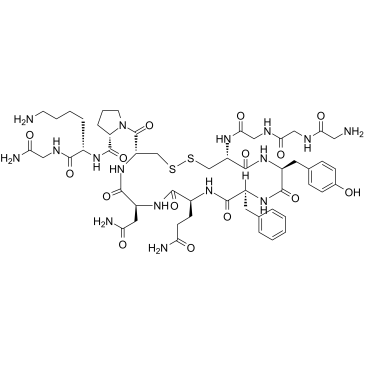
Physicochemical Properties
| Molecular Formula | C52H74N16O15S2 |
| Molecular Weight | 1227.3722 |
| Exact Mass | 1226.496 |
| Elemental Analysis | C, 50.89; H, 6.08; N, 18.26; O, 19.55; S, 5.22 |
| CAS # | 14636-12-5 |
| Related CAS # | Terlipressin diacetate; 1884420-36-3; Terlipressin acetate; 914453-96-6 |
| PubChem CID | 72081 |
| Appearance | White to off-white solid powder |
| Density | 1.5±0.1 g/cm3 |
| Boiling Point | 1824.0±65.0 °C at 760 mmHg |
| Flash Point | 1056.9±34.3 °C |
| Vapour Pressure | 0.0±0.3 mmHg at 25°C |
| Index of Refraction | 1.664 |
| LogP | -6.75 |
| Hydrogen Bond Donor Count | 16 |
| Hydrogen Bond Acceptor Count | 19 |
| Rotatable Bond Count | 25 |
| Heavy Atom Count | 85 |
| Complexity | 2380 |
| Defined Atom Stereocenter Count | 8 |
| SMILES | S1C([H])([H])[C@@]([H])(C(N2C([H])([H])C([H])([H])C([H])([H])[C@@]2([H])C(N([H])[C@]([H])(C(N([H])C([H])([H])C(N([H])[H])=O)=O)C([H])([H])C([H])([H])C([H])([H])C([H])([H])N([H])[H])=O)=O)N([H])C([C@]([H])(C([H])([H])C(N([H])[H])=O)N([H])C([C@]([H])(C([H])([H])C([H])([H])C(N([H])[H])=O)N([H])C([C@]([H])(C([H])([H])C2C([H])=C([H])C([H])=C([H])C=2[H])N([H])C([C@]([H])(C([H])([H])C2C([H])=C([H])C(=C([H])C=2[H])O[H])N([H])C([C@]([H])(C([H])([H])S1)N([H])C(C([H])([H])N([H])C(C([H])([H])N([H])C(C([H])([H])N([H])[H])=O)=O)=O)=O)=O)=O)=O)=O |
| InChi Key | BENFXAYNYRLAIU-QSVFAHTRSA-N |
| InChi Code | InChI=1S/C52H74N16O15S2/c53-17-5-4-9-31(45(76)60-23-41(57)72)63-51(82)38-10-6-18-68(38)52(83)37-27-85-84-26-36(61-44(75)25-59-43(74)24-58-42(73)22-54)50(81)65-34(20-29-11-13-30(69)14-12-29)48(79)64-33(19-28-7-2-1-3-8-28)47(78)62-32(15-16-39(55)70)46(77)66-35(21-40(56)71)49(80)67-37/h1-3,7-8,11-14,31-38,69H,4-6,9-10,15-27,53-54H2,(H2,55,70)(H2,56,71)(H2,57,72)(H,58,73)(H,59,74)(H,60,76)(H,61,75)(H,62,78)(H,63,82)(H,64,79)(H,65,81)(H,66,77)(H,67,80)/t31-,32-,33-,34-,35-,36-,37-,38-/m0/s1 |
| Chemical Name | (2S)-1-[(4R,7S,10S,13S,16S,19R)-19-[[2-[[2-[(2-aminoacetyl)amino]acetyl]amino]acetyl]amino]-7-(2-amino-2-oxoethyl)-10-(3-amino-3-oxopropyl)-13-benzyl-16-[(4-hydroxyphenyl)methyl]-6,9,12,15,18-pentaoxo-1,2-dithia-5,8,11,14,17-pentazacycloicosane-4-carbonyl]-N-[(2S)-6-amino-1-[(2-amino-2-oxoethyl)amino]-1-oxohexan-2-yl]pyrrolidine-2-carboxamide |
| Synonyms | Glycylpressin; Remestyp; Terlipressin |
| HS Tariff Code | 2934.99.9001 |
| Storage |
Powder-20°C 3 years 4°C 2 years In solvent -80°C 6 months -20°C 1 month |
| Shipping Condition | Room temperature (This product is stable at ambient temperature for a few days during ordinary shipping and time spent in Customs) |
Biological Activity
| Targets | Vasopressin V1 receptor |
| ln Vitro |
Terlipressin (25 nM; 24-72 hours; IEC-6 cells) treatment dramatically increases the viability, proliferation, and apoptosis of IEC-6 cells[1]. Terlipressin prevents IEC-6 cells from secreting TNF-α and 15-F2t-isoprostane after they are subjected to oxygen and glucose deprivation and then reoxygenated. Through the PI3K signaling pathway, terlipressin administration after OGD reduces OGD/R-induced cell damage[1]. |
| ln Vivo | Terlipressin treatment dramatically reduces IR-induced liver apoptosis, necrosis, and inflammation in a mouse model of nonlethal hepatic ischemia-reperfusion (IR)[3]. |
| Cell Assay |
Cell Line: IEC-6 cells induced by oxygen and glucose deprivation/re-oxygenation (OGD/R) Concentration: 25 nM Incubation Time: 24 hours, 48 hours, 72 hours Result: Significantly increased the proliferation of IEC-6 cells. |
| ADME/Pharmacokinetics |
Absorption, Distribution and Excretion Following a 1 mg IV injection of terlipressin acetate in patients with HRS-1, the median Cmax, AUC24h and Cave of terlipressin at steady-state were 70.5 ng/mL, 123 ng × hr/mL and 14.2 ng/mL, respectively. The median Cmax, AUC24h and Cave of lypressin were 1.2 ng/mL, 11.2 ng × hr/mL and 0.5 ng/mL, respectively. Terlipressin and lypressin exhibit linear pharmacokinetics in healthy subjects. Plasma concentrations of terlipressin demonstrate proportional increases with the dose administered. Less than 1% of terlipressin and <0.1% of lysine-vasopressin is excreted in urine in healthy subjects. The volume of distribution of terlipressin was 6.3 L and 1370 L for lysine-vasopressin. The clearance of terlipressin was 27.4 L/hr and 318 L/hr for lysine-vasopressin. Clearance of terlipressin in HRS-1 patients increased with body weight, while body weight had no effect on the clearance of lysine-vasopressin. Metabolism / Metabolites The N-terminal glycyl residues of terlipressin is cleaved by various tissue peptidases to release its pharmacologically active metabolite, [lypressin] or lysine-vasopressin. Once formed, lypressin is undergoes various peptidase-mediated metabolic pathways in body tissues. Terlipressin is not metabolized in the blood or plasma. Due to the ubiquitous nature of peptidases in body tissues, it is unlikely that the metabolism of terlipressin will be affected by disease state or other drugs. Biological Half-Life The terminal half-life of terlipressin was 0.9 hours and 3.0 hours for lysine-vasopressin. |
| References |
[1]. Terlipressin Protects Intestinal Epithelial Cells Against Oxygen-Glucose Deprivation/Re-Oxygenation Injury via the Phosphatidylinositol 3-kinase Pathway. Exp Ther Med. 2017 Jul;14(1):260-266. [2]. Refractory Torsade De Pointes Induced by Terlipressin (Glypressin). Int J Cardiol. 2016 Nov 1;222:135-140. [3]. Signaling Through Hepatocyte Vasopressin Receptor 1 Protects Mouse Liver From Ischemia-Reperfusion Injury. Oncotarget. 2016 Oct 25;7(43):69276-69290. [4]. Terlipressin for the Treatment of Acute Variceal Bleeding: A Systematic Review and Meta-Analysis of Randomized Controlled Trials. Medicine (Baltimore). 2018 Nov;97(48):e13437. [5]. Terlipressin for Norepinephrine-Resistant Septic Shock. Lancet. 2002 Apr 6;359(9313):1209-10. |
| Additional Infomation |
Pharmacodynamics Terlipressin mimics the biological effects of endogenous vasopressin, but it displays increased selectivity for the V1 receptor and a longer half-life than vasopressin. These pharmacokinetic and molecular properties of terlipressin give it several advantages, such as the prevention of rebound hypotension when the drug is stopped and convenience in patients with limited intravenous access. Terlipressin increases arterial pressure (diastolic, systolic, and mean) and decreases heart rate in patients with hepatorenal syndrome type 1 (HRS-1). After the administration of a single 0.85 mg dose of terlipressin in patients with HRS-1, cardiovascular effects were observed within five minutes after dosing and were maintained for at least six hours after dosing. The maximum change in blood pressure and heart rate occurred at 1.2 to two hours post-dose. |
Solubility Data
| Solubility (In Vitro) | DMSO: ~100 mg/mL (~81.5 mM) |
| Solubility (In Vivo) |
Solubility in Formulation 1: ≥ 2.5 mg/mL (2.04 mM) (saturation unknown) in 10% DMSO + 40% PEG300 + 5% Tween80 + 45% Saline (add these co-solvents sequentially from left to right, and one by one), clear solution. For example, if 1 mL of working solution is to be prepared, you can add 100 μL of 25.0 mg/mL clear DMSO stock solution to 400 μL PEG300 and mix evenly; then add 50 μL Tween-80 to the above solution and mix evenly; then add 450 μL normal saline to adjust the volume to 1 mL. Preparation of saline: Dissolve 0.9 g of sodium chloride in 100 mL ddH₂ O to obtain a clear solution. Solubility in Formulation 2: ≥ 2.5 mg/mL (2.04 mM) (saturation unknown) in 10% DMSO + 90% (20% SBE-β-CD in Saline) (add these co-solvents sequentially from left to right, and one by one), clear solution. For example, if 1 mL of working solution is to be prepared, you can add 100 μL of 25.0 mg/mL clear DMSO stock solution to 900 μL of 20% SBE-β-CD physiological saline solution and mix evenly. Preparation of 20% SBE-β-CD in Saline (4°C,1 week): Dissolve 2 g SBE-β-CD in 10 mL saline to obtain a clear solution. Solubility in Formulation 3: ≥ 2.5 mg/mL (2.04 mM) (saturation unknown) in 10% DMSO + 90% Corn Oil (add these co-solvents sequentially from left to right, and one by one), clear solution. For example, if 1 mL of working solution is to be prepared, you can add 100 μL of 25.0 mg/mL clear DMSO stock solution to 900 μL of corn oil and mix evenly. (Please use freshly prepared in vivo formulations for optimal results.) |
| Preparing Stock Solutions | 1 mg | 5 mg | 10 mg | |
| 1 mM | 0.8148 mL | 4.0738 mL | 8.1475 mL | |
| 5 mM | 0.1630 mL | 0.8148 mL | 1.6295 mL | |
| 10 mM | 0.0815 mL | 0.4074 mL | 0.8148 mL |