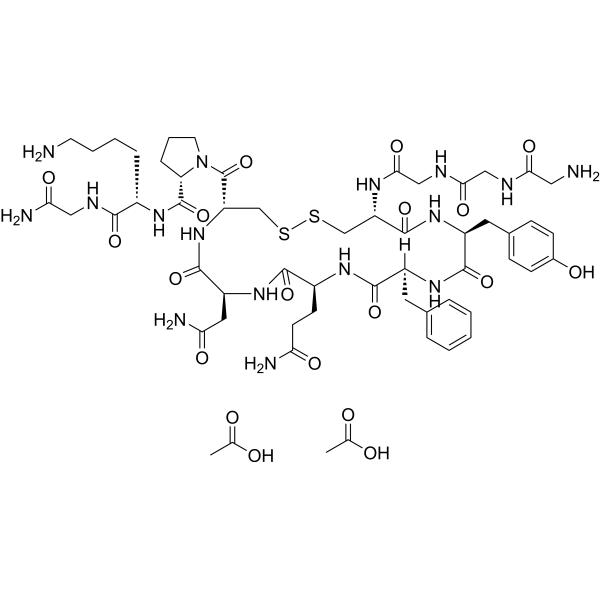
Physicochemical Properties
| Molecular Formula | C56H82N16O19S2 |
| Molecular Weight | 1347.48 |
| Exact Mass | 1346.538 |
| CAS # | 1884420-36-3 |
| Related CAS # | Terlipressin;14636-12-5;Terlipressin acetate;914453-96-6 |
| PubChem CID | 72941948 |
| Appearance | White to off-white solid powder |
| Hydrogen Bond Donor Count | 18 |
| Hydrogen Bond Acceptor Count | 23 |
| Rotatable Bond Count | 25 |
| Heavy Atom Count | 93 |
| Complexity | 2410 |
| Defined Atom Stereocenter Count | 8 |
| SMILES | CC(=O)O.CC(=O)O.C1C[C@H](N(C1)C(=O)[C@@H]2CSSC[C@@H](C(=O)N[C@H](C(=O)N[C@H](C(=O)N[C@H](C(=O)N[C@H](C(=O)N2)CC(=O)N)CCC(=O)N)CC3=CC=CC=C3)CC4=CC=C(C=C4)O)NC(=O)CNC(=O)CNC(=O)CN)C(=O)N[C@@H](CCCCN)C(=O)NCC(=O)N |
| InChi Key | WNFVFDPQEHRNTC-LWCZBKQBSA-N |
| InChi Code | InChI=1S/C52H74N16O15S2.2C2H4O2/c53-17-5-4-9-31(45(76)60-23-41(57)72)63-51(82)38-10-6-18-68(38)52(83)37-27-85-84-26-36(61-44(75)25-59-43(74)24-58-42(73)22-54)50(81)65-34(20-29-11-13-30(69)14-12-29)48(79)64-33(19-28-7-2-1-3-8-28)47(78)62-32(15-16-39(55)70)46(77)66-35(21-40(56)71)49(80)67-37;2*1-2(3)4/h1-3,7-8,11-14,31-38,69H,4-6,9-10,15-27,53-54H2,(H2,55,70)(H2,56,71)(H2,57,72)(H,58,73)(H,59,74)(H,60,76)(H,61,75)(H,62,78)(H,63,82)(H,64,79)(H,65,81)(H,66,77)(H,67,80);2*1H3,(H,3,4)/t31-,32-,33-,34-,35-,36-,37-,38-;;/m0../s1 |
| Chemical Name | acetic acid;(2S)-1-[(4R,7S,10S,13S,16S,19R)-19-[[2-[[2-[(2-aminoacetyl)amino]acetyl]amino]acetyl]amino]-7-(2-amino-2-oxoethyl)-10-(3-amino-3-oxopropyl)-13-benzyl-16-[(4-hydroxyphenyl)methyl]-6,9,12,15,18-pentaoxo-1,2-dithia-5,8,11,14,17-pentazacycloicosane-4-carbonyl]-N-[(2S)-6-amino-1-[(2-amino-2-oxoethyl)amino]-1-oxohexan-2-yl]pyrrolidine-2-carboxamide |
| HS Tariff Code | 2934.99.9001 |
| Storage |
Powder-20°C 3 years 4°C 2 years In solvent -80°C 6 months -20°C 1 month Note: Please store this product in a sealed and protected environment (e.g. under nitrogen), avoid exposure to moisture. |
| Shipping Condition | Room temperature (This product is stable at ambient temperature for a few days during ordinary shipping and time spent in Customs) |
Biological Activity
| Targets | Vasopressin V1 receptor[1] |
| ln Vitro | Treatment of IEC-6 cells with terlipressin diacetate (25 nM; 24-72 hours) greatly enhanced cell viability, proliferation, and apoptosis [1]. After OGD/R (oxygen and glucose deprivation), terlipressin diacetate inhibits the secretion of TNF-α and 15-F2t-isoprostane in IEC-6 cells. Through the PI3K signaling pathway, terlipressin diacetate given after OGD can lessen OGD/R-induced cell damage [1]. |
| ln Vivo | In a mouse model of non-lethal hepatic ischemia-reperfusion (IR), terlipressin diacetate treatment markedly alleviated hepatocyte apoptosis, necrosis, and inflammation caused by IR [3]. |
| Cell Assay |
Cell Proliferation Assay[1] Cell Types: IEC-6 cells induced by oxygen and glucose deprivation/re-oxygenation (OGD/R) Tested Concentrations: 25 nM Incubation Duration: 24 hrs (hours), 48 hrs (hours), 72 hrs (hours) Experimental Results: Dramatically increased the proliferation of IEC-6 cells. |
| References |
[1]. Terlipressin Protects Intestinal Epithelial Cells Against Oxygen-Glucose Deprivation/Re-Oxygenation Injury via the Phosphatidylinositol 3-kinase Pathway. Exp Ther Med. 2017 Jul;14(1):260-266. [2]. Refractory Torsade De Pointes Induced by Terlipressin (Glypressin). Int J Cardiol. 2016 Nov 1;222:135-140. [3]. Signaling Through Hepatocyte Vasopressin Receptor 1 Protects Mouse Liver From Ischemia-Reperfusion Injury. Oncotarget. 2016 Oct 25;7(43):69276-69290. [4]. Terlipressin for the Treatment of Acute Variceal Bleeding: A Systematic Review and Meta-Analysis of Randomized Controlled Trials. Medicine (Baltimore). 2018 Nov;97(48):e13437. [5]. Terlipressin for Norepinephrine-Resistant Septic Shock. Lancet. 2002 Apr 6;359(9313):1209-10. |
| Additional Infomation | See also: Terlipressin (is salt form of). |
Solubility Data
| Solubility (In Vitro) |
H2O: 100 mg/mL (74.21 mM) DMSO: 50 mg/mL (37.11 mM) |
| Solubility (In Vivo) |
Solubility in Formulation 1: ≥ 2.5 mg/mL (1.86 mM) (saturation unknown) in 10% DMSO + 90% (20% SBE-β-CD in Saline) (add these co-solvents sequentially from left to right, and one by one), clear solution. For example, if 1 mL of working solution is to be prepared, you can add 100 μL of 25.0 mg/mL clear DMSO stock solution to 900 μL of 20% SBE-β-CD physiological saline solution and mix evenly. Preparation of 20% SBE-β-CD in Saline (4°C,1 week): Dissolve 2 g SBE-β-CD in 10 mL saline to obtain a clear solution. Solubility in Formulation 2: ≥ 2.5 mg/mL (1.86 mM) (saturation unknown) in 10% DMSO + 90% Corn Oil (add these co-solvents sequentially from left to right, and one by one), clear solution. For example, if 1 mL of working solution is to be prepared, you can add 100 μL of 25.0 mg/mL clear DMSO stock solution to 900 μL of corn oil and mix evenly. Solubility in Formulation 3: 100 mg/mL (74.21 mM) in PBS (add these co-solvents sequentially from left to right, and one by one), clear solution; with ultrasonication. (Please use freshly prepared in vivo formulations for optimal results.) |
| Preparing Stock Solutions | 1 mg | 5 mg | 10 mg | |
| 1 mM | 0.7421 mL | 3.7106 mL | 7.4213 mL | |
| 5 mM | 0.1484 mL | 0.7421 mL | 1.4843 mL | |
| 10 mM | 0.0742 mL | 0.3711 mL | 0.7421 mL |