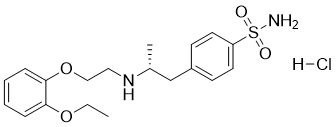
Tamsulosin HCl, a marketed drug, is a potent and selective α1a adrenergic receptor antagonist used for the treatment of benign prostatic hyperplasia (BPH). It exhibits a preference for the α1A receptor found in the prostate as opposed to the α1B receptor found in blood vessels. Compared to control patients, tamsulosin-treated patients had a 0.30-fold decreased risk of experiencing acute urinary retention. Tamsulosin can be suggested as a treatment for men who have had AUR catheterization, as it can lessen the chance that they will require another catheterization.
Physicochemical Properties
| Molecular Formula | C20H28N2O5S.HCL | |
| Molecular Weight | 444.97 | |
| Exact Mass | 444.148 | |
| Elemental Analysis | C, 55.00; H, 6.56; Cl, 8.54; N, 6.75; O, 15.42; S, 7.73 | |
| CAS # | 106463-17-6 | |
| Related CAS # | Tamsulosin;106133-20-4; Tamsulosin-d5 hydrochloride; Tamsulosin-d4 hydrochloride; 2518100-55-3 | |
| PubChem CID | 5362376 | |
| Appearance | White to off-white solid powder | |
| Boiling Point | 595.5ºC at 760 mmHg | |
| Melting Point | 228-230ºC | |
| Flash Point | 313.9ºC | |
| Vapour Pressure | 3.79E-14mmHg at 25°C | |
| LogP | 4.512 | |
| Hydrogen Bond Donor Count | 3 | |
| Hydrogen Bond Acceptor Count | 7 | |
| Rotatable Bond Count | 11 | |
| Heavy Atom Count | 29 | |
| Complexity | 539 | |
| Defined Atom Stereocenter Count | 1 | |
| SMILES | Cl[H].S(C1=C(C([H])=C([H])C(=C1[H])C([H])([H])[C@@]([H])(C([H])([H])[H])N([H])C([H])([H])C([H])([H])OC1=C([H])C([H])=C([H])C([H])=C1OC([H])([H])C([H])([H])[H])OC([H])([H])[H])(N([H])[H])(=O)=O |
|
| InChi Key | ZZIZZTHXZRDOFM-XFULWGLBSA-N | |
| InChi Code | InChI=1S/C20H28N2O5S.ClH/c1-4-26-17-7-5-6-8-18(17)27-12-11-22-15(2)13-16-9-10-19(25-3)20(14-16)28(21,23)24;/h5-10,14-15,22H,4,11-13H2,1-3H3,(H2,21,23,24);1H/t15-;/m1./s1 | |
| Chemical Name | 5-[(2R)-2-[2-(2-ethoxyphenoxy)ethylamino]propyl]-2-methoxybenzenesulfonamide;hydrochloride | |
| Synonyms |
|
|
| HS Tariff Code | 2934.99.9001 | |
| Storage |
Powder-20°C 3 years 4°C 2 years In solvent -80°C 6 months -20°C 1 month |
|
| Shipping Condition | Room temperature (This product is stable at ambient temperature for a few days during ordinary shipping and time spent in Customs) |
Biological Activity
| Targets | α1-adrenergic receptor | ||
| ln Vitro |
|
||
| ln Vivo |
|
||
| Animal Protocol |
|
||
| References |
[1]. Tamsulosin: an overview. World J Urol. 2002 Apr;19(6):397-404. [2]. Tamsulosin Attenuates Abdominal Aortic Aneurysm Growth. Surgery. 2018 Nov; 164(5): 1087-1092. |
||
| Additional Infomation |
Tamsulosin hydrochloride is a hydrochloride resulting from the reaction of equimolar amounts of tamulosin and hydrogen chloride. It has a role as an alpha-adrenergic antagonist and an antineoplastic agent. It contains a tamsulosin(1+). It is an enantiomer of an ent-tamsulosin hydrochloride. Tamsulosin Hydrochloride is the hydrochloride salt of tamsulosin, a sulfonamide derivative with adrenergic antagonist activity. Tamsulosin selectivity binds to and blocks the activity of alpha1 adrenoreceptors in the human prostate and bladder neck; blockade of these adrenoceptors can cause smooth muscle in the prostate and bladder neck to relax, resulting in an improvement in urinary flow rate. A sulfonamide derivative and adrenergic alpha-1 receptor antagonist that is used to relieve symptoms of urinary obstruction caused by BENIGN PROSTATIC HYPERPLASIA. See also: Tamsulosin (annotation moved to). |
Solubility Data
| Solubility (In Vitro) |
|
|||
| Solubility (In Vivo) |
|
| Preparing Stock Solutions | 1 mg | 5 mg | 10 mg | |
| 1 mM | 2.2473 mL | 11.2367 mL | 22.4734 mL | |
| 5 mM | 0.4495 mL | 2.2473 mL | 4.4947 mL | |
| 10 mM | 0.2247 mL | 1.1237 mL | 2.2473 mL |