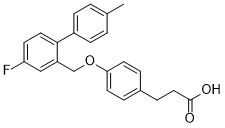
TUG-891 is a potent and selective agonist of the free fatty acid receptor 4 (FFA4/GPR120), which displays both potential opportunity and possible challenges to therapeutic agonism. TUG-891-induced activation of human FFA4 also caused the receptor to internalize and phosphorylate quickly. Although TUG-891 was also a strong agonist of mouse FFA4, its limited selectivity over mouse FFA1 made its in vivo application in this species more challenging.
Physicochemical Properties
| Molecular Formula | C23H21FO3 |
| Molecular Weight | 364.4164 |
| Exact Mass | 364.147 |
| Elemental Analysis | C, 75.81; H, 5.81; F, 5.21; O, 13.17 |
| CAS # | 1374516-07-0 |
| Related CAS # | 1374516-07-0 |
| PubChem CID | 57522038 |
| Appearance | White to off-white solid powder |
| LogP | 5.397 |
| Hydrogen Bond Donor Count | 1 |
| Hydrogen Bond Acceptor Count | 4 |
| Rotatable Bond Count | 7 |
| Heavy Atom Count | 27 |
| Complexity | 453 |
| Defined Atom Stereocenter Count | 0 |
| SMILES | C1C(C2C=CC(C)=CC=2)=C(COC2C=CC(CCC(=O)O)=CC=2)C=C(F)C=1 |
| InChi Key | LPGBXHWIQNZEJB-UHFFFAOYSA-N |
| InChi Code | InChI=1S/C23H21FO3/c1-16-2-7-18(8-3-16)22-12-9-20(24)14-19(22)15-27-21-10-4-17(5-11-21)6-13-23(25)26/h2-5,7-12,14H,6,13,15H2,1H3,(H,25,26) |
| Chemical Name | 3-[4-[[5-fluoro-2-(4-methylphenyl)phenyl]methoxy]phenyl]propanoic acid |
| Synonyms | TUG-891; TUG 891; TUG891 |
| HS Tariff Code | 2934.99.9001 |
| Storage |
Powder-20°C 3 years 4°C 2 years In solvent -80°C 6 months -20°C 1 month |
| Shipping Condition | Room temperature (This product is stable at ambient temperature for a few days during ordinary shipping and time spent in Customs) |
Biological Activity
| Targets | FFA4/GPR120 |
| ln Vitro | TUG-891 exhibits comparable signaling characteristics to the LCFA α-linolenic acid at human FFA4 at multiple assay end points, such as promoting Ca2+ mobilization, recruiting β-arrestin-1 and β-arrestin-2, and phosphorylating extracellular signal-regulated kinase. TUG-891-induced activation of human FFA4 also causes the receptor to internalize and phosphorylate quickly. [1] |
| ln Vivo | TUG-891 rapidly lowers body weight and fat mass while increasing fat oxidation in C57Bl/6J mice by activating GPR120.[2] |
| Cell Assay | The measured response is considered the peak signal over a 1.5-minute period following TUG-891 treatment, during which intracellular Ca2+ is monitored. Flp-In T-REx cell lines or HT-29 cells following a 5-minute TUG-891 treatment are used to measure the phosphorylation of extracellular signal-regulated kinase 1/2 (ERK). To observe the internalization of FFA4, human FFA4-eYFP Flp-In T-REx cells are grown on glass coverslips coated with poly-d-lysine. These cells are cultured for a full day prior to being treated with 100 ng/ml of doxycycline to enhance receptor expression. With confocal microscopy, live cells are imaged subsequent to TUG-891 addition. |
| References |
[1]. Mol Pharmacol . 2013 Nov;84(5):710-25. [2]. EMBO Mol Med . 2018 Mar;10(3):e8047. |
Solubility Data
| Solubility (In Vitro) |
DMSO: 73~100 mg/mL (200.3~274.4 mM) Ethanol: ~6 mg/mL |
| Solubility (In Vivo) |
Solubility in Formulation 1: ≥ 2.5 mg/mL (6.86 mM) (saturation unknown) in 10% DMSO + 40% PEG300 + 5% Tween80 + 45% Saline (add these co-solvents sequentially from left to right, and one by one), clear solution. For example, if 1 mL of working solution is to be prepared, you can add 100 μL of 25.0 mg/mL clear DMSO stock solution to 400 μL PEG300 and mix evenly; then add 50 μL Tween-80 to the above solution and mix evenly; then add 450 μL normal saline to adjust the volume to 1 mL. Preparation of saline: Dissolve 0.9 g of sodium chloride in 100 mL ddH₂ O to obtain a clear solution. Solubility in Formulation 2: ≥ 2.5 mg/mL (6.86 mM) (saturation unknown) in 10% DMSO + 90% (20% SBE-β-CD in Saline) (add these co-solvents sequentially from left to right, and one by one), clear solution. For example, if 1 mL of working solution is to be prepared, you can add 100 μL of 25.0 mg/mL clear DMSO stock solution to 900 μL of 20% SBE-β-CD physiological saline solution and mix evenly. Preparation of 20% SBE-β-CD in Saline (4°C,1 week): Dissolve 2 g SBE-β-CD in 10 mL saline to obtain a clear solution. Solubility in Formulation 3: ≥ 2.5 mg/mL (6.86 mM) (saturation unknown) in 10% DMSO + 90% Corn Oil (add these co-solvents sequentially from left to right, and one by one), clear solution. For example, if 1 mL of working solution is to be prepared, you can add 100 μL of 25.0 mg/mL clear DMSO stock solution to 900 μL of corn oil and mix evenly. Solubility in Formulation 4: 5% DMSO + 95% Corn oil: 0.9mg/ml (2.47mM) (Please use freshly prepared in vivo formulations for optimal results.) |
| Preparing Stock Solutions | 1 mg | 5 mg | 10 mg | |
| 1 mM | 2.7441 mL | 13.7204 mL | 27.4409 mL | |
| 5 mM | 0.5488 mL | 2.7441 mL | 5.4882 mL | |
| 10 mM | 0.2744 mL | 1.3720 mL | 2.7441 mL |