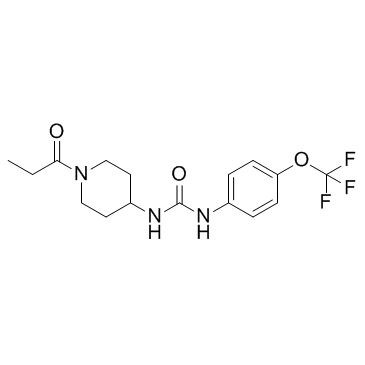
TTPU is a novel and potent soluble epoxide hydrolase (sEH) inhibitor with anti-inflammatory effects. It has an IC50 of 37 and 3.7 nM for monkey and human sEH, respectively.
Physicochemical Properties
| Molecular Formula | C16H20N3O3F3 |
| Molecular Weight | 359.3435 |
| Exact Mass | 359.145 |
| CAS # | 1222780-33-7 |
| PubChem CID | 44142782 |
| Appearance | White to off-white solid powder |
| Density | 1.3±0.1 g/cm3 |
| Boiling Point | 448.9±45.0 °C at 760 mmHg |
| Flash Point | 225.3±28.7 °C |
| Vapour Pressure | 0.0±1.1 mmHg at 25°C |
| Index of Refraction | 1.532 |
| LogP | 2.32 |
| Hydrogen Bond Donor Count | 2 |
| Hydrogen Bond Acceptor Count | 6 |
| Rotatable Bond Count | 4 |
| Heavy Atom Count | 25 |
| Complexity | 457 |
| Defined Atom Stereocenter Count | 0 |
| InChi Key | AAJMQTLFRTZCJK-UHFFFAOYSA-N |
| InChi Code | InChI=1S/C16H20F3N3O3/c1-2-14(23)22-9-7-12(8-10-22)21-15(24)20-11-3-5-13(6-4-11)25-16(17,18)19/h3-6,12H,2,7-10H2,1H3,(H2,20,21,24) |
| Chemical Name | 1-(1-propanoylpiperidin-4-yl)-3-[4-(trifluoromethoxy)phenyl]urea |
| HS Tariff Code | 2934.99.9001 |
| Storage |
Powder-20°C 3 years 4°C 2 years In solvent -80°C 6 months -20°C 1 month |
| Shipping Condition | Room temperature (This product is stable at ambient temperature for a few days during ordinary shipping and time spent in Customs) |
Biological Activity
| ln Vitro | Soluble epoxide rapid enzyme conjugation (sEHI) possesses anti-inflammatory, anti-atherosclerotic, anti-hypertensive and analgesic properties [1]. In the Caco-2 cell permeability assay, TPPU went through the cell monolayer, showing that it has good destruction permeability [2]. |
| ln Vivo | The biology of soluble epoxide resting enzymes and the function of epoxide-containing rosettes in regulatory regulation can both be studied with TPPU. At a dosage of 0.3 mg/kg, TPPU exhibited high rose concentration and drug-like characteristics. Cmax for TPPU rises from 0.3 to 3 mg/kg with dosage [1]. The blood concentration of TPPU showed a dose-dependent rise after treatment following incubation in water (0.2, 1 and 5 mg TPPU/L with 0.2% PEG400) and reached an almost steady condition after 8 days [2]. Animal models of depression show antidepressant benefits from sEH reverse TPPU. sEH preventative sEH inhibition or sEH-KO results in recovery from the stress of repeated social defeat in the brains of chronic intermittent and depressed patients and is linked to enhanced BDNF-TrkB signaling in the KO prefrontal layer and hippocampus [3]. |
| References |
[1]. Pharmacokinetics and in vivo potency of soluble epoxide hydrolase inhibitors in cynomolgus monkeys. Br J Pharmacol. 2012 Mar;165(5):1401-12. [2]. Oral treatment of rodents with soluble epoxide hydrolase inhibitor 1-(1-propanoylpiperidin-4-yl)-3-[4-(trifluoromethoxy)phenyl]urea (TPPU): Resulting drug levels and modulation of oxylipin pattern. Prostaglandins Other Lipid Mediat. 2015 Sep;121(Pt A):131-7. [3]. Gene deficiency and pharmacological inhibition of soluble epoxide hydrolase confers resilience to repeated social defeat stress. Proceedings of the National Academy of Sciences of the United States of America (2016), 113(13), E1944-E1952. |
Solubility Data
| Solubility (In Vitro) | DMSO : ~83.33 mg/mL (~231.90 mM) |
| Solubility (In Vivo) |
Solubility in Formulation 1: ≥ 2.08 mg/mL (5.79 mM) (saturation unknown) in 10% DMSO + 40% PEG300 + 5% Tween80 + 45% Saline (add these co-solvents sequentially from left to right, and one by one), clear solution. For example, if 1 mL of working solution is to be prepared, you can add 100 μL of 20.8 mg/mL clear DMSO stock solution to 400 μL PEG300 and mix evenly; then add 50 μL Tween-80 to the above solution and mix evenly; then add 450 μL normal saline to adjust the volume to 1 mL. Preparation of saline: Dissolve 0.9 g of sodium chloride in 100 mL ddH₂ O to obtain a clear solution. Solubility in Formulation 2: ≥ 2.08 mg/mL (5.79 mM) (saturation unknown) in 10% DMSO + 90% (20% SBE-β-CD in Saline) (add these co-solvents sequentially from left to right, and one by one), clear solution. For example, if 1 mL of working solution is to be prepared, you can add 100 μL of 20.8 mg/mL clear DMSO stock solution to 900 μL of 20% SBE-β-CD physiological saline solution and mix evenly. Preparation of 20% SBE-β-CD in Saline (4°C,1 week): Dissolve 2 g SBE-β-CD in 10 mL saline to obtain a clear solution. Solubility in Formulation 3: ≥ 2.08 mg/mL (5.79 mM) (saturation unknown) in 10% DMSO + 90% Corn Oil (add these co-solvents sequentially from left to right, and one by one), clear solution. For example, if 1 mL of working solution is to be prepared, you can add 100 μL of 20.8 mg/mL clear DMSO stock solution to 900 μL of corn oil and mix evenly. (Please use freshly prepared in vivo formulations for optimal results.) |
| Preparing Stock Solutions | 1 mg | 5 mg | 10 mg | |
| 1 mM | 2.7829 mL | 13.9144 mL | 27.8288 mL | |
| 5 mM | 0.5566 mL | 2.7829 mL | 5.5658 mL | |
| 10 mM | 0.2783 mL | 1.3914 mL | 2.7829 mL |