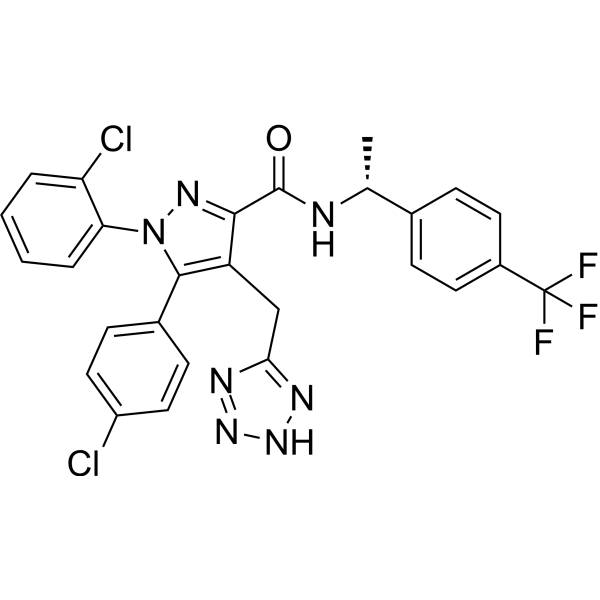
Physicochemical Properties
| CAS # | 1034264-77-1 |
| Appearance | Typically exists as solid at room temperature |
| Synonyms | TM38837; 1253641-65-4; TM-38837; 1-(2,4-dichlorophenyl)-4-ethyl-N-piperidin-1-yl-5-[5-[2-[4-(trifluoromethyl)phenyl]ethynyl]thiophen-2-yl]pyrazole-3-carboxamide; TM388371253641-65-4; CHEMBL3341897; VQOCBFYUDSBDCZ-UHFFFAOYSA-N; YD7836VJ3G; |
| HS Tariff Code | 2934.99.9001 |
| Storage |
Powder-20°C 3 years 4°C 2 years In solvent -80°C 6 months -20°C 1 month |
| Shipping Condition | Room temperature (This product is stable at ambient temperature for a few days during ordinary shipping and time spent in Customs) |
Biological Activity
| Targets | CB1/cannabinoid receptor 1 (IC50 = 0.4 nM) |
| ln Vitro | TM38837 was subsequently found to be clean (<30 % inhibition at 1 µM) against a total of 112 secondary pharmacology targets, including GPR55 and GPR119, and had no significant effect against a panel of CYPs and other metabolizing enzymes. This compound has been subjected to extensive pharmacological and toxicological studies that will be detailed in a separate publication [1]. TM38837 having a considerably lower lipophilicity and higher LLE of 5.2. In Table 1 pertinent in vitro data for TM38837 and another tetrazole TM40783 both having a chiral α-methyl group typically conferring an increase in CB1 potency, solubility and metabolic stability compared to the corresponding unsubstituted benzylamides [1]. |
| ln Vivo |
Several series of diverse pyrazole-3-carboxamides functionalized with 4-methylamides, 4-methylcarboxylic acids and 4-methyltetrazoles were prepared from the corresponding 4-cyanomethylpyrazoles and investigated as Cannabinoid receptor 1 (CB1) antagonists and inverse agonists with the aim of making compounds with less CNS (Central Nervous System) mediated side-effects compared to rimonabant. The compounds were evaluated and optimized with respect to lipophilicity, solubility, CB1 potency, metabolism, distribution to brain and liver, effect on weight loss in diet-induced mice models. A few carboxylic acids and tetrazoles were selected as especially promising with the tetrazole TM-38837 subsequently demonstrating impressive efficacy in various animal models of obesity, producing considerable weight loss and improvements on plasma markers of inflammation and glucose homeostasis, at doses apparently producing negligible brain exposure. TM38837 became the first peripherally restricted CB1 antagonist or inverse agonist to enter clinical trials supporting its lack of CNS effects and it is now believed that the non-CNS mediated efficacy is linked to high liver exposure. This opens opportunities to be explored in other indications such as nonalcoholic fatty liver disease (NAFLD) and steatohepatitis (NASH). Note that this is a first-time disclosure of the structure of TM-38837 and other structures appearing in literature are not connected with this program.[1] Despite a good PK profile, the acids showed poor or limited in vivo efficacy while some tetrazoles (e.g. TM-38837 and TM40783) induced an excellent body weight reduction (11.4 % and 11.8 %, respectively), similar to that observed with rimonabant (14.5 %), as shown in Fig. 2. The Mini-DIO model in mice produced reproducible effects shown by 4 studies of oral treatment with 10 mg/kg of TM-38837 giving 11.4 %, 9.7 %, 10.1 % and 11.9 % weight reductions compared to vehicle treated. The tetrazoles TM40783, TM38837 had low concentrations in the brain comparable to 1 % of the plasma concentrations. The acid TM39875 displayed higher brain concentrations in contrast to the other acid, which could explain the observed weight reduction of 6.4 % of the former compared to 0.2 % for the latter (Fig. 3) [1]. |
| ADME/Pharmacokinetics |
The PK profiles were investigated for the best carboxylic acids and tetrazoles exemplified with the tetrazole TM38837 and the acid TM39875 (Table 3). Plasma protein binding (PPB) for both compounds were above 99 % in mouse plasma in accordance with other acidic compounds. We noted no P-glycoprotein (Pgp) transport for either compound in the Caco-2 model (efflux ratios were between 1.0 and 1.3 with or without the Pgp antagonist cyclosporin A). In mouse both compounds had very good oral bioavailability and low clearance but low volumes of distribution consistent with the high PPB. TM39875 and TM38837 consistently had measured brain levels of approximately 1 % of the plasma concentration without correction for blood contamination of brain tissue samples.[1] We observed a marked difference in the tissue distribution between the carboxylic acids and the tetrazoles (Table 4). Thus, a high liver concentration was confirmed for TM38837 and TM40783 in a separate PK study in obese mice with plasma and tissue measurements made 6 h after a single 10 mg/kg dose in contrast to TM39875. The adipose tissue levels of the carboxylic acids were 4 % of the plasma concentrations while the tetrazoles displayed 5- to 7-fold higher levels. All compounds had very low or undetectable brain levels at both the 6- and 24-hour timepoints. The overwhelming distribution to liver compared to other tissues and blood was also confirmed in a quantitative whole body autoradiography study in lean C57BL/6J mouse after dosing with [3H]-TM38837, while radioactivity in brain was close to the detection limit at all time points. This indicates that the effects seen on food intake and weight loss, induced by the tetrazoles, are likely driven to a large extent by inhibition of CB1 in the liver. Cf. additional data in Supplementary material. [1] |
| References |
[1].Optimizing and characterizing 4-methyl substituted pyrazol-3-carboxamides leading to the peripheral cannabinoid 1 receptor inverse agonist TM38837. Bioorg Med Chem Lett. 2023 Dec 1;98:129572. |
| Additional Infomation | Since the withdrawal of rimonabant there has been considerable interest in the metabolic effects of CB1 in peripheral organs and many groups have reported efficacy from peripherally restricted compounds. Typically the design of peripherally restricted compounds focuses upon low permeability, usually through increased PSA, and efflux mechanisms. However, such approaches can have detrimental effects on PK, particularly with regard to oral absorption, and there is inevitably a trade-off between effective exclusion of the compound from the CNS and a drug-like profile. The approach described herein was to incorporate different polar functionality onto the rimonabant template to reduce logD and improve physicochemical properties, whilst retaining potency and selectivity, then optimize mouse PK profiles and select compounds with high in vivo plasma/brain ratios for evaluation in PD studies. This approach identified acidic compounds with good bioavailability that were effectively restricted to the periphery but with sustained plasma exposure. Evaluation of selected acidic compounds in sub-chronic Mini-DIO studies led to identification of the tetrazole TM38837 which consistently produced weight loss of similar magnitude to rimonabant and subsequently became the first peripherally restricted CB1 inhibitor to enter clinical trials. In this double-blind, randomized, placebo-controlled, crossover study, healthy subjects received 5 × 4 mg tetrahydrocannabinol (THC) and TM38837, rimonabant or placebo. Supporting the present mouse studies TM38837 at 100 mg had no impact on CNS effects, suggesting that this dose does not penetrate the brain. Weight-reducing efficacy of TM38837 and related analogues was associated with high liver levels which implicates hepatic CB1 upregulation as a driver of the obese phenotype. The peripheral profile of this type of CB1 antagonists with a high liver exposure opens possibilities for exploration of other indications such as nonalcoholic fatty liver disease (NAFLD), steatohepatitis (NASH), liver fibrosis and type 2 diabetes.16 Notably, global knockout of the cannabinoid receptor 1 gene reduced the expression of the lipid droplet binding protein PLIN2 to alleviate hepatic steatosis.[1] |
Solubility Data
| Solubility (In Vitro) | Typically soluble in DMSO (e.g. 10 mM) |
| Solubility (In Vivo) |
Note: Listed below are some common formulations that may be used to formulate products with low water solubility (e.g. < 1 mg/mL), you may test these formulations using a minute amount of products to avoid loss of samples. Injection Formulations (e.g. IP/IV/IM/SC) Injection Formulation 1: DMSO : Tween 80: Saline = 10 : 5 : 85 (i.e. 100 μL DMSO stock solution → 50 μL Tween 80 → 850 μL Saline) *Preparation of saline: Dissolve 0.9 g of sodium chloride in 100 mL ddH ₂ O to obtain a clear solution. Injection Formulation 2: DMSO : PEG300 :Tween 80 : Saline = 10 : 40 : 5 : 45 (i.e. 100 μL DMSO → 400 μLPEG300 → 50 μL Tween 80 → 450 μL Saline) Injection Formulation 3: DMSO : Corn oil = 10 : 90 (i.e. 100 μL DMSO → 900 μL Corn oil) Example: Take the Injection Formulation 3 (DMSO : Corn oil = 10 : 90) as an example, if 1 mL of 2.5 mg/mL working solution is to be prepared, you can take 100 μL 25 mg/mL DMSO stock solution and add to 900 μL corn oil, mix well to obtain a clear or suspension solution (2.5 mg/mL, ready for use in animals). Injection Formulation 4: DMSO : 20% SBE-β-CD in saline = 10 : 90 [i.e. 100 μL DMSO → 900 μL (20% SBE-β-CD in saline)] *Preparation of 20% SBE-β-CD in Saline (4°C,1 week): Dissolve 2 g SBE-β-CD in 10 mL saline to obtain a clear solution. Injection Formulation 5: 2-Hydroxypropyl-β-cyclodextrin : Saline = 50 : 50 (i.e. 500 μL 2-Hydroxypropyl-β-cyclodextrin → 500 μL Saline) Injection Formulation 6: DMSO : PEG300 : castor oil : Saline = 5 : 10 : 20 : 65 (i.e. 50 μL DMSO → 100 μLPEG300 → 200 μL castor oil → 650 μL Saline) Injection Formulation 7: Ethanol : Cremophor : Saline = 10: 10 : 80 (i.e. 100 μL Ethanol → 100 μL Cremophor → 800 μL Saline) Injection Formulation 8: Dissolve in Cremophor/Ethanol (50 : 50), then diluted by Saline Injection Formulation 9: EtOH : Corn oil = 10 : 90 (i.e. 100 μL EtOH → 900 μL Corn oil) Injection Formulation 10: EtOH : PEG300:Tween 80 : Saline = 10 : 40 : 5 : 45 (i.e. 100 μL EtOH → 400 μLPEG300 → 50 μL Tween 80 → 450 μL Saline) Oral Formulations Oral Formulation 1: Suspend in 0.5% CMC Na (carboxymethylcellulose sodium) Oral Formulation 2: Suspend in 0.5% Carboxymethyl cellulose Example: Take the Oral Formulation 1 (Suspend in 0.5% CMC Na) as an example, if 100 mL of 2.5 mg/mL working solution is to be prepared, you can first prepare 0.5% CMC Na solution by measuring 0.5 g CMC Na and dissolve it in 100 mL ddH2O to obtain a clear solution; then add 250 mg of the product to 100 mL 0.5% CMC Na solution, to make the suspension solution (2.5 mg/mL, ready for use in animals). Oral Formulation 3: Dissolved in PEG400 Oral Formulation 4: Suspend in 0.2% Carboxymethyl cellulose Oral Formulation 5: Dissolve in 0.25% Tween 80 and 0.5% Carboxymethyl cellulose Oral Formulation 6: Mixing with food powders Note: Please be aware that the above formulations are for reference only. InvivoChem strongly recommends customers to read literature methods/protocols carefully before determining which formulation you should use for in vivo studies, as different compounds have different solubility properties and have to be formulated differently. (Please use freshly prepared in vivo formulations for optimal results.) |