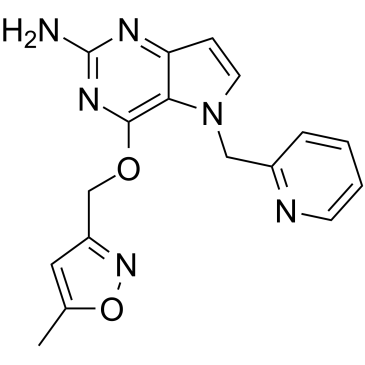
TLR7 agonist 2 is a novel, oral, potent and selective agonist of Toll-like Receptor 7 (TLR7) with antiviral activity. It activates TLR7 with a LEC of 0.4 μM. It has the potential for the immunotherapy of viral hepatitis. Oral administration of the TLR7 agonist 2 effectively induced a transient interferon stimulated gene (ISG) response in mice and cynomolgus monkeys.
Physicochemical Properties
| Molecular Formula | C17H16N6O2 |
| Molecular Weight | 336.347942352295 |
| Exact Mass | 336.133 |
| CAS # | 1642857-69-9 |
| PubChem CID | 86346192 |
| Appearance | White to off-white solid powder |
| LogP | 1.3 |
| Hydrogen Bond Donor Count | 1 |
| Hydrogen Bond Acceptor Count | 7 |
| Rotatable Bond Count | 5 |
| Heavy Atom Count | 25 |
| Complexity | 441 |
| Defined Atom Stereocenter Count | 0 |
| SMILES | O(CC1C=C(C)ON=1)C1=C2C(C=CN2CC2C=CC=CN=2)=NC(N)=N1 |
| InChi Key | FVKOYFLAKSGBBV-UHFFFAOYSA-N |
| InChi Code | InChI=1S/C17H16N6O2/c1-11-8-13(22-25-11)10-24-16-15-14(20-17(18)21-16)5-7-23(15)9-12-4-2-3-6-19-12/h2-8H,9-10H2,1H3,(H2,18,20,21) |
| Chemical Name | 4-[(5-methyl-1,2-oxazol-3-yl)methoxy]-5-(pyridin-2-ylmethyl)pyrrolo[3,2-d]pyrimidin-2-amine |
| Synonyms | TLR7 agonist 2; TLR7 agonist-2 |
| HS Tariff Code | 2934.99.9001 |
| Storage |
Powder-20°C 3 years 4°C 2 years In solvent -80°C 6 months -20°C 1 month |
| Shipping Condition | Room temperature (This product is stable at ambient temperature for a few days during ordinary shipping and time spent in Customs) |
Biological Activity
| Targets |
|
|
| ln Vitro | TLR7 agonist 2: In HEK293 cells, it has a lowest effective concentration (LEC) of 0.4 μM and is a strong and specific Toll-like Receptor 7 (TLR7) agonist. When applied to human TLR8, TLR7 agonist 2 has a lethal dose of >100 μM and is proven to be selective for TLR7 over TLR8. In addition to not being a time-dependent inhibitor of CYP450 3A4, TLR7 agonist 2 exhibits low inhibition across five CYP450 isozymes (IC50 >10 μM). A limited suppression of 3H-dofetilide binding to the hERG potassium ion channel (IC50 >50 μM) is seen by TLR7 agonist 2[1]. | |
| ln Vivo | It is discovered that TLR7 agonist 2 is quickly eliminated in tandem with our target profile. Between 0.3 and 3 mg/kg, both Cmax and AUC increase more than dose-proportionally; between 3 and 10 mg/kg, they increase less than dose-proportionally. At modest doses, TLR7 agonist 2 can elicit an antiviral interferon stimulated gene (ISG) response without eliciting an IFNα response. Additionally, starting at 0.3 mg/kg, TLR7 agonist 2 reduces the serum HBV viral load by 2.7 logs, with a maximal reduction of 3.1 logs reported for doses between 1 and 5 mg/kg[1]. | |
| Cell Assay |
|
|
| References |
[1]. Identification and Optimization of Pyrrolo[3,2-d]pyrimidine Toll-like Receptor 7 (TLR7) Selective Agonists for the Treatment of Hepatitis B. J Med Chem. 2017 Jul 27;60(14):6137-6151. |
Solubility Data
| Solubility (In Vitro) | DMSO : ~160 mg/mL (~475.69 mM) |
| Solubility (In Vivo) |
Note: Listed below are some common formulations that may be used to formulate products with low water solubility (e.g. < 1 mg/mL), you may test these formulations using a minute amount of products to avoid loss of samples. Injection Formulations (e.g. IP/IV/IM/SC) Injection Formulation 1: DMSO : Tween 80: Saline = 10 : 5 : 85 (i.e. 100 μL DMSO stock solution → 50 μL Tween 80 → 850 μL Saline) *Preparation of saline: Dissolve 0.9 g of sodium chloride in 100 mL ddH ₂ O to obtain a clear solution. Injection Formulation 2: DMSO : PEG300 :Tween 80 : Saline = 10 : 40 : 5 : 45 (i.e. 100 μL DMSO → 400 μLPEG300 → 50 μL Tween 80 → 450 μL Saline) Injection Formulation 3: DMSO : Corn oil = 10 : 90 (i.e. 100 μL DMSO → 900 μL Corn oil) Example: Take the Injection Formulation 3 (DMSO : Corn oil = 10 : 90) as an example, if 1 mL of 2.5 mg/mL working solution is to be prepared, you can take 100 μL 25 mg/mL DMSO stock solution and add to 900 μL corn oil, mix well to obtain a clear or suspension solution (2.5 mg/mL, ready for use in animals). Injection Formulation 4: DMSO : 20% SBE-β-CD in saline = 10 : 90 [i.e. 100 μL DMSO → 900 μL (20% SBE-β-CD in saline)] *Preparation of 20% SBE-β-CD in Saline (4°C,1 week): Dissolve 2 g SBE-β-CD in 10 mL saline to obtain a clear solution. Injection Formulation 5: 2-Hydroxypropyl-β-cyclodextrin : Saline = 50 : 50 (i.e. 500 μL 2-Hydroxypropyl-β-cyclodextrin → 500 μL Saline) Injection Formulation 6: DMSO : PEG300 : castor oil : Saline = 5 : 10 : 20 : 65 (i.e. 50 μL DMSO → 100 μLPEG300 → 200 μL castor oil → 650 μL Saline) Injection Formulation 7: Ethanol : Cremophor : Saline = 10: 10 : 80 (i.e. 100 μL Ethanol → 100 μL Cremophor → 800 μL Saline) Injection Formulation 8: Dissolve in Cremophor/Ethanol (50 : 50), then diluted by Saline Injection Formulation 9: EtOH : Corn oil = 10 : 90 (i.e. 100 μL EtOH → 900 μL Corn oil) Injection Formulation 10: EtOH : PEG300:Tween 80 : Saline = 10 : 40 : 5 : 45 (i.e. 100 μL EtOH → 400 μLPEG300 → 50 μL Tween 80 → 450 μL Saline) Oral Formulations Oral Formulation 1: Suspend in 0.5% CMC Na (carboxymethylcellulose sodium) Oral Formulation 2: Suspend in 0.5% Carboxymethyl cellulose Example: Take the Oral Formulation 1 (Suspend in 0.5% CMC Na) as an example, if 100 mL of 2.5 mg/mL working solution is to be prepared, you can first prepare 0.5% CMC Na solution by measuring 0.5 g CMC Na and dissolve it in 100 mL ddH2O to obtain a clear solution; then add 250 mg of the product to 100 mL 0.5% CMC Na solution, to make the suspension solution (2.5 mg/mL, ready for use in animals). Oral Formulation 3: Dissolved in PEG400 Oral Formulation 4: Suspend in 0.2% Carboxymethyl cellulose Oral Formulation 5: Dissolve in 0.25% Tween 80 and 0.5% Carboxymethyl cellulose Oral Formulation 6: Mixing with food powders Note: Please be aware that the above formulations are for reference only. InvivoChem strongly recommends customers to read literature methods/protocols carefully before determining which formulation you should use for in vivo studies, as different compounds have different solubility properties and have to be formulated differently. (Please use freshly prepared in vivo formulations for optimal results.) |
| Preparing Stock Solutions | 1 mg | 5 mg | 10 mg | |
| 1 mM | 2.9731 mL | 14.8655 mL | 29.7309 mL | |
| 5 mM | 0.5946 mL | 2.9731 mL | 5.9462 mL | |
| 10 mM | 0.2973 mL | 1.4865 mL | 2.9731 mL |