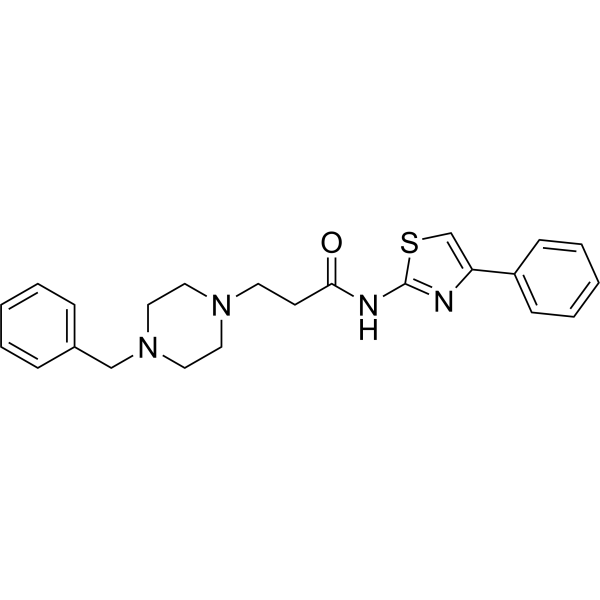
Physicochemical Properties
| Molecular Formula | C23H26N4OS |
| Molecular Weight | 406.54 |
| Exact Mass | 406.182 |
| CAS # | 1357471-57-8 |
| PubChem CID | 71542350 |
| Appearance | Light yellow to yellow solid powder |
| LogP | 3.4 |
| Hydrogen Bond Donor Count | 1 |
| Hydrogen Bond Acceptor Count | 5 |
| Rotatable Bond Count | 7 |
| Heavy Atom Count | 29 |
| Complexity | 499 |
| Defined Atom Stereocenter Count | 0 |
| SMILES | N1(CCC(NC2=NC(C3=CC=CC=C3)=CS2)=O)CCN(CC2=CC=CC=C2)CC1 |
| InChi Key | DTIQJBUDKQVBLT-UHFFFAOYSA-N |
| InChi Code | InChI=1S/C23H26N4OS/c28-22(25-23-24-21(18-29-23)20-9-5-2-6-10-20)11-12-26-13-15-27(16-14-26)17-19-7-3-1-4-8-19/h1-10,18H,11-17H2,(H,24,25,28) |
| Chemical Name | 3-(4-benzylpiperazin-1-yl)-N-(4-phenyl-1,3-thiazol-2-yl)propanamide |
| HS Tariff Code | 2934.99.9001 |
| Storage |
Powder-20°C 3 years 4°C 2 years In solvent -80°C 6 months -20°C 1 month Note: (1). This product requires protection from light (avoid light exposure) during transportation and storage.(2). Please store this product in a sealed and protected environment (e.g. under nitrogen), avoid exposure to moisture. |
| Shipping Condition | Room temperature (This product is stable at ambient temperature for a few days during ordinary shipping and time spent in Customs) |
Biological Activity
| ln Vitro | In vitro, TJ-M2010-5 (40 μM) suppresses MyD88 signaling in RAW 264.7 cells that respond to LPS (100 ng/mL) and MyD88 homodimerization in transfected HEK293 cells in a concentration-dependent manner [1]. Following stimulation with R848 (500 ng/mL), TJ-M2010-5 (5-30 μM) inhibits B cell growth and promotes B cell death [3]. |
| ln Vivo | In a 10-week CAC mouse model, TJ-M2010-5 statistically significantly decreased AOM/DSS-induced colitis and completely prevented the development of CAC with less weight loss associated with it. As a result, the treated mice had a zero percent mortality rate, reduced cell proliferation, and increased cell apoptosis in colon tissue[1]. TJ-M2010-5 significantly decreased serum concentrations of IL-22 and IL-22-23, TGF-β1, and TNF-α, IL-6, G-CSF, MIP-1β, IL-11, and IL-17A in mice at 2 and 7 weeks after induction[1]. |
| Cell Assay |
Cell Viability Assay[3] Cell Types: Purified B cells Tested Concentrations: 0 μM, 5 μM, 10 μM, 20 μM and 30 μM Incubation Duration: 48 hrs (hours) Experimental Results: Inhibited the viability of B cells with or without the stimulation of CD40L. |
| Animal Protocol |
Animal/Disease Models: Female balb/c (Bagg ALBino) mouse (6–8 weeks old)[1] Doses: 50 mg/kg Route of Administration: Treated ip daily beginning two days before the first dextran sodium sulfate (DSS) administration throughout a 10-week observation period. Experimental Results: Dramatically prevented inflammation/CAC-related body weight loss and mortality (0% vs 53% in the control group). |
| References |
[1]. Targeting of MyD88 Homodimerization by Novel Synthetic Inhibitor TJ-M2010-5 in Preventing Colitis-Associated Colorectal Cancer. J Natl Cancer Inst. 2015 Dec 28;108(4):djv364. [2]. Inhibition of MyD88 by a novel inhibitor reverses two-thirds of the infarct area in myocardial ischemia and reperfusion injury.Am J Transl Res. 2020 Sep 15;12(9):5151-5169. |
Solubility Data
| Solubility (In Vitro) | DMSO: 100 mg/mL (245.98 mM) |
| Solubility (In Vivo) |
Solubility in Formulation 1: ≥ 2.5 mg/mL (6.15 mM) (saturation unknown) in 10% DMSO + 40% PEG300 + 5% Tween80 + 45% Saline (add these co-solvents sequentially from left to right, and one by one), clear solution. For example, if 1 mL of working solution is to be prepared, you can add 100 μL of 25.0 mg/mL clear DMSO stock solution to 400 μL PEG300 and mix evenly; then add 50 μL Tween-80 to the above solution and mix evenly; then add 450 μL normal saline to adjust the volume to 1 mL. Preparation of saline: Dissolve 0.9 g of sodium chloride in 100 mL ddH₂ O to obtain a clear solution. Solubility in Formulation 2: 2.5 mg/mL (6.15 mM) in 10% DMSO + 90% (20% SBE-β-CD in Saline) (add these co-solvents sequentially from left to right, and one by one), suspension solution; with ultrasonication. For example, if 1 mL of working solution is to be prepared, you can add 100 μL of 25.0 mg/mL clear DMSO stock solution to 900 μL of 20% SBE-β-CD physiological saline solution and mix evenly. Preparation of 20% SBE-β-CD in Saline (4°C,1 week): Dissolve 2 g SBE-β-CD in 10 mL saline to obtain a clear solution. (Please use freshly prepared in vivo formulations for optimal results.) |
| Preparing Stock Solutions | 1 mg | 5 mg | 10 mg | |
| 1 mM | 2.4598 mL | 12.2989 mL | 24.5978 mL | |
| 5 mM | 0.4920 mL | 2.4598 mL | 4.9196 mL | |
| 10 mM | 0.2460 mL | 1.2299 mL | 2.4598 mL |