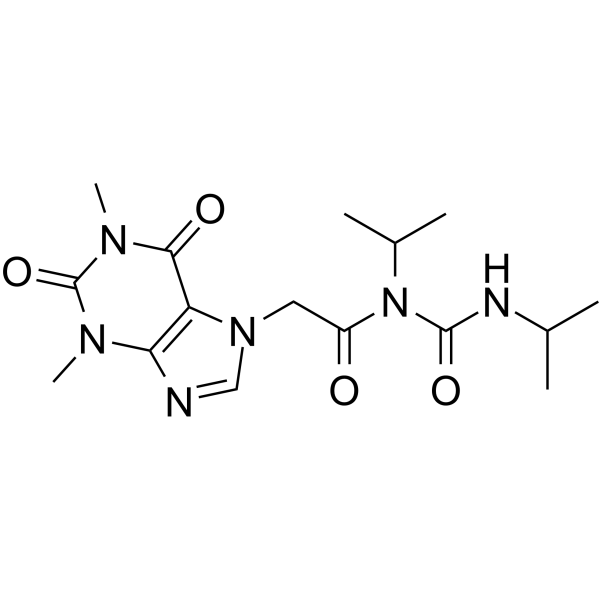
Physicochemical Properties
| Molecular Formula | C16H24N6O4 |
| Molecular Weight | 364.40 |
| Exact Mass | 364.185 |
| CAS # | 1372206-64-8 |
| PubChem CID | 68352357 |
| Appearance | White to off-white solid powder |
| LogP | 0.9 |
| Hydrogen Bond Donor Count | 1 |
| Hydrogen Bond Acceptor Count | 5 |
| Rotatable Bond Count | 4 |
| Heavy Atom Count | 26 |
| Complexity | 608 |
| Defined Atom Stereocenter Count | 0 |
| SMILES | CN1C(=O)C2N(CC(N(C(C)C)C(NC(C)C)=O)=O)C=NC=2N(C)C1=O |
| InChi Key | NDUQXXCBPZEHEN-UHFFFAOYSA-N |
| InChi Code | InChI=1S/C16H24N6O4/c1-9(2)18-15(25)22(10(3)4)11(23)7-21-8-17-13-12(21)14(24)20(6)16(26)19(13)5/h8-10H,7H2,1-6H3,(H,18,25) |
| Chemical Name | 2-(1,3-dimethyl-2,6-dioxopurin-7-yl)-N-propan-2-yl-N-(propan-2-ylcarbamoyl)acetamide |
| HS Tariff Code | 2934.99.9001 |
| Storage |
Powder-20°C 3 years 4°C 2 years In solvent -80°C 6 months -20°C 1 month Note: This product requires protection from light (avoid light exposure) during transportation and storage. |
| Shipping Condition | Room temperature (This product is stable at ambient temperature for a few days during ordinary shipping and time spent in Customs) |
Biological Activity
| ln Vitro | THX-B (10 μM, 4 days) inhibits myoblast proliferation[1]. In C2C12 myoblasts, THX-B (10 μM, 1 h) suppresses the phosphorylation of ERK1/2 produced by NGF[1]. In cultured rd10 retinas, THX-B (20 μM, 24 h) reduces reactive gliosis and photoreceptor cell death[2]. |
| ln Vivo | In a diabetic voiding dysfunction animal model, THX-B (50 μg in 125 μL PBS, ip weekly for 4 weeks) improves bladder function[3]. Photoreceptor cells in P17 rd10 mice exhibit a neuroprotective response to THX-B (2 μL of 2 μg/μL, IVT injection, single dose)[2]. The retinal pathology's inflammatory, vascular, and neurodegenerative phases are resolved with THX-B (40 μg in 20 μL, IVT injection)[4]. |
| Cell Assay |
Western Blot Analysis[1] Cell Types: C2C12 myoblasts Tested Concentrations: 10 μM Incubation Duration:Pre-treated for 1 hour Experimental Results: Inhibited βNGF-induced ERK2 phosphorylation by 67%. Inhibited proNGF-induced ERK2 phosphorylation by 90%. Immunofluorescence[1] Cell Types: Cultured P22 rd10 retinas. Tested Concentrations: 20 μM Incubation Duration: 24 h Experimental Results: Attenuated the thickening and enlargement of processes of astrocytes and Müller glia cells. |
| Animal Protocol |
Animal/Disease Models: Mouse model of diabetic voiding dysfunction Doses: 50 μg in 125 μL PBS Route of Administration: intraperitoneal (ip) injection Experimental Results: Prevented bladder weight increase, which was 18% (95% CI 3%, 32%) and 37% (95% CI 14% , 60%) lower after 2 and 4 weeks of treatment. Animal/Disease Models: P17 rd10 mice[1] Doses: 2 μL of 2 μg/μL, single dose Route of Administration: Intravitreal (IVT) injected in one eye Experimental Results: Increased the number of photoreceptor rows as well as the ONL/INL ratio. diminished the total number of microglial cells in the treated retinas, as well as some of the inflammatory signs, such as GFAP, α2M and the proinflammatory cytokines IL-1β and TNFα. |
| References |
[1]. Nerve growth factor stimulation of ERK1/2 phosphorylation requires both p75NTR and α9β1 integrin and confers myoprotection towards ischemia in C2C12 skeletal muscle cell model. Cell Signal. 2012 Dec;24(12):2378-88. [2]. p75NTR antagonists attenuate photoreceptor cell loss in murine models of retinitis pigmentosa. Cell Death Dis. 2017 Jul 13;8(7):e2922. [3]. Antagonism of proNGF or its receptor p75 NTR reverses remodelling and improves bladder function in a mouse model of diabetic voiding dysfunction. Diabetologia. 2020 Sep;63(9):1932-1946. [4]. Subconjunctival Delivery of p75NTR Antagonists Reduces the Inflammatory, Vascular, and Neurodegenerative Pathologies of Diabetic Retinopathy. Invest Ophthalmol Vis Sci. 2017 Jun 1;58(7):2852-2862. |
Solubility Data
| Solubility (In Vitro) | DMSO: 100 mg/mL (274.42 mM) |
| Solubility (In Vivo) |
Note: Listed below are some common formulations that may be used to formulate products with low water solubility (e.g. < 1 mg/mL), you may test these formulations using a minute amount of products to avoid loss of samples. Injection Formulations (e.g. IP/IV/IM/SC) Injection Formulation 1: DMSO : Tween 80: Saline = 10 : 5 : 85 (i.e. 100 μL DMSO stock solution → 50 μL Tween 80 → 850 μL Saline) *Preparation of saline: Dissolve 0.9 g of sodium chloride in 100 mL ddH ₂ O to obtain a clear solution. Injection Formulation 2: DMSO : PEG300 :Tween 80 : Saline = 10 : 40 : 5 : 45 (i.e. 100 μL DMSO → 400 μLPEG300 → 50 μL Tween 80 → 450 μL Saline) Injection Formulation 3: DMSO : Corn oil = 10 : 90 (i.e. 100 μL DMSO → 900 μL Corn oil) Example: Take the Injection Formulation 3 (DMSO : Corn oil = 10 : 90) as an example, if 1 mL of 2.5 mg/mL working solution is to be prepared, you can take 100 μL 25 mg/mL DMSO stock solution and add to 900 μL corn oil, mix well to obtain a clear or suspension solution (2.5 mg/mL, ready for use in animals). Injection Formulation 4: DMSO : 20% SBE-β-CD in saline = 10 : 90 [i.e. 100 μL DMSO → 900 μL (20% SBE-β-CD in saline)] *Preparation of 20% SBE-β-CD in Saline (4°C,1 week): Dissolve 2 g SBE-β-CD in 10 mL saline to obtain a clear solution. Injection Formulation 5: 2-Hydroxypropyl-β-cyclodextrin : Saline = 50 : 50 (i.e. 500 μL 2-Hydroxypropyl-β-cyclodextrin → 500 μL Saline) Injection Formulation 6: DMSO : PEG300 : castor oil : Saline = 5 : 10 : 20 : 65 (i.e. 50 μL DMSO → 100 μLPEG300 → 200 μL castor oil → 650 μL Saline) Injection Formulation 7: Ethanol : Cremophor : Saline = 10: 10 : 80 (i.e. 100 μL Ethanol → 100 μL Cremophor → 800 μL Saline) Injection Formulation 8: Dissolve in Cremophor/Ethanol (50 : 50), then diluted by Saline Injection Formulation 9: EtOH : Corn oil = 10 : 90 (i.e. 100 μL EtOH → 900 μL Corn oil) Injection Formulation 10: EtOH : PEG300:Tween 80 : Saline = 10 : 40 : 5 : 45 (i.e. 100 μL EtOH → 400 μLPEG300 → 50 μL Tween 80 → 450 μL Saline) Oral Formulations Oral Formulation 1: Suspend in 0.5% CMC Na (carboxymethylcellulose sodium) Oral Formulation 2: Suspend in 0.5% Carboxymethyl cellulose Example: Take the Oral Formulation 1 (Suspend in 0.5% CMC Na) as an example, if 100 mL of 2.5 mg/mL working solution is to be prepared, you can first prepare 0.5% CMC Na solution by measuring 0.5 g CMC Na and dissolve it in 100 mL ddH2O to obtain a clear solution; then add 250 mg of the product to 100 mL 0.5% CMC Na solution, to make the suspension solution (2.5 mg/mL, ready for use in animals). Oral Formulation 3: Dissolved in PEG400 Oral Formulation 4: Suspend in 0.2% Carboxymethyl cellulose Oral Formulation 5: Dissolve in 0.25% Tween 80 and 0.5% Carboxymethyl cellulose Oral Formulation 6: Mixing with food powders Note: Please be aware that the above formulations are for reference only. InvivoChem strongly recommends customers to read literature methods/protocols carefully before determining which formulation you should use for in vivo studies, as different compounds have different solubility properties and have to be formulated differently. (Please use freshly prepared in vivo formulations for optimal results.) |
| Preparing Stock Solutions | 1 mg | 5 mg | 10 mg | |
| 1 mM | 2.7442 mL | 13.7212 mL | 27.4424 mL | |
| 5 mM | 0.5488 mL | 2.7442 mL | 5.4885 mL | |
| 10 mM | 0.2744 mL | 1.3721 mL | 2.7442 mL |